
Unfairness in Connectivity: Analyzing Traffic and Capacity in Social Opportunistic Networks
Traffic distribution and network capacity analysis in social opportunistic networks
This paper investigates traffic distribution and network capacity in Social Opportunistic Networks by modeling human mobility as scale-free graphs. It evaluates various forwarding strategies (Isolated, Complete, and Local knowledge) and introduces a mathematical model for network capacity based on node degree.
Executive Summary
TL;DR: Social opportunistic networks leverage human contact patterns to bridge communication gaps. However, this reliance on "social hubs" creates a massive bottleneck. This paper demonstrates that while social-aware forwarding increases performance, it leads to extreme traffic unfairness. By incorporating tie strength (contact duration/frequency) and modeling network capacity via node degree, the authors provide a framework to mitigate hub congestion and predict the maximum throughput these networks can sustain.
Background: Positioned as a critical theoretical study, this work moves beyond simple "delivery ratio" metrics. It addresses the sustainability of Delay Tolerant Networks (DTNs) by focusing on the physical limitations of the devices (nodes) that constitute the network.
Problem & Motivation: The Hub Node Trap
Traditional routing in mobile ad-hoc networks assumes persistent end-to-end paths. In Social Opportunistic Networks, these paths are ephemeral. Researchers previously proposed using Centrality (popularity) to pick the best relays.
The intuition was simple: "Give the message to the person who meets the most people."
The Problem: This creates a "Rich-Get-Richer" phenomenon. A few popular nodes (hubs) are bombarded with relay traffic, depleting their battery and storage, while the rest of the network remains idle. Prior work failed to provide a robust mathematical link between these social metrics and actual Network Capacity.
Methodology: Beyond Binary Connections
The authors propose a more nuanced representation of social links by moving from binary graphs (connected/not connected) to Weighted Scale-Free Networks.
1. The Weak-Tie Hypothesis
Following Onnela’s research, the authors utilize the "weak-tie" hypothesis: links that bridge different social clusters (high edge betweenness) often have lower contact duration (low tie strength).
2. Markov Modeling of Traffic
To understand how messages flow, they use a discrete Markov process to calculate the Occupation Ratio—the probability of a message being at a specific node during steady-state traffic.
3. Architecture & Hierarchy
The study categorizes forwarding into three levels of "intelligence":
- Isolated: Random choice (fair, but inefficient).
- Local Knowledge: Using Degree or Ego-Betweenness (realistic).
- Complete Knowledge: Using global Betweenness Centrality (theoretical upper bound).
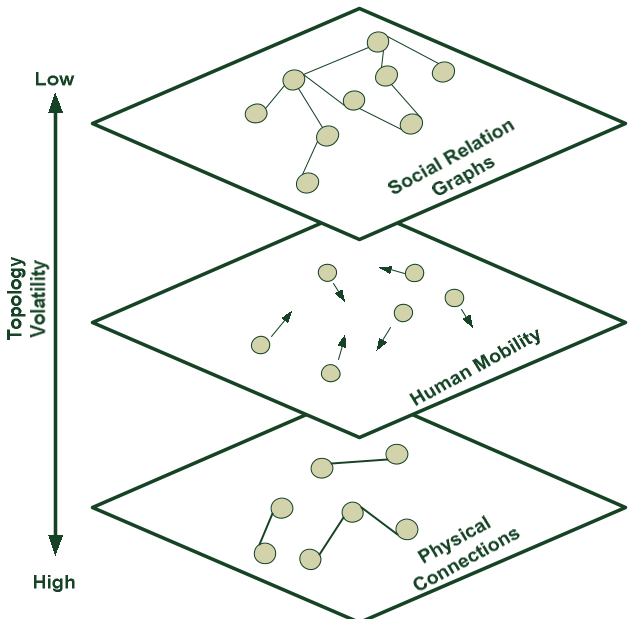 Figure 1: The structural view of a social opportunistic network, showing the transition from physical contact to social overlay.
Experiments & Results: The Power of Weighted Links
The core finding is that Tie Strength is the "hidden variable" that saves hub nodes.
- Traffic Fairness: The Peak-to-Average Ratio (PAR) is significantly reduced when tie strength is added to the metric. This redirects traffic from the absolute "highest" hubs to "well-connected" neighbors.
- Capacity Breakthrough: The authors derived a critical message generation rate (). If users generate messages faster than this rate, the network collapses into congestion.
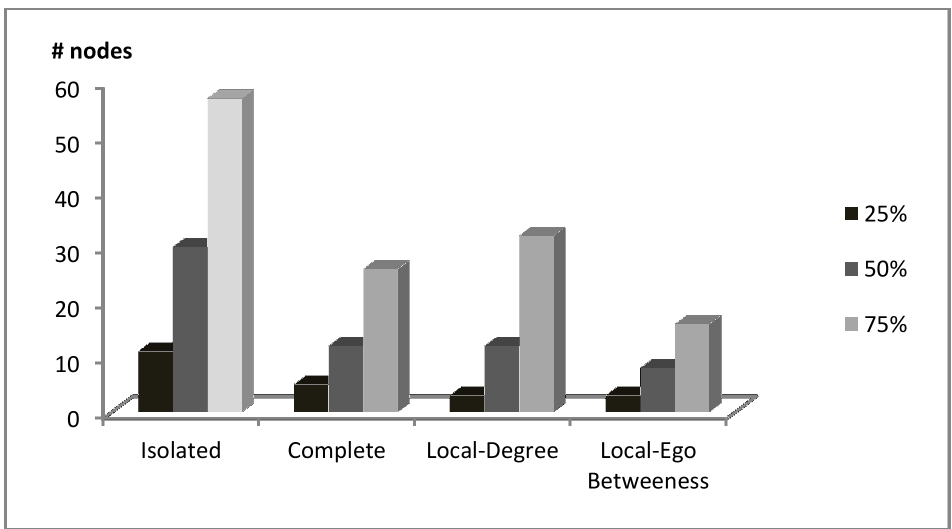 Figure 2: Comparing PAR across binary and weighted networks. Lower values indicate better load balancing.
Key quantitative result: For local knowledge strategies, adding tie strength significantly increases the , meaning the network can handle more users before failing.
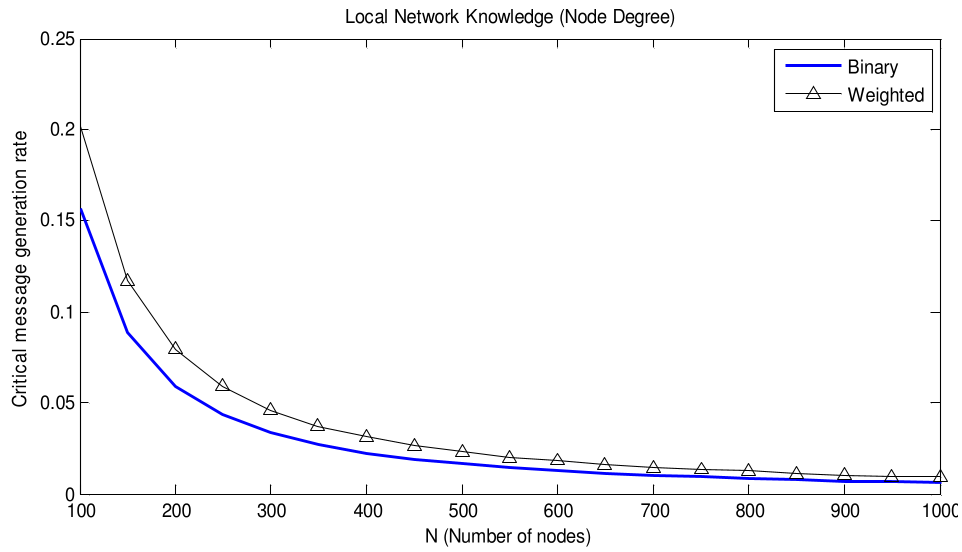 Figure 3: The critical message generation rate () as a function of network size. Inclusion of weighted ties significantly extends the network's operational ceiling.
Critical Insight & Conclusion
Takeaway
The study proves that node degree is a viable and more practical proxy for calculating network capacity in ICNs than global betweenness. It confirms that "blindly" following the most popular nodes is a recipe for network failure.
Limitations
- The model assumes uniform message generation across all nodes, which rarely happens in real social settings.
- The BA (Barabási-Albert) model used for scale-free graphs is a simplified approximation of human movement.
Future Work
The next frontier is Community Structure. Future protocols shouldn't just look at how "popular" a node is, but which "tribe" it belongs to, allowing for localized load balancing within social clusters.