
Beyond Single Labels: Mastering Urban Traffic Intelligence via Twitter Multi-label Classification
Identifying Traffic Event Types from Twitter by Multi-Label Classification
This paper presents a multi-label classification approach for identifying traffic event types (e.g., incidents, weather, heavy traffic) from Portuguese Twitter data. By employing the RAkEL (Random k-Labelsets) algorithm, the authors successfully move beyond single-topic classification to capture the overlapping nature of real-world traffic reports.
TL;DR
Researchers from the University of Rio Grande do Sul have developed a multi-label classification framework to transform chaotic tweets into structured traffic intelligence. By shifting from "one-tweet-one-topic" to a multi-label approach using the RAkEL algorithm, they achieved over 83% accuracy in identifying complex scenarios where crashes, weather, and congestion overlap.
The "Short Text" Challenge in Traffic Monitoring
Traffic management agencies increasingly rely on social media for real-time awareness. However, the academic community has long struggled with a fundamental reality: Traffic events are rarely isolated.
A typical tweet doesn't just mention an "accident"; it mentions an "accident causing a jam under heavy rain." Previous SOTA methods often forced these into a single bucket, losing critical metadata. Coupled with the informal nature of Portuguese microblogging—short, slang-heavy, and full of abbreviations—traditional NLP pipelines frequently fail to provide the granularity needed for emergency response.
Methodology: The Multi-Label Engine
The proposed system architectures are divided into two distinct pipelines: Data Modeling and Multi-Label Classification.
1. Feature Engineering with Term Frequency Variance
To handle the high dimensionality of text data, the authors didn't just use standard TF-IDF. They applied Term Frequency Variance, a method to select keywords that exhibit significant variance across the corpus, effectively filtering out "noise" and focusing on discriminative traffic terms.
2. The Classification Architecture
The core innovation lies in comparing several multi-label strategies. Specifically, they tested:
- Binary Relevance (BR): Treating each label as an independent 0/1 problem.
- Classifier Chains (CC): Accounting for label correlations (e.g., Rain Accident).
- RAkEL (Random k-Labelsets): An ensemble method that breaks the label set into small random subsets to capture label synergies without the computational explosion of Power Set methods.
Experimental Battleground: Porto Alegre Case Study
The model was trained on 3,246 manually labeled tweets from the Brazilian city of Porto Alegre (@EPTC_POA). The categories included:
- Incidents
- Weather
- Breakdowns
- Traffic Lights
- Heavy Traffic
- Light Traffic
Performance Breakdown
The results prove that RAkEL with Decision Trees (J48) is the champion for this task.
| Method | Accuracy (%) | Precision (%) | Recall (%) |
|---|---|---|---|
| BR | 82.8 | 78.9 | 89.7 |
| RAkEL (Best) | 83.2 | 82.5 | 92.3 |
| PCC | 82.3 | 78.5 | 89.8 |
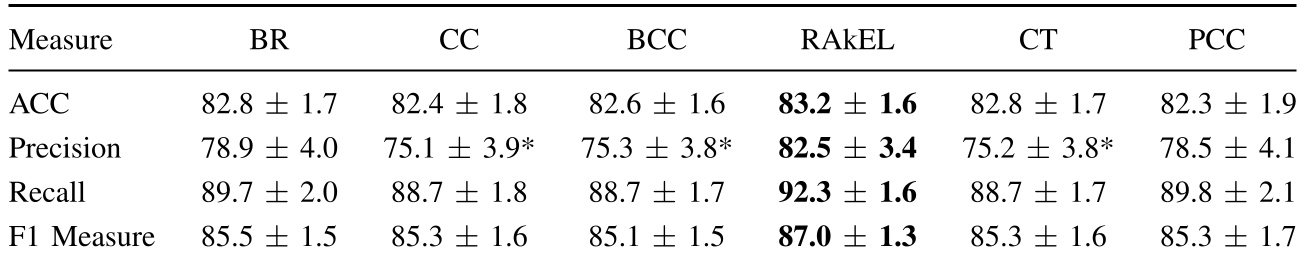
The data confirms that RAkEL provides a balanced performance, particularly excelling in Recall, which is vital for traffic agencies who cannot afford to miss a reported incident.
Critical Analysis & Insights
- Why did it work? The high performance in "Weather" and "Traffic Lights" suggests these events have a very specific, limited vocabulary. Conversely, "Breakdowns" were harder to classify, likely because the language used to describe a stalled car overlaps significantly with general "Heavy Traffic" complaints.
- Context Matters: Interestingly, some tweets were labeled as both "Heavy Traffic" and "Light Traffic." This sounds like a contradiction, but the model correctly identified tweets where a user compares two different routes—recommending a free road to avoid a jam.
Limitations & Future Work
While the Term Frequency Variance approach is efficient, it remains a Bag-of-Words style feature set. It lacks the semantic understanding of Word Embeddings (like Word2Vec) or Transformers (like BERT). The authors acknowledge that moving toward Ensemble Schemes and Word Embeddings will be the next frontier to solve the "Breakdown" identification problem.
Conclusion
This research provides a robust blueprint for cities looking to integrate social sensing into their traffic management centers. By embracing the complexity of multi-label classification, public agencies can move beyond "detecting traffic" to "understanding the causality" behind urban mobility disruptions.