
Decoding Digital Sociality: A Complex Network Analysis of Global IM Traffic
Using traffic flow data to analyze the large-scale social networking behavior
This paper utilizes real-world ISP traffic flow data to model and analyze large-scale social networking behaviors through flow graphs. By comparing QQ, Skype, and MSN across fixed-line and mobile networks, it identifies distinct structural and statistical characteristics that reflect heterogeneous user interactions and system architectures.
TL;DR
By transforming raw ISP traffic data into weighted directed graphs, this research provides a macroscopic view of how millions of users interact on QQ, Skype, and MSN. The study reveals that Internet behavior follows a strict Power Law, identifies high-density communities, and uncovers a startling 50% overlap between instant messaging usage and malware-related traffic.
Contextualizing Traffic as Social Fabric
In the hierarchy of network research, this work sits at the intersection of Network Traffic Measurement and Complex Network Theory. While most studies focus on single-packet metrics (latency, jitter), this paper treats flows as social interaction "edges." This allows the authors to bypass the challenges of encrypted proprietary protocols by focusing on the topology of the interaction rather than the content of the message.
Research Intuition: From Logs to Graphs
The authors' core insight is that traffic flows are not just data transfers; they are proxies for human decision-making and system architecture. By analyzing the "Heavy-Tail" distribution of these flows, they can distinguish between peer-to-peer interactions and server-client dependencies.
Methodology: The Flow Graph Framework
The researchers deployed high-performance hardware probes at 10Gbps trunk links. They modeled the data using:
- Nodes: IP addresses or Mobile IDs.
- Edges: Actual data transfers.
- Weight (Strength): Aggregate bytes transmitted.
1. Structural Comparison
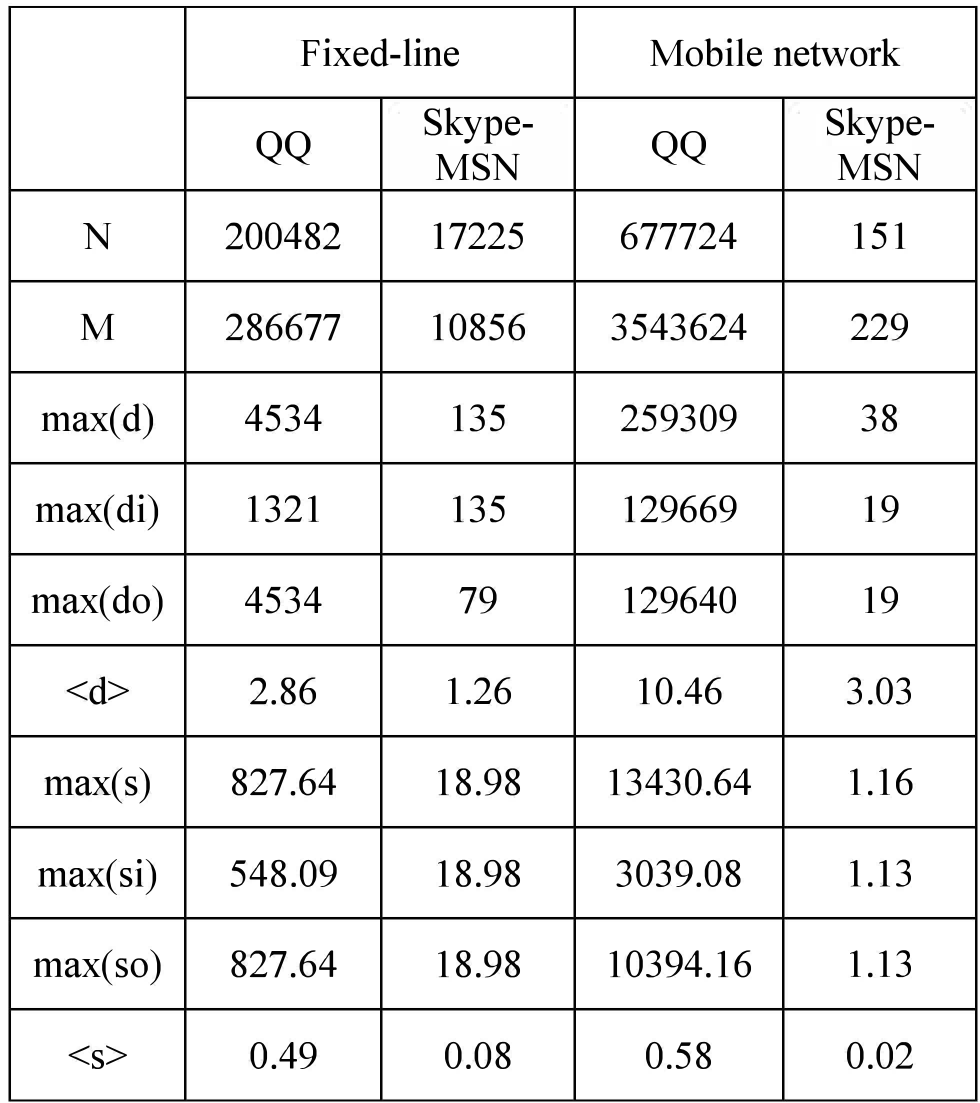
The paper highlights a massive disparity in usage. In China, QQ acts as a "super-spreader" of information with orders of magnitude more nodes and edges than Skype or MSN.
2. The Power Law and "Hub" Nodes
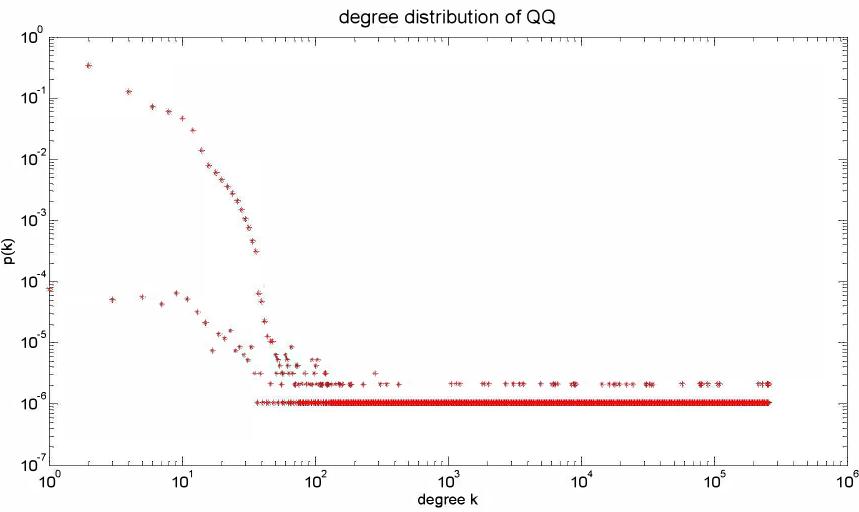
Both QQ and Skype-MSN degree distributions follow a power law .
- QQ's lower exponent indicates a higher concentration of "Hub" servers—central nodes that handle massive amounts of concurrent connections.
- Mobile Network Anomaly: In mobile environments, the degree distribution curves split, representing the "request-response" pairing inherent in cellular tunneling protocols.
Experiments & Deep Insights
Using the Newman Fast Algorithm, the researchers identified "Communities"—groups of users who talk more to each other than to the outside world.
- Skype-MSN Modularity (0.9889): Extremely high. This suggests that Skype-MSN users form very tight, isolated clusters, likely reflecting its use for specific business or international calls.
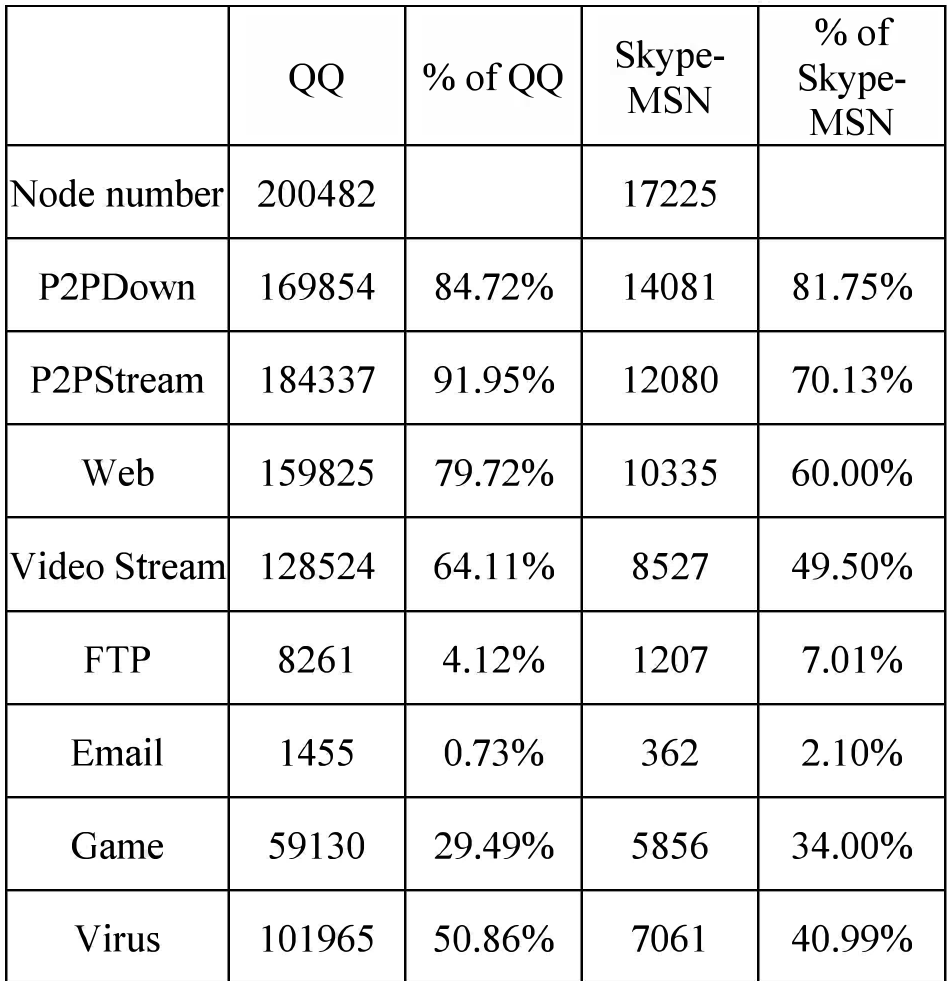
- App Overlapping: A critical finding was that 84-91% of IM users are simultaneously using P2P services. More alarmingly, 50.86% of QQ users showed traffic patterns overlapping with known virus/malware behavior, highlighting the vulnerability of popular social platforms.
Critical Analysis & Takeaways
The "How" and "Why"
Why does Skype have a more even traffic distribution? The authors point to Load Balance schemes. By distributing users across multiple nodes, Skype avoids the massive "hubs" seen in QQ, leading to higher modularity and potentially better resilience against localized network failures.
Limitations
The study’s data dates back to 2010-2012. In the modern era of HTTPS/TLS 1.3 and QUIC, "Packet Payload Analysis" mentioned by the authors has become significantly harder. However, the Flow Graph methodology remains robust because it relies on metadata (IP/Port/Volume) which is still visible to ISPs even when the payload is encrypted.
Conclusion
This paper proves that traffic data is a goldmine for understanding global social dynamics. For network architects, it emphasizes that system design (e.g., centralized vs. peer-based) leaves a distinct "topological fingerprint" on the network. For security professionals, it serves as a reminder that high-traffic social hubs are primary targets for automated malware propagation.