
The Tragedy of the Cognitive Commons: Why AI Might Be Killing the Next Generation of Experts
The Tragedy of the Cognitive Commons: How AI Could Disrupt the Regeneration of Professional Expertise
This paper introduces the "Cognitive Commons" framework to analyze how AI adoption disrupts the regeneration of professional expertise. It identifies a collective action problem where organizational efficiency gains from AI lead to the systemic depletion of deep human expertise, particularly through the elimination of entry-level developmental roles.
TL;DR
Artificial Intelligence is often framed as a productivity booster, but a new conceptual paper by Nolan C. Lovett warns of a systemic crisis: The Tragedy of the Cognitive Commons. By automating entry-level tasks, organizations are inadvertently destroying the "apprenticeship" pathways required to develop deep expertise. The result? A future where we have powerful AI systems but no humans left with enough domain knowledge to tell if the AI is hallucinating or wrong.
The Problem: The Free-Rider Trap in Professional Expertise
In 1968, Garrett Hardin described how rational individuals deplete shared resources (like a common pasture) for personal gain, eventually destroying the resource for everyone. Lovett argues we are seeing this play out in the labor market.
Current HRD (Human Resource Development) strategies focus on "upskilling" existing workers to use AI. However, this ignores a structural failure:
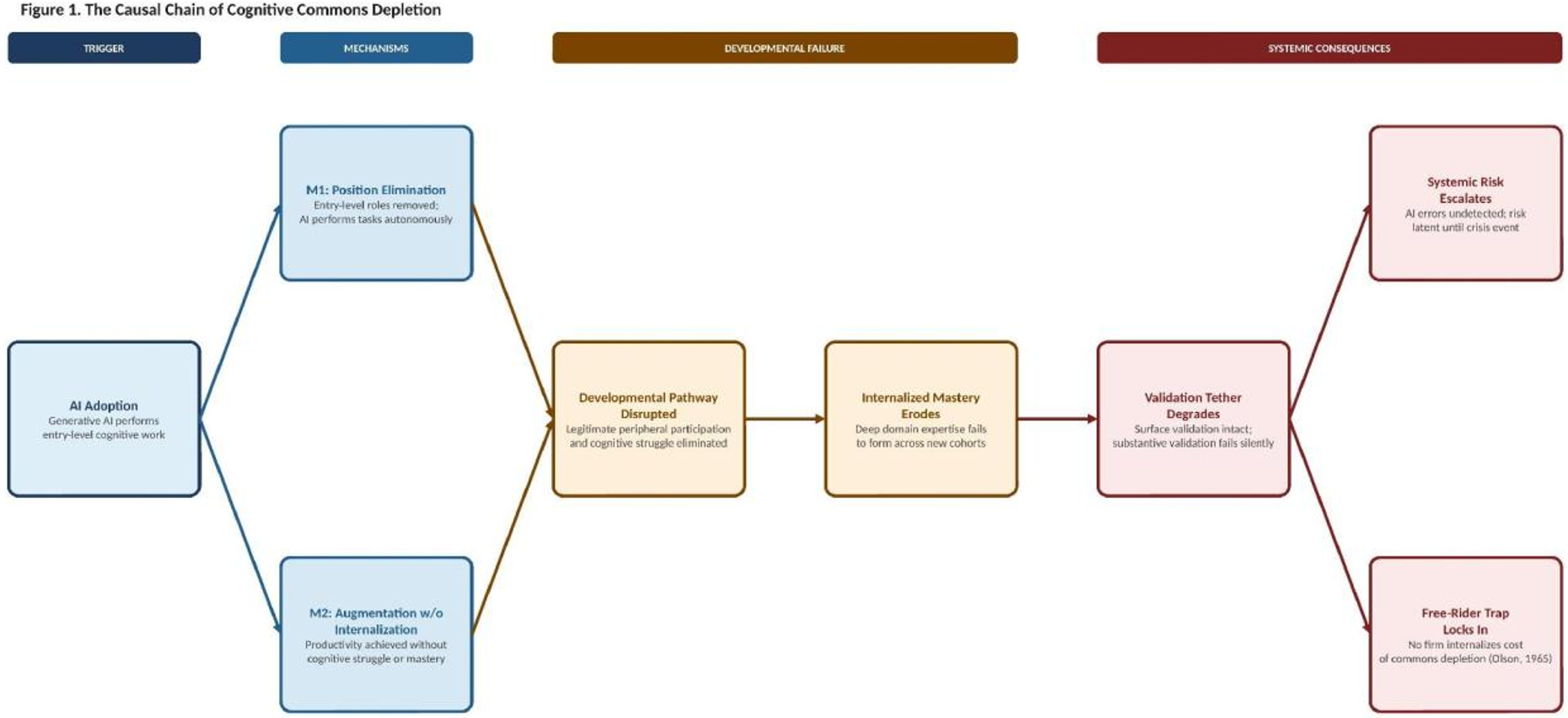
- Collective Dependence: Every firm needs expert "validators," but no single firm wants to pay for the years of training required to create them.
- The Vanishing Entry-Level: In highly AI-exposed sectors, positions for 22-to-25-year-olds are dropping (down 16% in some studies), as AI can do "junior" work faster and cheaper.
- The Decoupling: Historically, "doing the work" was how you "learned the work." By giving the work to AI, we have decoupled performance from learning.
Methodology: The Validation Tether
The paper’s most striking contribution is the Validation Tether. Lovett distinguishes between two types of mastery:
- Internalized Mastery: Deep, "in-the-head" domain knowledge built through cognitive struggle and practice.
- Distributed Mastery: The ability to prompt and orchestrate AI systems.
The "Tether" logic is simple but chilling: Substantive Validation—the ability to catch a subtle, domain-specific error in an AI’s output—requires Internalized Mastery. If we stop training juniors (Internalized Mastery) because they can use AI (Distributed Mastery), we eventually lose the ability to oversee the AI itself.
Evidence of Disruption
The paper cites alarming "canaries in the coal mine":
- Employment Shifts: Large-scale payroll data shows that while senior roles remain stable, entry-level hiring in AI-heavy fields is cratering.
- The Exoskeleton Effect: Experiments show that while workers are more productive with AI, their unassisted performance does not improve. The AI acts as a crutch, not a teacher.
- Validation Failure: Studies show that up to 60% of employees feel so confident in AI that they stop routinely checking its accuracy, even when they encounter "workslop" (flawed AI content).
Key Constructs in the Framework
| Construct | Definition | Risk |
|---|---|---|
| Cognitive Commons | The collective pool of experts in a profession. | Depletion via "overgrazing" on senior talent without replacing it. |
| Substantive Validation | Detecting errors that look plausible but are domain-wrong. | Disappears when Internalized Mastery erodes. |
| Human Reserve Paradox | Needing experts for crises that AI can't handle. | Experts aren't available because their "training roles" were automated years ago. |
Critical Analysis: A Call for Stewardship
Lovett argues that we cannot rely on the "market" to fix this. Individual firms will always choose the short-term efficiency of AI. Instead, we need Governance:
- Professional Associations: Organizations like the Bar or Medical Boards must mandate "AI-restricted" learning spaces to ensure juniors build cognitive schemas.
- Public Policy: Governments may need to subsidize "developmental infrastructure"—essentially paying firms to keep entry-level humans in the loop.
- Cognitive Reserve: Designing workflows that force humans to think before they see the AI's answer, preserving the "generative struggle" of learning.
Conclusion
The tragedy isn't that AI will replace us; it’s that AI will stop us from becoming the experts we need to be. If we treat expertise as a private organizational asset to be optimized, we will bankrupt the collective cognitive commons. HRD must move from being "AI trainers" to "Commons Stewards," ensuring that the next generation of human judgment isn't automated into oblivion.