
TRAGEN: Bridging the Privacy Gap in Cache Research with Succinct Traffic Modeling
TRAGEN: a synthetic trace generator for realistic cache simulations
TRAGEN is an open-source synthetic trace generator designed for realistic cache simulations. It leverages Footprint Descriptors (FD) and a newly proposed Byte-weighted Footprint Descriptor (bFD) to generate traces that achieve nearly identical Hit Rate Curves (HRC) to production workloads across multiple traffic classes and caching policies.
TL;DR
The inability to share production traces due to privacy and proprietary concerns is a major bottleneck in caching research. TRAGEN (Trace Generator) solves this by converting massive production traces into succinct mathematical models called Footprint Descriptors. It then uses these models to generate synthetic traces that are statistically "indistinguishable" from the original in terms of cache hit rates, supporting diverse traffic types like Video, Web, and Software Downloads.
The "Data Desert" in Caching Research
In the world of Content Delivery Networks (CDNs), the efficiency of a cache policy (like LRU or FIFO) is measured by its Hit Rate Curve (HRC). However, obtaining the traces needed to plot these curves is nearly impossible for researchers outside of giants like Akamai or Facebook.
Existing synthetic generators often fall into two traps:
- Over-simplification: They assume all objects are the same size (ignoring Byte Hit Rate).
- Inaccuracy: Methods like the classic LRUSM (LRU Stack Model) fail to maintain the complex temporal correlations found in modern, multi-class traffic.
Methodology: From Bytes to Descriptors
TRAGEN’s core innovation is the use of Footprint Descriptors (FD) and the introduction of the Byte-weighted Footprint Descriptor (bFD).
1. The Traffic Modeler
Instead of saving every request, TRAGEN computes the probability distribution of "stack distances" (the number of unique bytes accessed between two requests for the same object).
- FD: Tracks Request Hit Rate (RHR).
- bFD: Tracks Byte Hit Rate (BHR) by weighting reuse sequences by the size of the objects.
2. The Traffic Mixer
Modern CDNs don't just serve one thing. A single server might handle 60% Video and 40% Web traffic. TRAGEN uses "Calculus" (Convolution and FFT) to combine descriptors from different traffic classes to create a model for a specific "mix" without needing a physical trace of that exact combination.
3. The Generator Algorithm
The generator maintains a virtual cache list (implemented as a B+-tree). It samples a distance from the Descriptor and moves the "requested" object to that specific depth in the stack.
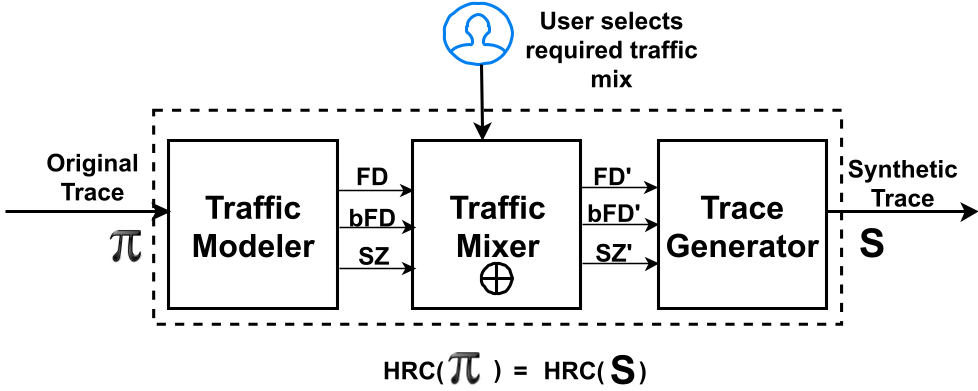 Figure 1: The TRAGEN pipeline—from production traces to mathematical models, then to synthetic request sequences.
Proven Accuracy Across Policies
The authors didn't just test against LRU. They validated TRAGEN against a "zoo" of caching policies: FIFO, RANDOM, SLRU, MARKERS, CLOCK, and PLRU.
Key Experimental Results:
- Near-Perfect Alignment: The HRC of the synthetic trace almost perfectly overlaps with the original production trace.
- Eviction Age: The "time-to-live" for objects in the synthetic cache matches the original within 1.8%.
- Superiority over LRUSM: As shown in the evaluation, the traditional LRUSM approach fails significantly when object sizes vary, while TRAGEN remains robust.
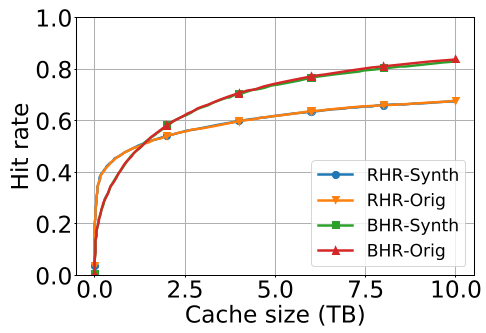 Figure 2: Performance validation—the Request and Byte Hit Rates for synthetic traces (GEN) closely track the original production data (ORIG) across various cache sizes.
Why TRAGEN Matters
TRAGEN effectively de-couples Traffic Characteristics from Private Data.
- Open Science: Organizations can release Footprint Descriptors (KB-sized files) instead of Terabyte-sized raw traces.
- Scenario Testing: Developers can simulate "What if our video traffic doubles while web traffic drops?" by simply adjusting the weights in the Traffic Mixer.
- Efficiency: Generating 10 million requests takes roughly 10 minutes on a standard machine, making it a highly practical tool for iterative system design.
Conclusion & Future Look
While TRAGEN is highly effective for recency-based eviction policies, it still faces challenges with policies that use complex admission logic (like Lead-based or Cost-aware caching). However, as a public tool seeded with Akamai’s traffic models, it represents a massive leap forward for the internet measurement and systems community.
TRAGEN is now open-source, inviting researchers to contribute their own traffic models to build a global library of internet request patterns.
Keywords: Caching, CDN, Synthetic Workload, Footprint Descriptors, LRU, Simulation.