
Training-Free Looped Transformers: Unlocking Latent Compute via ODE Refinement
Training-Free Looped Transformers
The paper introduces Training-Free Looped Transformers, a method where a contiguous block of middle layers in a frozen LLM is re-applied during inference using a numerical integration wrapper. By interpreting transformer blocks as ODE solvers, the method achieves SOTA-level improvements (e.g., +2.64 pp on MMLU-Pro) across various model families without any fine-tuning or architectural changes.
TL;DR
What if you could make your LLM smarter at inference time without training a single parameter? Training-Free Looped Transformers achieve exactly this. By wrapping a few middle layers of a frozen model (like Llama-3 or Qwen3) in a numerical integration loop, the authors show significant gains on hard reasoning tasks (+2.64 pp on MMLU-Pro) simply by "re-thinking" internal representations.
The Problem: Why Naive Looping Fails
The community has long known that the middle layers of LLMs are somewhat redundant—you can often delete them or swap them with minimal damage. This suggests they are doing iterative refinement. However, if you simply take a block of layers and run it twice (Naive Looping), the model usually breaks.
Why? Because the layers at the end of the "loop" produce a hidden state that is "too far" from what the following layers expect. In mathematical terms, the model drifts out of its trained distribution.
The Insight: LLMs as ODE Solvers
The core contribution of this paper is viewing the Transformer's residual connection () as a forward Euler step with a step size on a underlying Ordinary Differential Equation (ODE):
Instead of naive looping (which is like integrating the ODE from to ), the authors propose sub-stepping. By taking smaller steps of size , they improve the accuracy of the approximation at . This keeps the representation within the "low-loss valley" that the rest of the network was trained to handle.
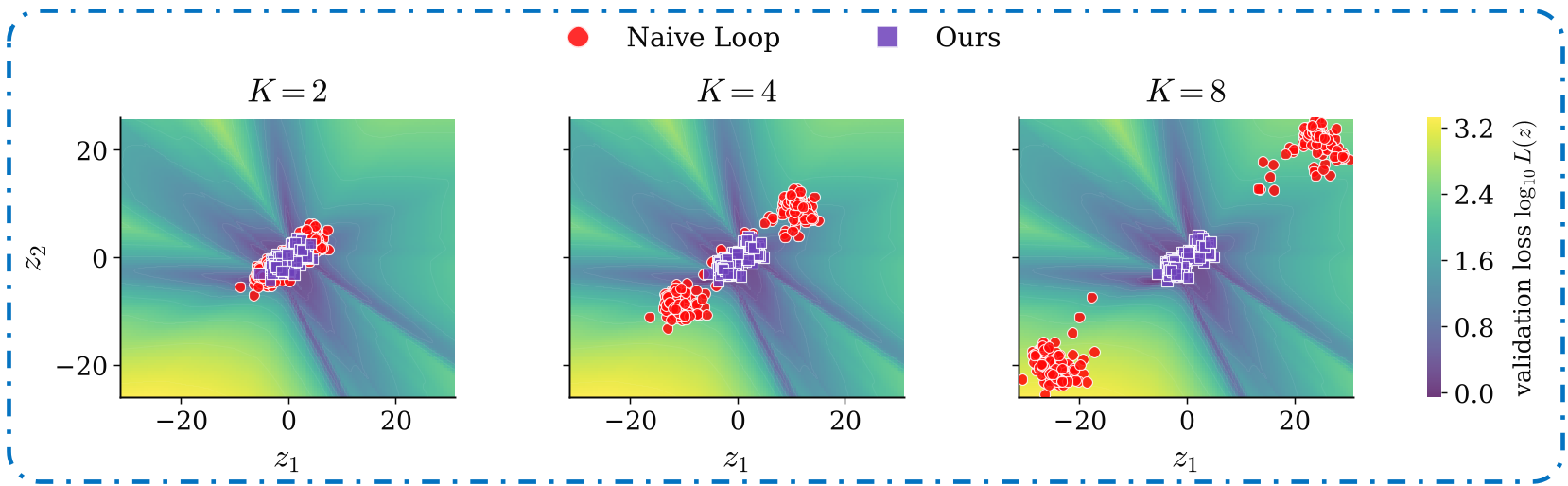 Figure 1: Visualization showing how sub-stepping (purple) stays in the low-loss regime while naive looping (red) drifts into high-loss regions.
Methodology: The Loop Wrapper
The authors introduce two primary modes:
- Block-mode: Iterates the entire window as one unit.
- Layer-mode: Iterates each layer individually before moving to the next.
The MoE "Thrash" Fix: A critical discovery was that Mixture-of-Experts (MoE) models fail in Block-mode. This is because the "router" makes a slightly different decision in every loop, creating noise (routing thrash). Layer-mode solves this by pinning the routing decision for all iterations of a single layer.
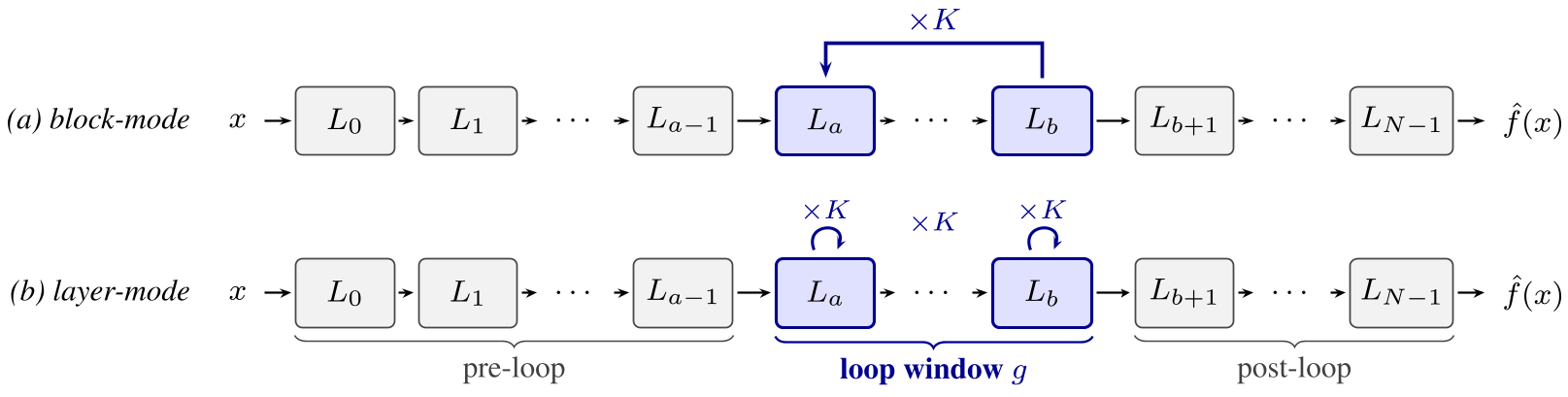 Figure 2: The Training-free loop wrapper architecture showing both Block and Layer modes.
Experiments & SOTA Results
The researchers tested this on 7 model families including Qwen3, Llama-3.2, and DeepSeek-V2-Lite.
Key Performance Gains:
- Qwen3-4B-Instruct: +2.64 pp on MMLU-Pro.
- Llama-3.2-1B: +1.79 pp on GPQA-Main.
- Qwen1.5-MoE-A2.7B: +2.30 pp on ARC-Challenge.
The "Depth Fraction Rule" discovered through ablation suggests that for most models, the "sweet spot" for looping is between 45% and 60% of the model's depth.
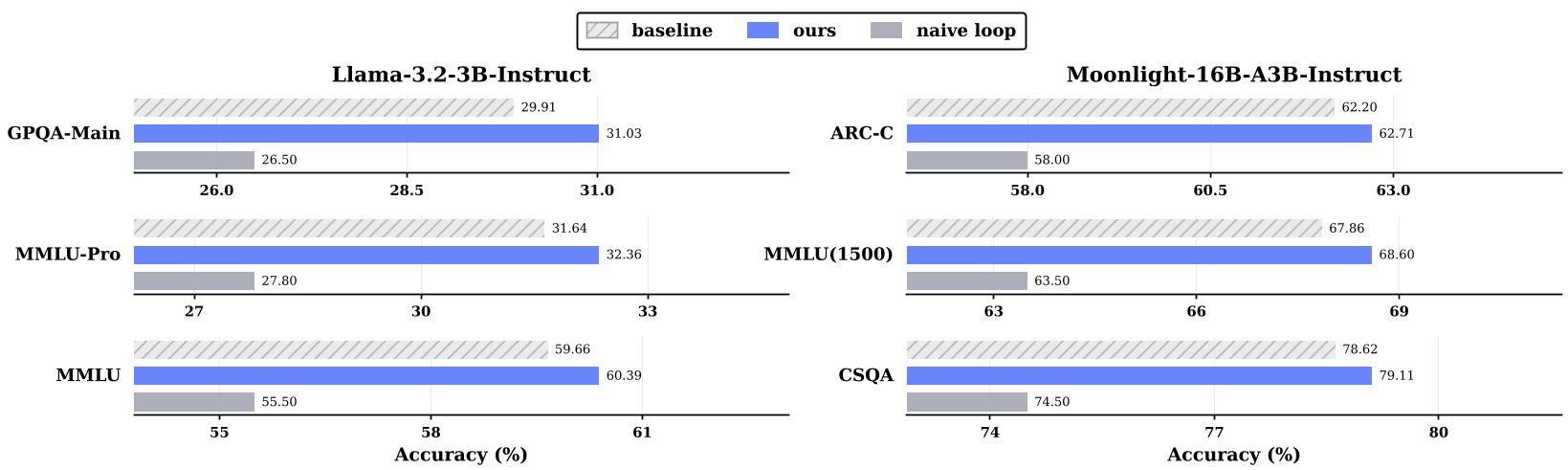 Figure 3: Comparative performance showing the superiority of the proposed ODE-based looping over baseline and naive methods.
Critical Analysis & Conclusion
Takeaway: This paper proves that modern LLMs are under-utilizing their parameters. By applying classical numerical analysis (Runge-Kutta) to inference-time logic, we can extract more "intelligence" from existing weights.
Limitations:
- Inference Overhead: Looping times naturally increases the wall-clock time for the prefill stage. However, the authors note that
bypassmode (looping only during prefill) costs zero extra time during token generation while still providing knowledge-task gains. - Model Size: The smallest models (<1B parameters) show less redundancy and thus gain less from this technique.
Future Outlook: This opens the door for a new category of "Dynamic LLM Wrappers" where users can trade-off inference compute for accuracy on the fly, without needing specific "Reasoning Models" like DeepSeek-R1 for every task.