
Training in Imagination: The Math Behind the World Model’s Mirror
On Training in Imagination
The paper introduces a theoretical framework for "Training in Imagination," a model-based RL paradigm where policies are updated using trajectories from learned dynamics and reward models. It provides the first formal decomposition of return error into independent dynamics and reward components and derives the optimal sample allocation ratio between transition data and reward annotations (REINFORCE) under power-law scaling.
TL;DR
State-of-the-art RL agents like DreamerV3 don't just learn from the world—they learn inside a "dream" or imagination. But how accurate does that dream need to be? This paper provides the first rigorous mathematical framework to split your data budget between dynamics (moving parts) and rewards (scores). The big reveal: Reward models often learn much faster than dynamics, and you can actually tolerate quite a lot of "noisy" feedback if you use the extra budget to dream more often.
Background: Why Imagination is Hard
In model-based RL, we train a policy on rollouts generated by a learned dynamics model and a reward model . The danger is compounding error: a tiny mistake in the dynamics model at step 1 leads to a massive hallucination at step 50.
Until now, theoretical bounds (like the classic Simulation Lemma) didn't give us a "knob" to turn for dynamics vs. rewards. This paper fixes that, placing this work as a critical theoretical bridge between scaling laws (how models improve with data) and Lipschitz stability (how smooth the models are).
The Problem: The Cost of Feedback
In the real world, "dynamics" data (e.g., video frames of a robot moving) is often cheap, but "reward" data (e.g., a human saying "that was a good grasp") is incredibly expensive. The fundamental question: Given $10,000, should you spend it all on high-quality human labels for fewer clips, or get thousands of low-quality, noisy labels from a cheaper source?
Methodology: Decomposing the Dream
The authors extend the Simulation Lemma to create a separable bound for return error:

1. The Lipschitz Connection
The bound depends on the Lipschitz constants () of the dynamics, reward, and policy. If these functions are "smooth" (low ), the return error stays small even as rollouts get longer.
- Insight: This justifies Temporal Straightening. By forcing latent states to move in "straight lines" (reducing curvature), we are essentially lowering the Lipschitz constant of the velocity map, making imagination more stable.
2. The Scaling Law of Imagination
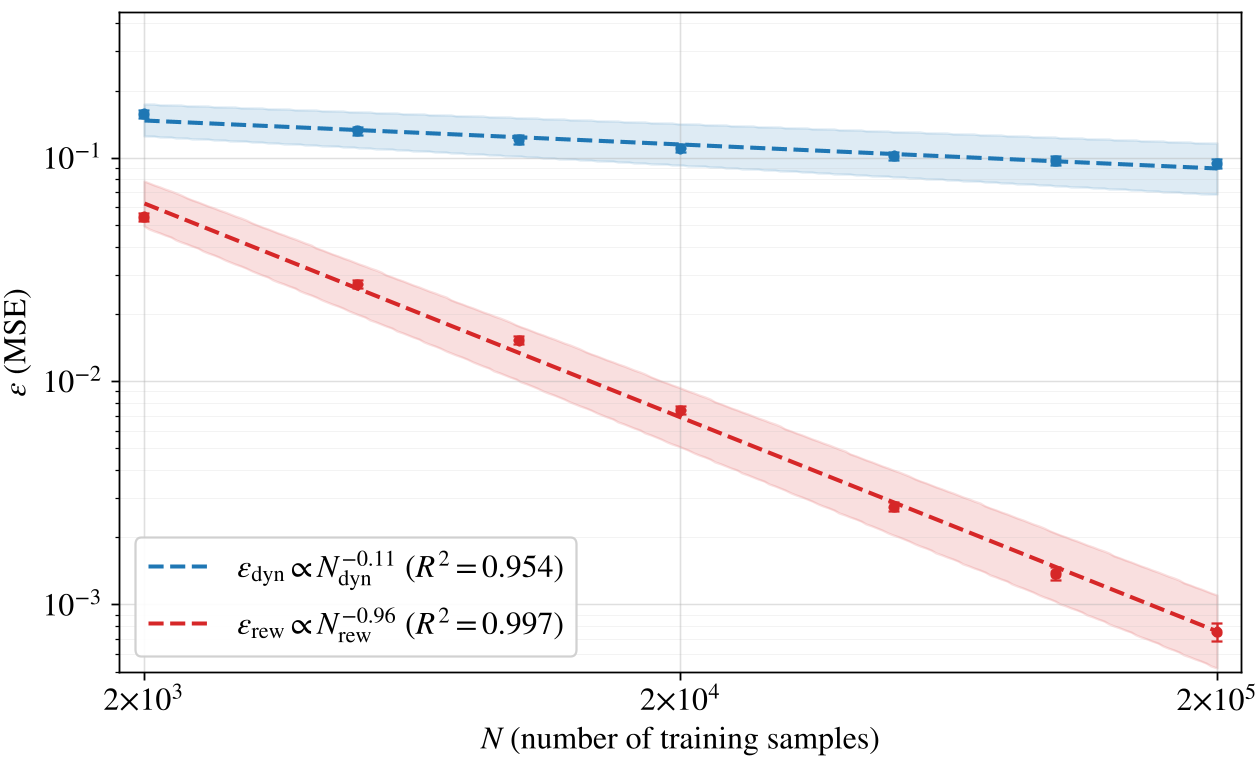
By fitting power laws () to both dynamics and rewards, the authors discovered a striking asymmetry: Reward models learn much faster. In their experiments, reward error decayed nearly 9x faster per decade of data than dynamics error.
3. Budget Allocation (Theorem 1)
The paper provides a closed-form solution (Equation 4) to determine the optimal ratio of samples. It balances the exponents of learning (), the per-sample costs, and the planning horizon ().
Experimental Proof: Noise is Okay
One of the most counter-intuitive findings is the analysis of REINFORCE under reward noise. The authors prove that if your reward noise has a zero mean, the policy gradient is still unbiased.
They identified three regimes for reward fidelity:
- High-Fidelity Regime: If paying more results in exponentially better labels, buy the best.
- Quantity Regime: If noise reduces slowly with cost, it’s better to buy the cheapest labels possible and just average them over thousands of rollouts.
- Irreducible Noise: If there's a noise "floor" that money can't fix, always go for quantity.
Deep Insight & Future Outlook
This work shifts the focus of Model-Based RL from just "building better models" to "allocating data intelligence."
Takeaways:
- Architecture Matters: To make imagination work, use Spectral Normalization or Curvature losses to keep your Lipschitz constants low.
- Data Strategy: Don't overspend on gold-standard rewards if your dynamics model is still struggling. Use the Fast-Learning nature of rewards to your advantage.
Limitations: The current bound assumes a contraction regime (), which might not hold in highly chaotic environments. Future work will likely explore how these bounds behave in "divergent" imagination scenarios where the model knows it is hallucinating.
Final Thought
This paper is a must-read for anyone building "Grand World Models." It provides the mathematical "accounting" for how to build a dream that is accurate enough to train a hero.