
This paper introduces WRITEBACK-RAG, a framework that treats the retrieval-augmented generation (RAG) knowledge base as a trainable component. It identifies high-utility retrieved documents through a two-stage gating mechanism and distills them into compact, persistent knowledge units that are indexed alongside the original corpus to improve future performance.
TL;DR
Standard RAG systems treat the Knowledge Base (KB) as an immutable library. WRITEBACK-RAG flips this script by treating the KB as a "trainable" component. By analyzing retrieval patterns on labeled data, it distills fragmented and noisy documents into compact, highly-relevant "knowledge units" that are written back into the index. The result? A +2.14% average boost across diverse tasks with zero extra cost at inference.
Moving Beyond Static Knowledge
Most RAG research focuses on building a better "search engine" (retriever) or a better "reader" (generator). However, the "library" (knowledge base) remains a messy pile of raw Wikipedia dumps or textbooks.
The authors identify a critical mismatch:
- Fragmentation: Facts needed for one query are often split across multiple documents.
- Noise: Each document contains significant irrelevant content that distracts the generator.
Instead of just trying to find the needles in the haystack, WRITEBACK-RAG creates a new, organized drawer of "pre-threaded" needles based on past successful retrievals.
Methodology: The KB Training Pipeline
The framework operates as an offline preprocessing step. It doesn't use gradient descent but instead uses Evidence Distillation guided by task signals.
1. The Gating Mechanism
Not every retrieval is worth saving. The system uses a two-stage filter:
- Utility Gate: Only processes examples where retrieval actually improved the model's answer compared to its internal knowledge.
- Document Gate: Identifies which specific documents among the Top-K were the "heroes" that provided the breakthrough information.
2. Distillation & Write-Back
Once the "hero" documents are identified, an LLM fuses them into a single, encyclopedic paragraph. This process significantly compresses the data (up to 6.79x for complex tasks like HotpotQA), creating a "dense" knowledge unit.
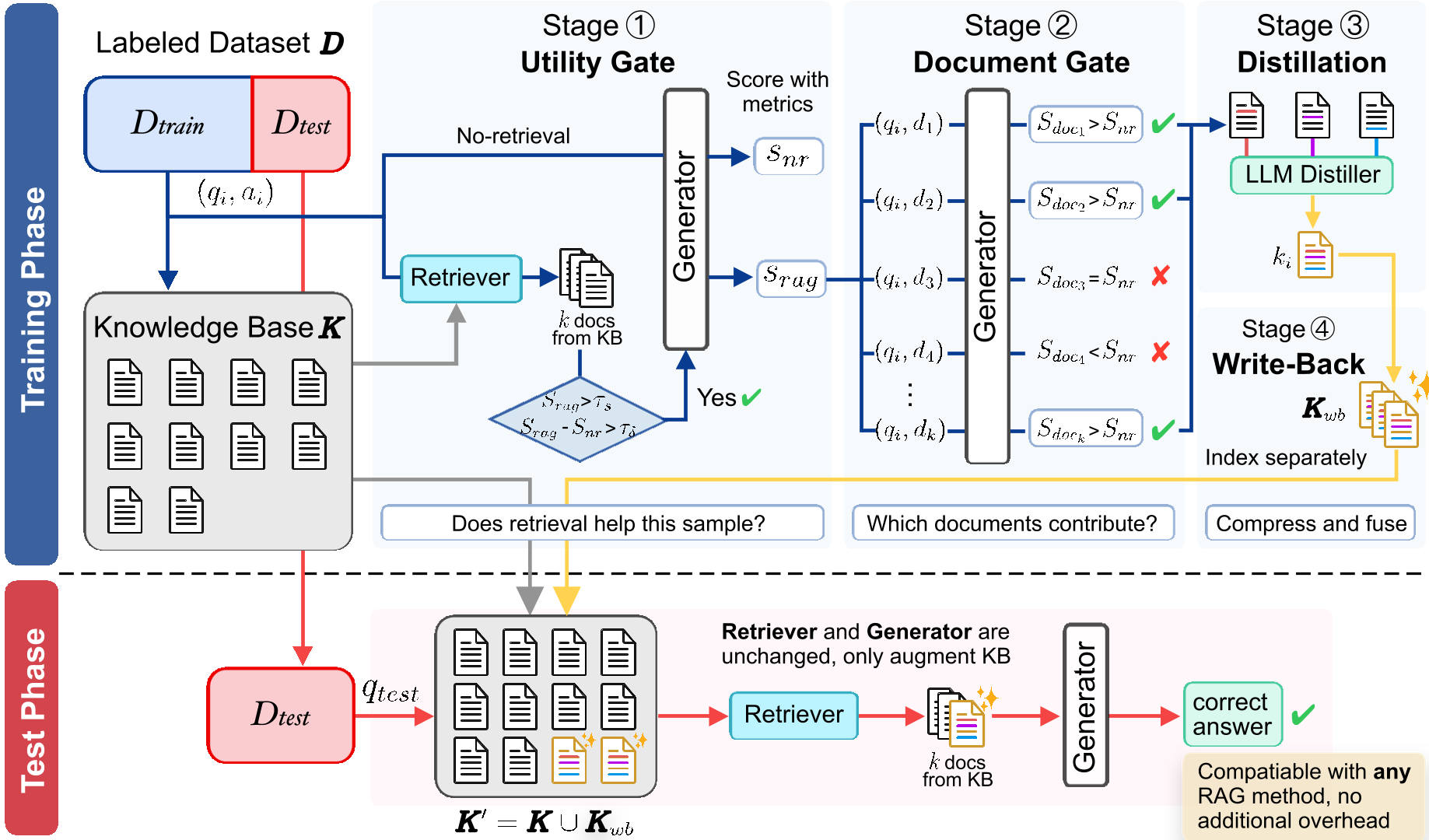 Figure: The pipeline involves identifying useful evidence during training and distilling it into a persistent write-back corpus.
Experimental Insights: Does It Actually Work?
The authors tested the method on 48 different configurations. The results were clear: performance improved in every single setting.
- Cross-Method Transfer: A fascinating discovery was that "write-back" documents created for one RAG method (like Naive RAG) improved other methods (like RePlug) just as effectively. This proves the improvement is a fundamental property of the knowledge organization, not just a "trick" for a specific model.
- Efficiency: Distilled units are much shorter than original documents, meaning the LLM generator processes fewer tokens while getting more high-quality information.
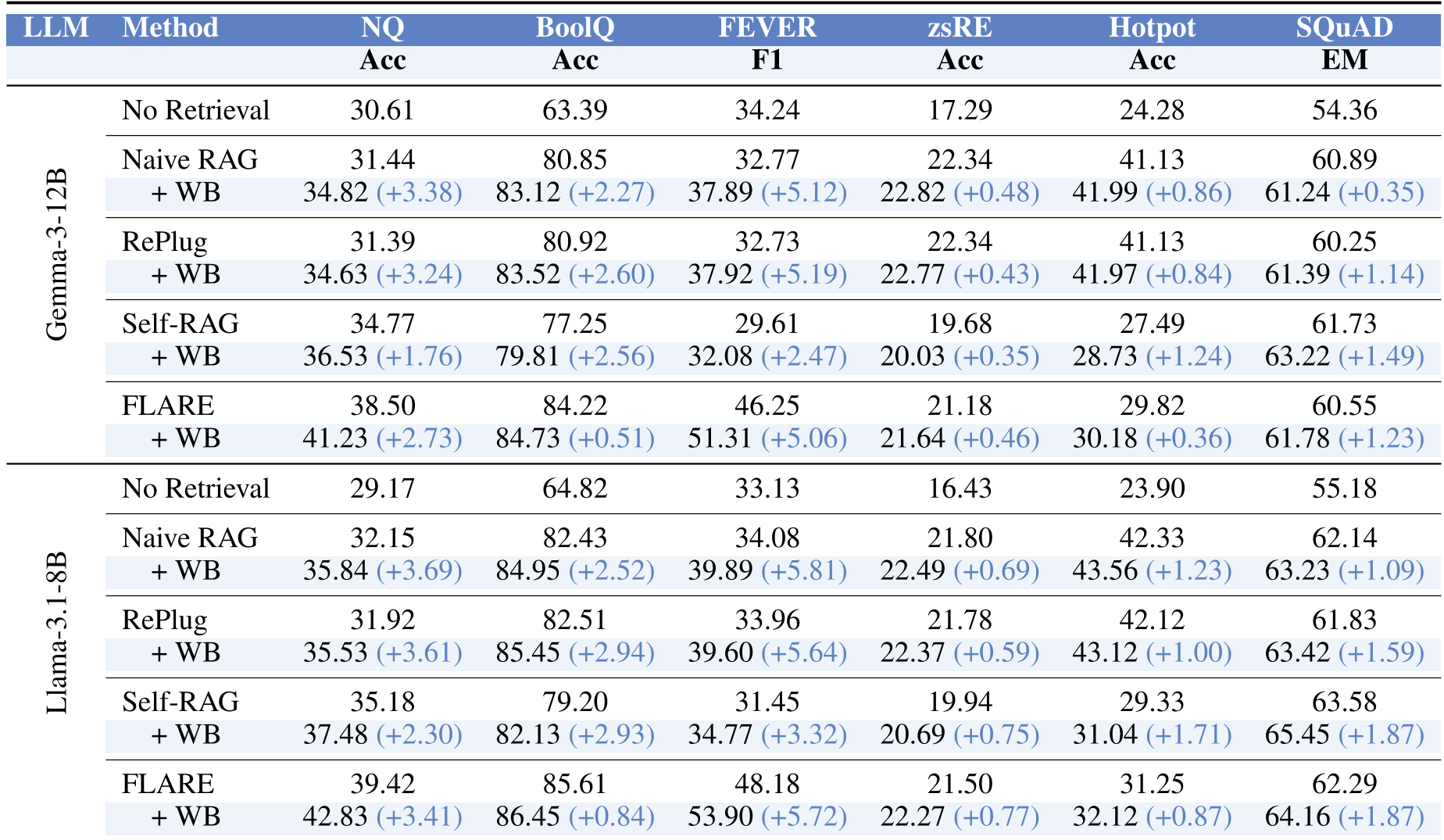 Table: Performance gains across various datasets and LLM backbones.
Critical Analysis: Why This Matters
The most impressive aspect of WRITEBACK-RAG is its orthogonality. Because it only modifies the corpus, you can combine it with any new retriever or generator released next month. It essentially provides a way to "mature" a RAG system: the more questions it answers during the training/tuning phase, the more refined its library becomes.
Limitations to consider:
- It requires labeled data, which might not be available for every niche domain.
- It is currently "additive"—it adds new documents but doesn't yet delete or correct obsolete ones (a potential "KB Maintenance" research path).
Conclusion
WRITEBACK-RAG marks a shift from "RAG as a Search Problem" to "RAG as a Knowledge Management Problem." By treating the corpus as a trainable asset, we can move away from raw, noisy data toward a curated, distilled knowledge source that optimizes itself for the tasks it actually performs.
Keep an eye on this tech—as LLMs get better at distillation, the "raw" knowledge base may soon become a thing of the past.