nGPT: Redefining Transformer Scaling through Hyperspherical Geometry
TRAINING nGPT
The paper introduces nGPT (normalized GPT), a novel Transformer-based architecture where all internal representations and weights are constrained to a hypersphere. By combining this geometry-driven design with GatedAdamW optimization and Logarithmic Learning Rate Decay, nGPT achieves significantly better scaling laws than standard GPT models.
TL;DR
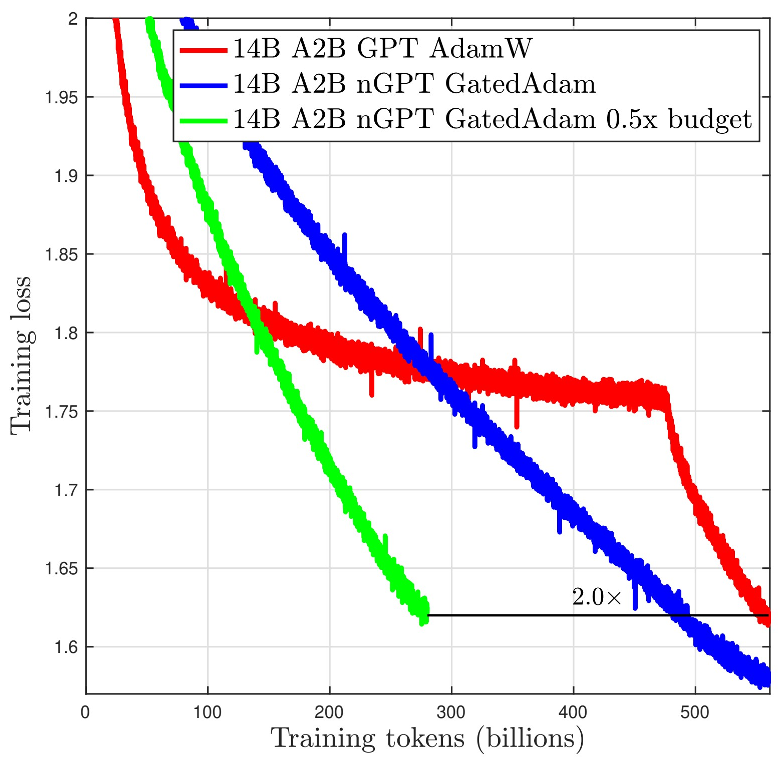
nGPT (normalized GPT) is a radical restructuring of the Transformer architecture that maps all hidden states and weights onto a unit hypersphere. By treating the forward pass as a multi-step optimization on this sphere and introducing GatedAdamW, the researchers have achieved a significant boost in training efficiency, allowing models to reach lower loss levels with fewer tokens compared to standard AdamW-based GPTs.
The Core Insight: The Hypersphere as a Natural Constraint
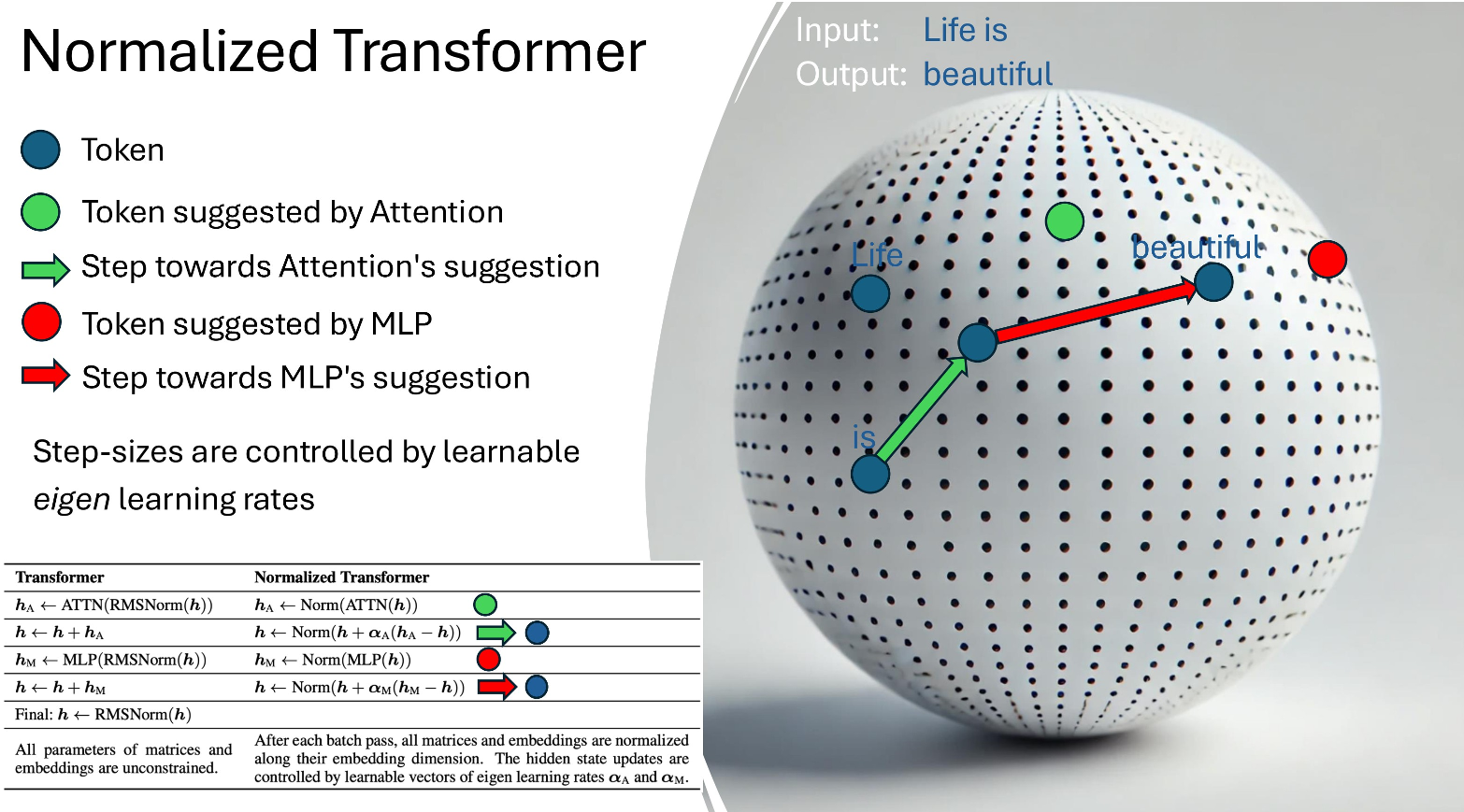
In standard Transformers, the magnitude of hidden vectors can fluctuate wildly, leading to vanishing or exploding signals that necessitate LayerNorm. nGPT takes a different path: What if we ignore magnitude entirely and focus on direction?
By constraining vectors to a hypersphere, the model effectively performs a sequence of rotations and spherical interpolations. This geometric constraint provides a powerful inductive bias, ensuring that the internal representations remain well-conditioned throughout the depth of the network.
Methodology: The nGPT Toolbox
1. GatedAdamW: Intelligence at the Gradient Level
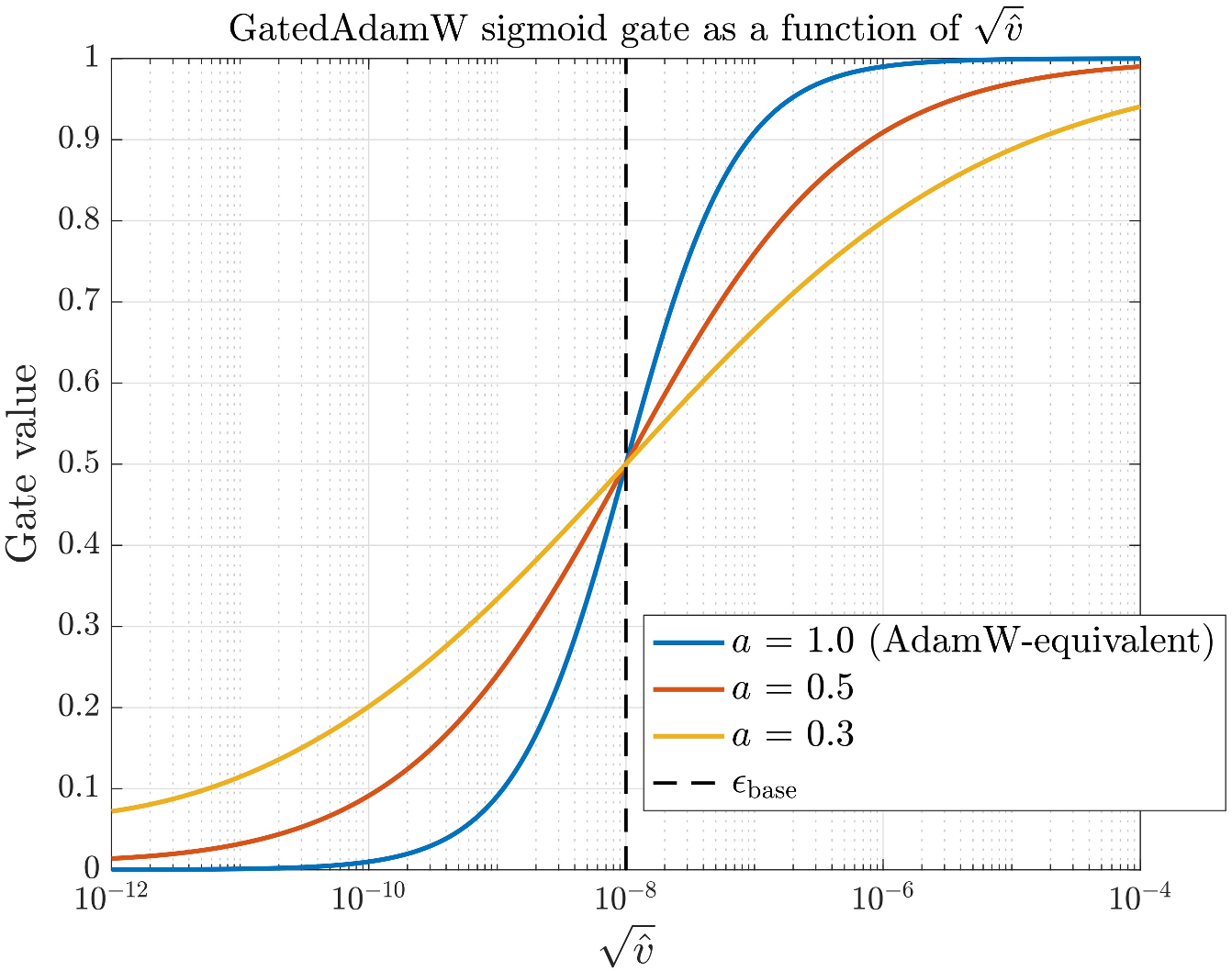
Standard AdamW updates can be noisy when the second-moment estimate () is very small. nGPT introduces GatedAdamW, which applies a sigmoid gate to the update.
- The Logic: If the gradient scale is below a threshold , the gate closes, suppressing the update to prevent noise from corrupting the weights.
- The Sharpness: A parameter controls how abruptly the gate opens, allowing for smoother transitions in the optimization landscape.
2. Logarithmic LR Decay
Moving away from the traditional Cosine Annealing, nGPT uses a Logarithmic schedule. This allocates more "learning energy" to the early and middle stages of training, which the authors found more effective for the hyperspherical geometry.
3. Logit Gradient Preconditioning (LGP)
The final output layer often suffers from high variance. LGP scales the gradients based on the magnitude of the logit scale vector , ensuring that the final layer doesn't dominate the backpropagation signal and destabilize the earlier layers.
Experimental Battleground: SOTA Comparisons
The authors tested nGPT against standard GPT architectures (specifically hybrid Mamba-2-Transformer MoE models) across sizes ranging from 1B to 14B parameters.
Key Findings:
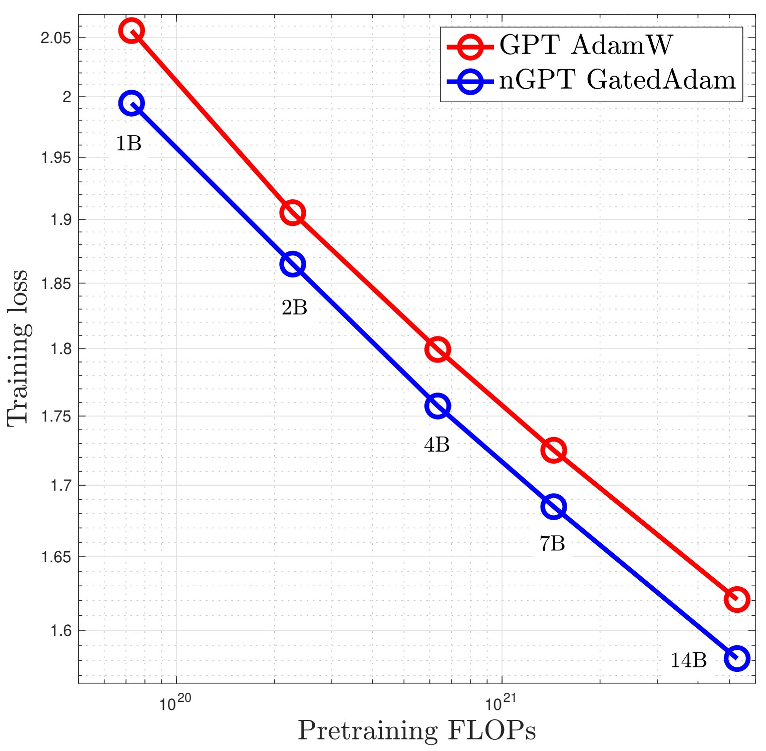
- Consistent Improvement: nGPT consistently outperformed the baseline across all sizes.
- 14B Benchmark: The 14B nGPT model reached a validation loss of 1.2501, compared to 1.2827 for the standard GPT—a relative improvement of ~2.5%.
- Token Efficiency: The scaling curves indicate that nGPT reaches the same loss level as a standard GPT while using significantly fewer tokens, effectively "speeding up" the learning process by over 20%.
Critical Analysis & Conclusion
nGPT represents a significant step toward "principled" Transformer design. By replacing empirical normalization tricks with a rigorous geometric framework, the authors have found a way to squeeze more performance out of the same parameter budget.
Limitations: The architecture introduces some computational overhead (roughly 6%) due to frequent normalization and complex optimizer logic. However, the gains in token efficiency far outweigh this minor FLOPs increase.
Future Outlook: The success of nGPT in MoE and hybrid Mamba-2 architectures suggests that hyperspherical optimization is generalizable. The next frontier will be applying these principles to multi-modal models and exploring if nGPT can resolve the "long-context decay" issues observed in standard Transformers.