
Can the Crowd Truly Feel Your Pain? Trait Empathy and Ethnic Identity in Visual Sentiment Tagging
Can the crowd tell how I feel? Trait empathy and ethnic background in a visual pain judgment task
This study investigates the feasibility of using crowdsourcing for visual pain emotion recognition, specifically exploring how trait empathy and ethnic identity influence metadata generation. The research utilizes Amazon Mechanical Turk to analyze how a diverse workforce labels images of strangers in distress, highlighting the complex interplay between annotator demographics and subjective emotional judgment.
TL;DR
Is a random crowdworker's label of "sadness" accurate enough to train a medical AI? This paper argues that emotion recognition in crowdsourcing is not a commodity task but a deeply subjective one. By analyzing how different ethnicities and personality types perceive pain in others, the authors find that trait empathy and ethnic identity search are more critical for metadata quality than simple demographic categories like age or gender.
Motivation: The High Cost of Misreading Distress
We are living in an era of "affective computing," where social robots and AI agents are expected to respond to human emotions. However, the datasets powering these systems often rely on anonymous crowdworkers.
The authors identify a critical danger: if an AI misinterprets "disgust" for "sadness" or "hostility" due to biased training data, the consequences in mental health or support contexts could be catastrophic. The research intuition here is that we must understand who is doing the labeling before we can trust what they are labeling.
Methodology: Beyond Simple Labels
The study moved beyond binary tags, measuring five distinct response variables:
- Pain Arousal: How badly the annotator felt for the subject.
- Task Confidence: How sure the annotator was of their accuracy.
- Tag Valence: The pleasantness of the chosen words.
- Tag Arousal: The intensity of the emotion expressed by the tag.
- Tag Dominance: The degree of control suggested by the word (e.g., "defeated" vs "courageous").
 The task involved viewing images of strangers in painful settings, followed by arousal ratings, tagging, and psychological assessments.
Core Insights: Empathy and Ethnicity
1. Trait Empathy > Demographics
The study found that Empathic Concern (EC)—the ability to understand another's feelings—was the strongest predictor of how much pain an annotator felt. Interestingly, while women are often stereotyped as more "empathic" in general population studies, this did not translate to higher pain arousal or confidence in the crowdworker context, though it did influence their vocabulary (choosing higher-intensity words).
2. The Identity Paradox
A significant/surprising find involved Caucasian (CA) participants. CA annotators were consistently less confident than other groups, even when viewing subjects of their own ethnicity. Conversely, minority groups (EA and AA) showed higher confidence, especially if they scored high on "Ethnic Identity Search"—a measure of how much they have explored their own cultural background.
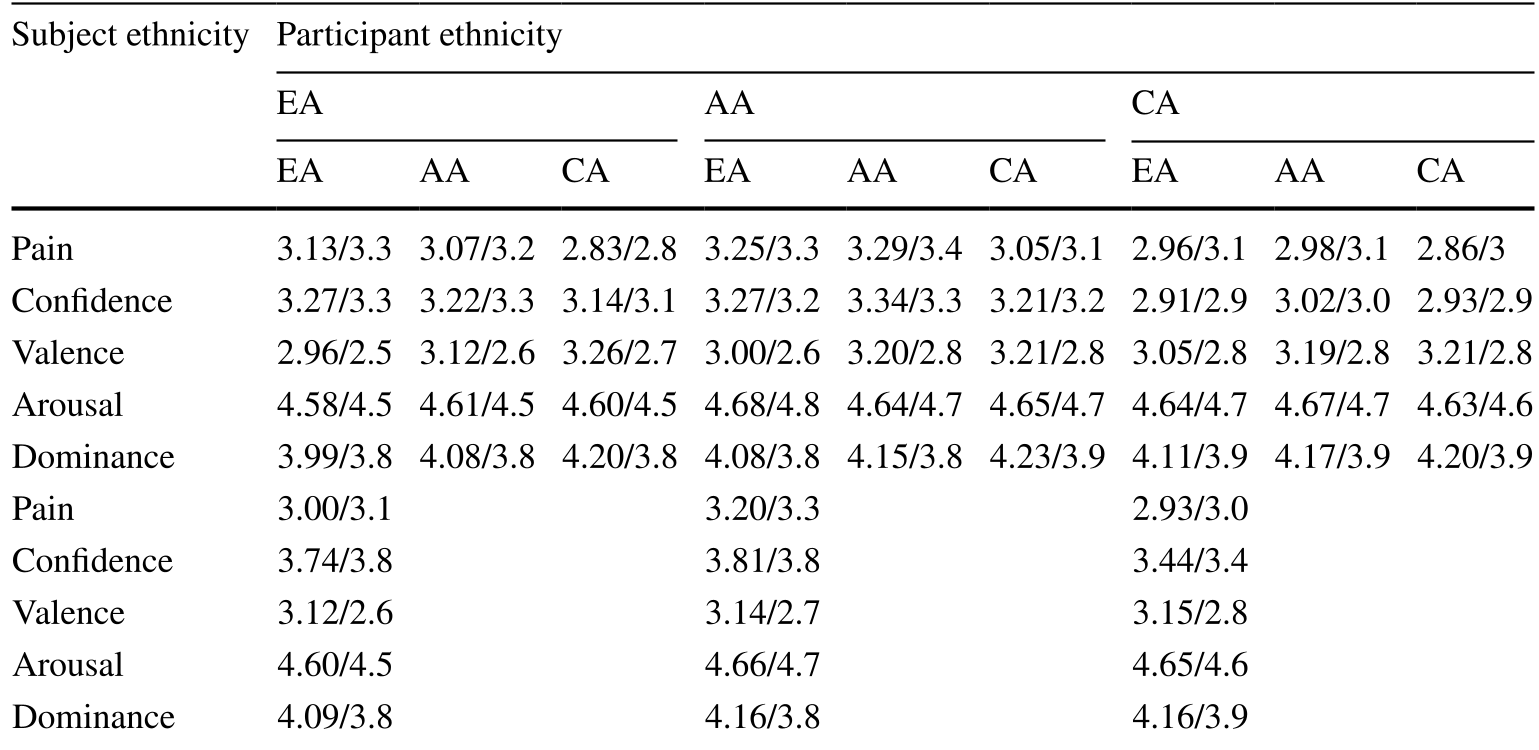 Table 4 highlights the variations in pain and confidence scores across different annotator and subject ethnic backgrounds.
Critical Analysis: Is the Crowd Homogeneous?
The results prove that crowdworkers are not a monolithic block. The "In-group Advantage"—the idea that we recognize emotions better in our own race—was present but mitigated by an individual's identity maturity. Those who actively reflect on their ethnicity are more attuned to the distress of others, regardless of the subject's race.
Limitations
- Platform Bias: The study is limited to Amazon Mechanical Turk (USA-centric).
- Static Images: Visual cues were limited to still photos; video or verbal cues might shift the confidence levels significantly.
Conclusion & Future Work
This paper serves as a wake-up call for AI developers. We can no longer treat "the crowd" as an abstract entity. To build truly empathic systems, crowdsourcing platforms should move toward verified demographic and personality profiles that allow researchers to match sensitive tasks (like medical sentiment analysis) with the most qualified, empathic workers.
The future of AI-human interaction depends on our ability to capture "cultural truth" rather than chasing a non-existent, universal "ground truth."