
Decoding The Crowd: How Hidden Motivations Shape Task Choice in Crowdsourcing
7618_Trait motivations of crowdsourcing and task choice A distal-proximal perspective.
This study investigates the relationship between trait motivators and task choice in crowdsourcing. By applying a distal-proximal perspective, the authors reveal how payment, competence development, and social affiliation differentially drive participants to choose structured, high-commitment, or interdependent tasks.
TL;DR
Not all "crowds" are created equal. This research moves beyond the simple "fun vs. money" debate to explain why certain people choose grueling, high-commitment tasks while others gravitate toward collaborative ones. Using the Distal-Proximal Perspective, the study finds that while money attracts those who want to prove they are better than others through simple tasks, it is the desire for growth and community that drives the heavy lifting and teamwork essential for complex crowdsourcing.
Background: Beyond the Black Box
For years, crowdsourcing research focused on the "What"—what makes people click? The answers were usually payment, skills, or community. However, this study argues that "participation" has been treated as a black box. A simple data-labeling task on Amazon Mechanical Turk is fundamentally different from co-authoring a Wikipedia article or solving an R&D challenge on InnoCentive. To understand the future of digital labor, we must understand the link between Trait Motivation (stable personality preferences) and Task Complexity.
The "Why": The Distal-Proximal Insight
The researchers introduce a sophisticated psychological framework:
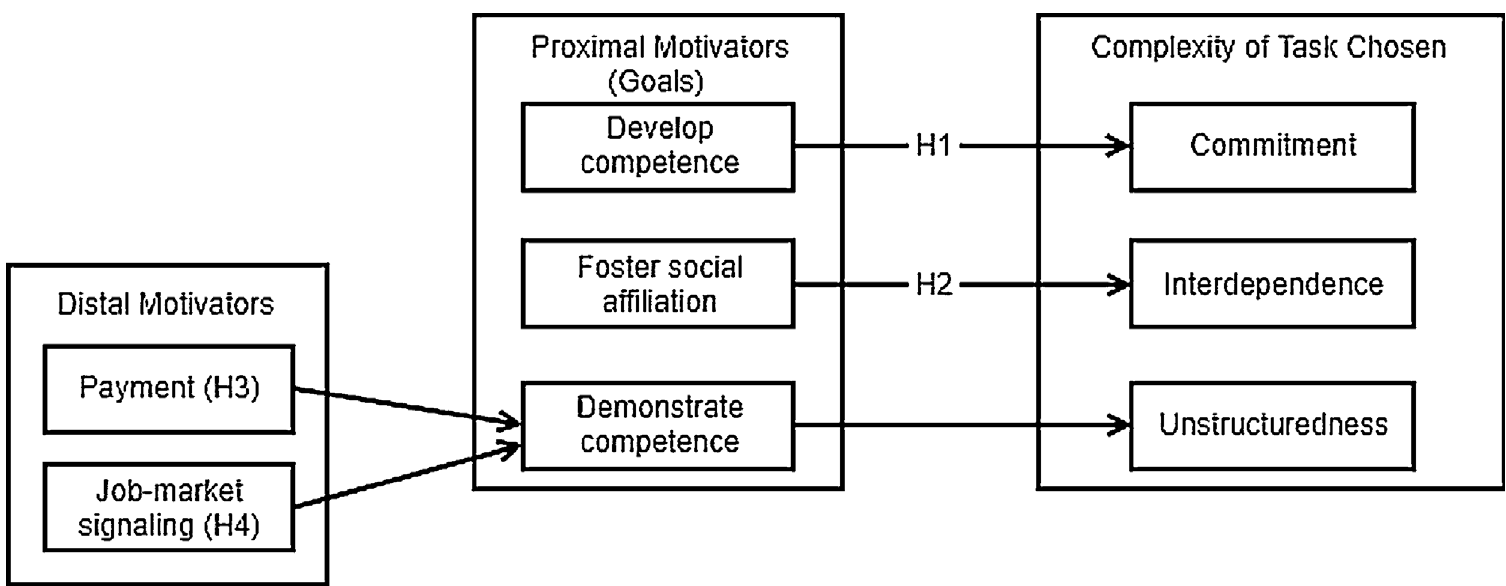
- Distal Motivators: Factors like Payment or Job-Market Signaling that sit in the background; they influence the goals you set but don't directly guide the action.
- Proximal Motivators: Immediate goals like Developing Competence or Fostering Social Affiliation that directly control which tasks you pick and how you execute them.
The core intuition is that payment makes you want to "Demonstrate Competence" (show off), which leads you to pick Structured Tasks where success is clear and easily rewarded. Conversely, wanting to actually "Develop Competence" (learn) leads you to High-Commitment Tasks because that's where the learning happens.
Methodology: Mapping the Mind
The team surveyed 283 active crowd-workers across multiple platforms (MTurk, TopCoder, Innocentive). They looked at three dimensions of task choice:
- Structuredness: How well-defined is the output?
- Commitment: How much effort/time is required?
- Interdependence: Does it require working with others?
Key Results & Visual Evidence
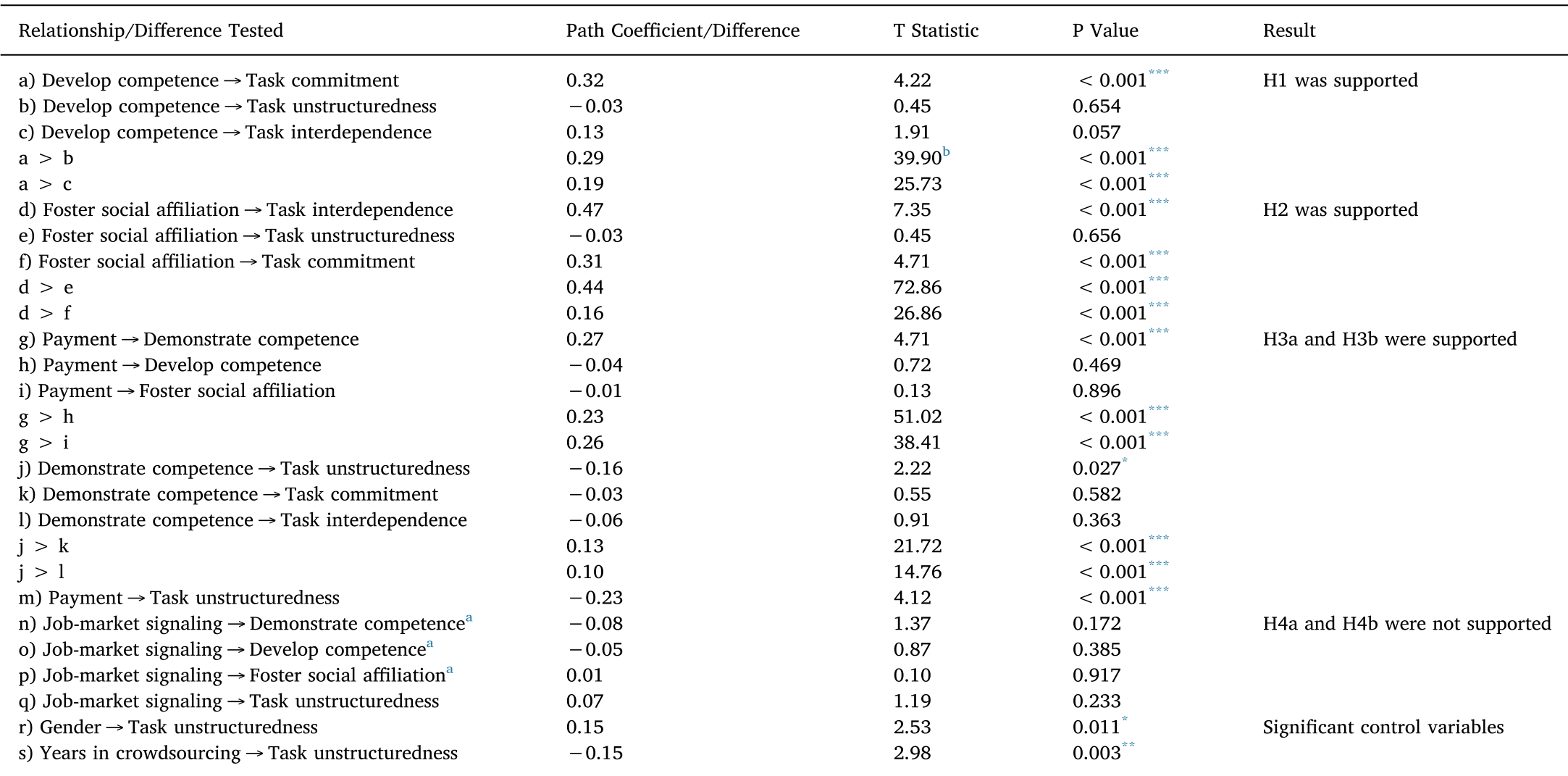
The findings, analyzed via PLS-SEM, provide a striking "Heat Map" of human behavior in digital markets:
- The Payment Trap: High payment does not necessarily attract people to difficult, unstructured tasks. Instead, it strongly correlates with a desire to demonstrate relative ability in Structured Tasks.
- The Learning Paradox: People who want to learn (Competence Development) actively seek out High-Commitment Tasks. They view effort as a vehicle for growth.
- The Social Magnet: Social affiliation is the strongest predictor for Interdependent Tasks. These participants aren't just looking for tasks; they are looking for a team.
Strategic Implications
For platform designers and organizers, the takeaways are actionable:
- To solve R&D problems: Don't just throw money at the crowd. Highlight the "learning potential" and "skill-stretch" opportunities of the task.
- To build a collaborative community: Emphasize social interdependence and coordination tools.
- To get high-volume simple work done: Use clear, competitive payment structures that allow workers to "signal" their efficiency.
Critical Analysis & Future Outlook
While the study is robust, it found that Job-Market Signaling (using tasks to get a real job) was a surprisingly weak motivator across the general sample. This suggests that the "gig economy" might be viewed more as a permanent side-hustle or a hobbyist's playground than a bridge to traditional employment.
Future Work: As AI begins to automate the "Structured Tasks" favored by the payment-motivated crowd, the future of crowdsourcing will likely shift toward the High-Commitment and Interdependent tasks identified here. Understanding how to sustain these deeper motivations will be the next frontier for digital labor platforms.
Conclusion: This paper provides the missing link between "Why we work" and "What we choose," proving that to move the crowd, you must first understand the goal behind the click.