
Exploring Trajectory-Driven Local Geographic Topics: Why Your Movement Defines the City
Exploring trajectory-driven local geographic topics in foursquare
This paper introduces a trajectory-driven approach to discover "Local Geographic Topics" in Pittsburgh using Foursquare check-in data. By applying Latent Dirichlet Allocation (LDA) to user movement sequences, the researchers successfully clustered venues into functional topics—such as education, sports, and professional hubs—revealing intrinsic relationships between locations that surpass static category definitions.
TL;DR
Researchers from the University of Pittsburgh have moved beyond static map categories to understand cities through the lens of human movement. By applying Latent Dirichlet Allocation (LDA) to Foursquare check-in trajectories, they discovered "Geographic Topics"—groups of venues related by how people use them, rather than just where they are. This approach reveals a "hidden" layer of urban connectivity, such as the intrinsic link between specific transit tunnels and professional hubs.
Problem & Motivation: The Limits of Static Geography
When you look for a place to eat on Foursquare or Yelp, you usually search by category (e.g., "Cafe") or proximity. However, our urban lives are defined by trajectories. A student at the University of Pittsburgh doesn't just visit "colleges"; they follow a specific path between libraries, specific cafes, and sports stadiums.
The authors identified that prior work often missed these nuances because:
- Static Categories are too rigid and don't reflect the crowd's "vibe" or sequence of behavior.
- Proximity Bias assumes things close together are related, while a commute links two distant points (home and work) into a single functional unit.
- Data Fragmentation: Most researchers used Twitter-mined Foursquare data, which only captures a fraction of actual check-ins.
Methodology: LDA Meets Human Mobility
The core innovation lies in the mapping of a linguistic model to physical movement. In natural language processing, LDA assumes documents are mixtures of topics, and topics are mixtures of words.
The paper translates this as follows:
- Word = A unique venue (a specific Starbucks or a stadium).
- Document = A user's total trajectory (the sequence of check-ins).
- Topic = A geographic "theme" (e.g., "The CMU Student Routine" or "The Weekend Shopping Trip").
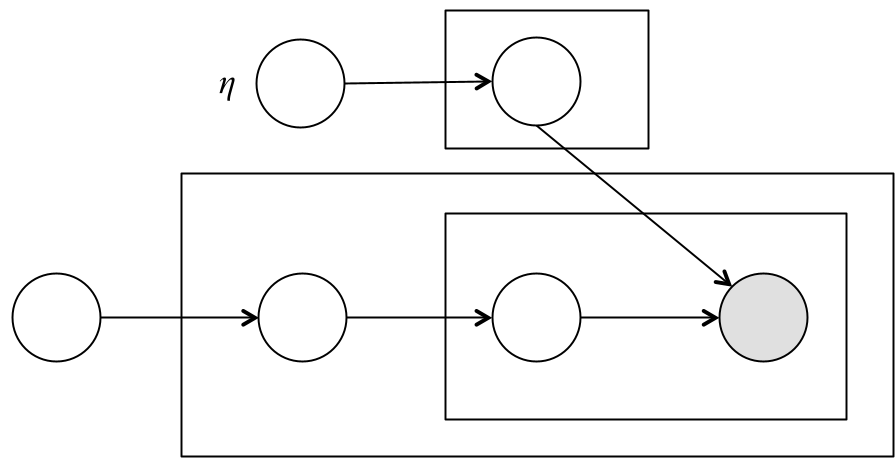
By setting topics, the researchers allowed the model to autonomously group venues that frequently appear in the same users' check-in histories.
Experiments: Weekdays vs. Weekends
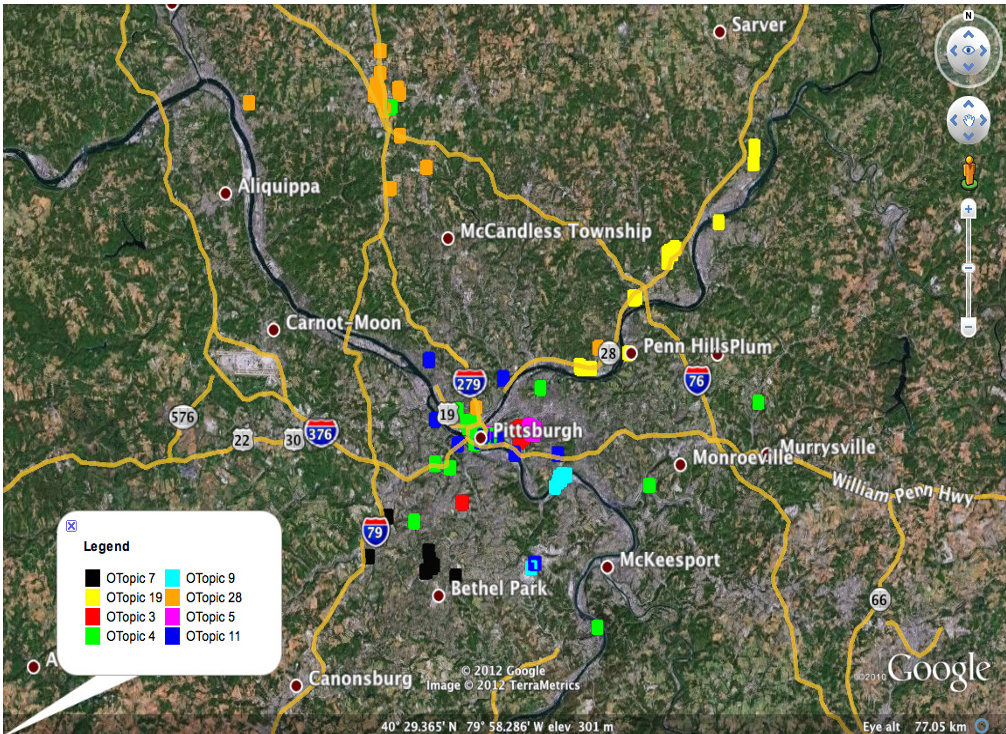
The study analyzed over 813,000 check-ins in the Pittsburgh area. The results were categorized into overall topics (OTopics), weekday topics (WDTopics), and weekend topics (WETopics).
Key Findings:
- The Professional Heartbeat: Weekday topics were dominated by professional buildings and hospitals. WDTopic 5, for example, clustered multiple UPMC hospitals together, likely capturing the movements of medical professionals or patients referred between specialists.
- The Vanishing Campus: Interestingly, education-related topics (University of Pittsburgh/CMU) were prominent on weekdays but virtually disappeared during the weekends, replaced by pure entertainment and dining topics.
- Spatial "Elasticity": The researchers found that while some topics were geographically tight (like the Oakland campus), others were spatially sparse (like stadium-driven topics), proving that human interest can bridge physical distance.
SOTA Comparison & Results
Unlike previous studies that relied on sparse Twitter data, this paper used a more complete direct Foursquare dataset. The LDA model demonstrated a high degree of "semantic" accuracy. For instance, it correctly identified that hockey fans (Pittsburgh Penguins) often check in at the CONSOL Energy Center and then visit specific nearby bars/hotels, despite those bars having different primary categories.
| Data Subset | Check-ins | Venues | Users |
|---|---|---|---|
| All | 813,221 | 16,461 | 32,113 |
| Weekdays | 574,372 | 16,222 | 26,224 |
| Weekends | 238,849 | 13,780 | 22,868 |
Critical Analysis & Takeaways
The Industry Insight
This research has massive implications for Business Intelligence. If a local coffee chain like "Crazy Mocha" sees that it never appears in the same topic as major transit hubs while "Starbucks" does, it provides a data-driven mandate for location expansion.
Limitations
While LDA is powerful, it is a "bag-of-words" model—it ignores the order of the check-ins. A user going from "Gym -> Office" is treated the same as "Office -> Gym." Future work utilizing Sequence-to-Sequence models or LSTMs could capture the temporal flow more accurately.
Conclusion
The city of Pittsburgh is not just a collection of coordinates; it is a tapestry of behaviors. By leveraging LDA on check-in trajectories, Long et al. have provided a blueprint for how LBSNS platforms can transition from simple directories to intelligent recommenders that understand the rhythm of human life.