
TS-ESI: Predicting Real-World Encounters for Anonymous Social Networks
Trajectory-Matching Prediction for Friend Recommendation in Anonymous Social Networks
This paper introduces a trajectory-matching friend recommendation framework for Anonymous Social Networks (ASNs) using the concept of "Serendipity." It proposes the Time-Sliced Expected Serendipity Index (TS-ESI) algorithm, which significantly outperforms the traditional LCSS baseline by achieving over 60% Top-5 precision in predicting future encounters.
TL;DR
How do you recommend friends in an app where you don't know who anyone is? This paper moves away from "profile matching" and toward Spatio-Temporal Serendipity. By analyzing historical movement patterns through a new algorithm called TS-ESI, the researchers can predict if two strangers will cross paths in the future with over 60% precision, outperforming traditional sequence matching methods by a massive margin.
The "stranger-danger" of Recommendation Engines
In conventional networks like Facebook or LinkedIn, recommendations are easy: you share a college, a boss, or a mutual friend. But in Anonymous Social Networks (ASNs) like Tinder or Whisper, these signals are missing.
Prior work relied on coarse-grained location proximity (e.g., "you are both in Beijing"). The problem? Beijing is huge. Just because two people are in the same city doesn't mean they'll ever meet. Existing similarity algorithms like LCSS (Longest Common Subsequence) or DTW (Dynamic Time Warping) are great at finding "similar shapes" of paths, but they ignore when those paths were taken. If I'm at the park at 8 AM and you're there at 8 PM, we are spatially similar but temporally miles apart.
The Core Insight: Defining Serendipity
The authors define Serendipity mathematically as a function of space-time cross points. A cross point occurs only if two users are within a distance at a time interval shorter than .
The goal is to solve the Serendipity Maximization Problem: Given a user's past 5 days of movement, who are the top people they are most likely to have a "meaningful encounter" with on day 6?
Methodology: From Continuous Paths to Time Slices
The paper introduces two major technical innovations:
- Interpolation: Since GPS pings are irregular, the algorithm uses linear interpolation to create a continuous set of space-time pairs.
- TS-ESI (Time-Sliced Expected Serendipity Index): To avoid the nightmare of comparing every point in my path to every point in yours, the authors slice the day into segments . They only check for encounters within the same time slice.
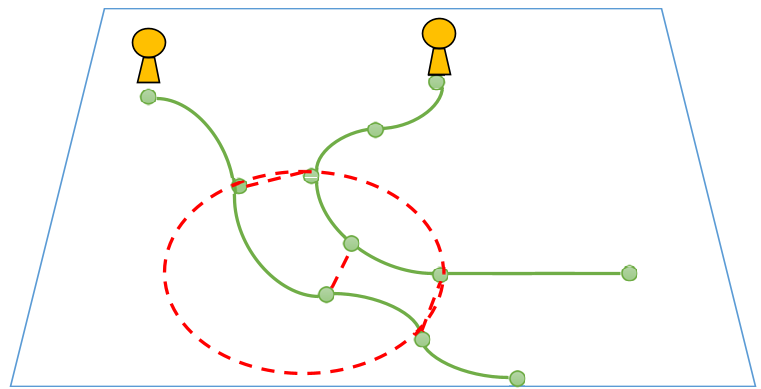 In the figure above, the red dashed circle represents the specific "Serendipity" window where two trajectories overlap in both time and space.
Experimental Results: Precision Matters
Using data from "Ledongli" (a major Chinese fitness app), the researchers tested 3,000 users in Beijing.
1. Accuracy Breakout
When looking at the Top-5 recommendations, TS-ESI achieved a precision of roughly 65%. In contrast, the baseline LCSS algorithm hovered around 13%. This proves that ignoring the "time" component in trajectory matching makes the results almost random for social recommendations.
2. Efficiency Gains
Computational cost is the death of many trajectory algorithms. As seen below, the TS-ESI algorithm maintains a linear runtime growth compared to the exponential-like curve of LCSS.
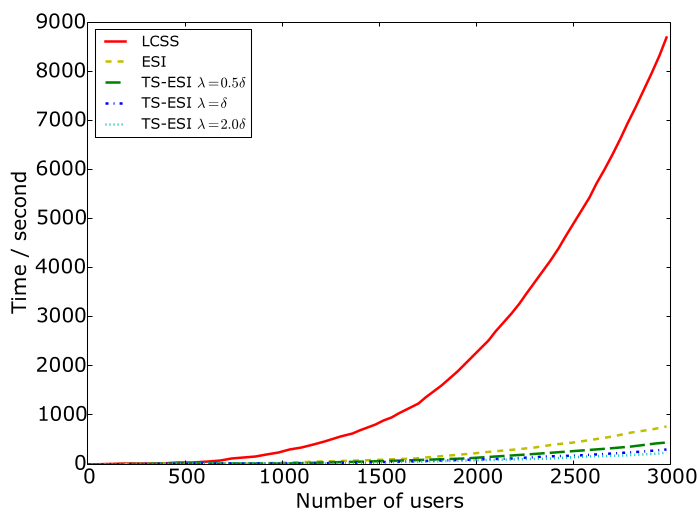 The TS-ESI approach significantly reduces consumption time, making it viable for production social apps.
Critical Analysis & Takeaways
The brilliance of this paper lies in its simplicity. Instead of throwing a "black-box" Deep Learning model at the problem, the authors used a physically intuitive metric (Serendipity) and an engineering-focused optimization (Time-Slicing).
Limitations:
- The model assumes high-frequency GPS data is available via iOS/Android background services, which is increasingly restricted due to modern privacy permissions.
- It treats all encounters as equal, though an encounter at a gym might be more "recommendable" than an encounter in a traffic jam.
Future Outlook: For developers of local discovery apps, the lesson is clear: Don't just look at where your users go; look at when they are there. The intersection of time and space is where real-world relationships begin.