
Service Election System: Leveraging Crowdsourcing and Voting for Robust Service Selection
A Framework for Transactional Service Selection Based on Crowdsourcing
The paper introduces a "Service Election System," a crowdsourcing-inspired framework for selecting transactional Web services. It aggregates diverse evaluations from multiple "voting services"—which can be human experts or automated algorithms—to select the most suitable candidate based on functional, QoS, and transactional properties.
TL;DR
As the Web becomes saturated with functionally identical services, choosing the "best" one is increasingly difficult. This paper presents a Service Election System that treats service selection like a democratic election. By allowing various "voting services" (from QoS forecasters to execution log analyzers) to cast their preference, the framework achieves a consensus that is more robust than any single selection algorithm.
Problem & Motivation: The Paradox of Choice in SOA
In modern Service-Oriented Architecture (SOA), it is common to find dozens of services that do the exact same thing (e.g., "Get Weather") but differ in Quality of Service (QoS)—like latency and price—and Transactional Properties (i.e., can the action be undone if a failure occurs?).
Most existing solutions are "siloed." One might use reputation, another collaborative filtering. The authors argue that no single method is perfect. The challenge is: How do we benefit from all these different perspectives simultaneously without forcing them into a single, rigid mathematical model?
Methodology: The Democratic Framework
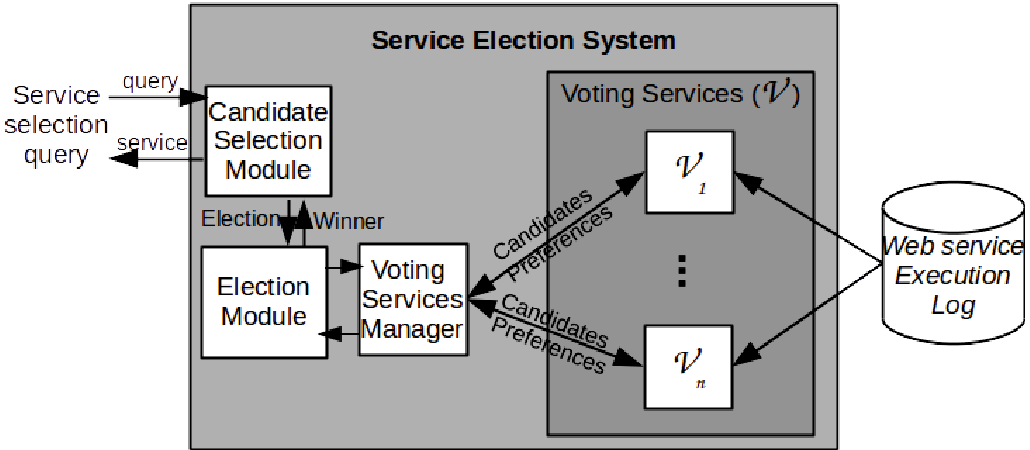
The core innovation is the decomposition of the selection process into a modular election.
1. Transactional Filtering
Before voting begins, the system filters candidates based on their "Transactional Property" (TP). The paper defines a hierarchy (Pivot, Compensable, Retriable) to ensure that the selected service doesn't just work fast, but works safely within a business process.
2. The Voting Paradigm
The system introduces "Voting Services" (). Any assessment method can be wrapped as a voting service. The only requirement? It must rank the candidates.
- Basic Voting: Ranks based on advertised QoS.
- Historical Voting: Analyzes execution logs to see how the service actually performed in the past.
- Forecaster Voting: Uses linear regression to predict future performance.
3. Aggregation Logic
The Election Module acts as the "poll counter." It uses a weighted scoring formula to decide the winner:
Experiments & Results
The authors validated their framework using the WS-DREAM dataset, which contains over 1.5 million real-world service invocations.
Efficiency vs. Effectiveness
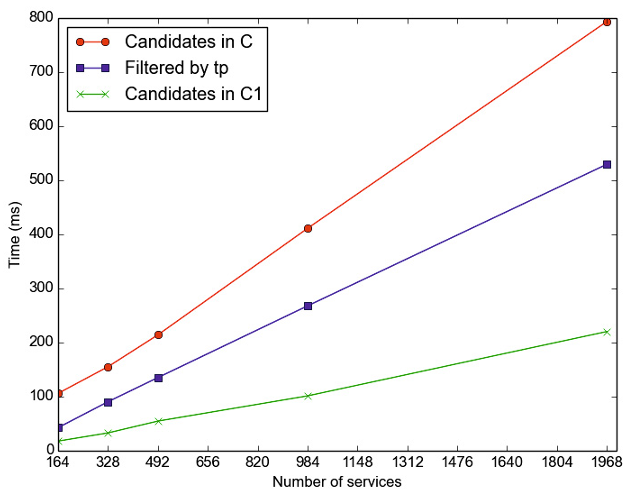
- Efficiency: Even with complex forecasting models, the selection time is minimal. For a composite service (a chain of multiple services), the "election" overhead drops to only 2% of total execution time as the service complexity increases.
- Effectiveness: The framework successfully resolved ties and "disagreements" between different ranking strategies. For instance, when a "Forecaster" service preferred one candidate while the "Historical" service preferred another, the voting system provided a mathematically sound tie-breaker.
Critical Analysis & Conclusion
Takeaway
The shift from "Selection Algorithms" to "Election Frameworks" is a significant step toward more resilient distributed systems. By decoupling the ranking (the strategy) from the selection (the decision), the framework allows developers to add new selection criteria (like energy consumption or carbon footprint) without rewriting the core system.
Limitations & Future Work
The current approach assumes voting services are honest. However, in a true "crowdsourcing" environment, some voters might be "malicious" (trying to promote their own service). The authors admit that future iterations need Reputation Management for the voters themselves—essentially a "Who watches the watchmen?" mechanism.
This framework paves the way for a more open, competitive, and reliable Web service ecosystem where "consensus" leads to better performance.