
Transfer Cross Entropy: Decoding Social Hierarchy from the Pulse of Conversation
Transfer cross entropy for fast sociometric inference in longitudinal collections of multi-party conversation
The paper introduces Transfer Cross Entropy (TCE), a novel information-theoretic measure to quantify pair-wise influence in multi-party conversations using only binary speech activity (chronograms). By extending transfer entropy to smoothed n-gram models of turn-taking, it enables the construction of sociomatrices from unannotated audio without requiring complex speech recognition or natural language processing.
TL;DR
Can we determine who holds the most power in a room without listening to what they are actually saying? This paper introduces a method using Transfer Cross Entropy to map social networks based solely on the timing of speech (on/off signals). By treating turn-taking as a stochastic process, the author successfully identified organizational seniority and social influence in professional meetings, bypassing the need for expensive Speech Recognition (ASR).
Background: Beyond the Words
Social Network Analysis (SNA) usually looks at overt links—who emails whom, or who follows whom. In the messy reality of a multi-party meeting, these links are invisible. We might guess someone is influential if they are "mimicked," but human interaction is more subtle than that.
The author's core insight is that influence is predictability. If knowing what Participant A did 500ms ago helps us significantly better predict what Participant B is doing now, then A likely exerts a social "force" on B.
Methodology: The Information-Theoretic "X-Ray"
The research transforms conversations into Chronograms—binary matrices where each row represents a participant and each column is a 100ms time slice (1 = speaking, 0 = silent).
1. Coupled n-gram Models
The system predicts the next state of a participant based on:
- Their own history (Are they currently speaking?).
- The "Group State" (Is anyone else speaking?).
Traditional models often ignore the "interlocutor effect," but this paper proves that including the state of others dramatically improves prediction accuracy (lowers cross-entropy).
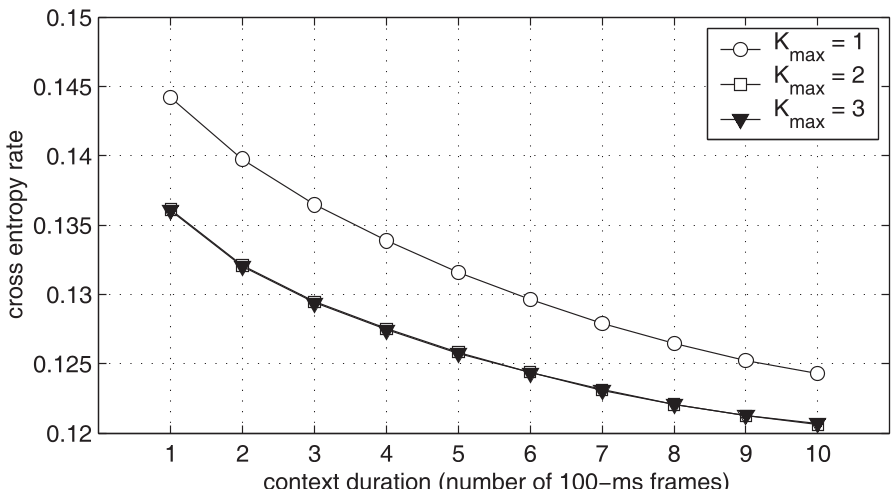 In the figure above, we see that longer histories and "coupled" models (considering interlocutors) result in lower bits-per-frame, meaning the behavior becomes more predictable.
2. Formulating Influence
The "Influence" of on is defined by how much harder it becomes to predict Participant when Participant 's data is hidden. If removing makes look like "random noise" to the model, is highly influential.
The "Seniority" Discovery
When this method was applied to the ICSI Meeting Corpus—a dataset of real-world research meetings—a "peculiar finding" emerged.
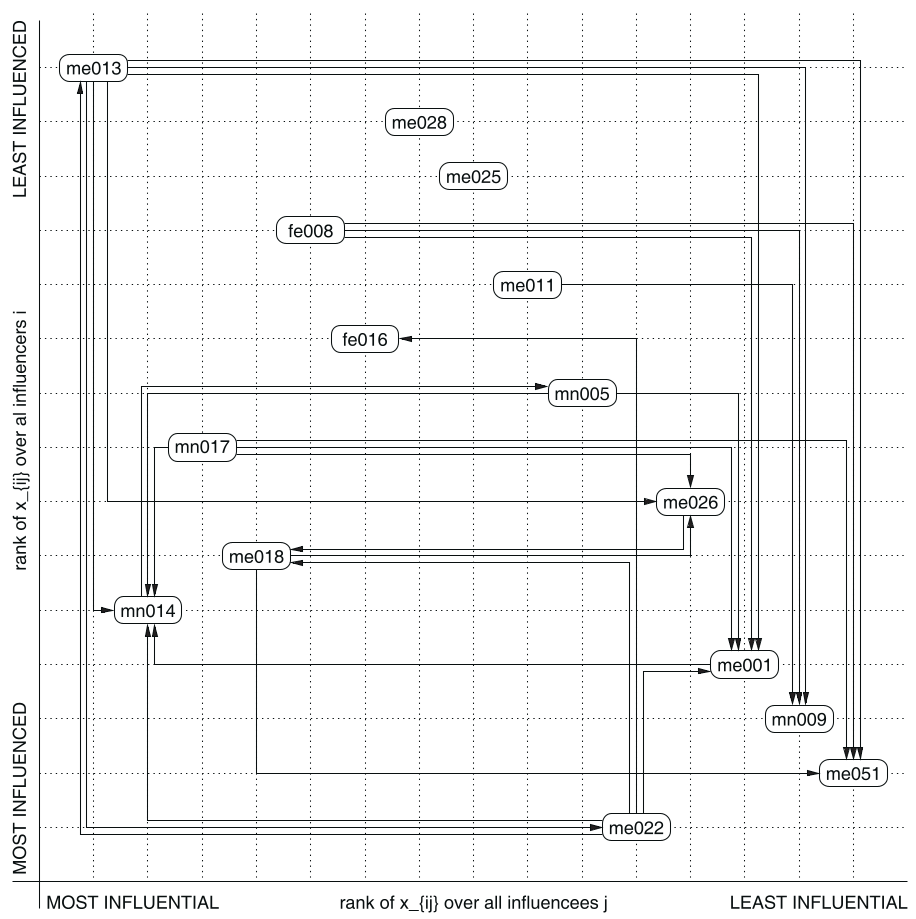 The directed sociogram above reveals that influence is often asymmetric.
By ranking participants based on their Influence scores, the model effectively recreates the educational and professional hierarchy of the group. The most "influential" nodes (top-left) were senior professors and PhD holders, while the bottom-ranked nodes were those without doctorates. The model found that lower-ranking members "dovetail" their speech more precisely to match the turn-terminations of the seniors—a form of linguistic compliance.
Critical Insight & Future Outlook
The beauty of this approach lies in its simplicity and privacy-friendliness. Because it doesn't require word recognition:
- It works across all languages.
- It can be deployed in encrypted environments where the audio content is withheld.
- It is computationally "cheap" enough to analyze thousands of hours of audio at once.
Limitations: The author admits this is a "preliminary effort." It treats intra-utterance pauses (brief silences while one person is still holding the floor) as noise, which might actually be a powerful social signal in itself.
Future Work: This framework could easily be extended to other binary signals—like laughter or gaze. Imagine a system that maps "who likes whom" by calculating the Transfer Cross Entropy of laughter across a crowd. As we move into an era of massive metadata, this paper reminds us that the rhythm of our interactions often says more than the content.