
Weight-SCL: Solving the Platform Cold-Start Problem in Crowdsourcing via Transfer Learning
Transfer Learning for Cross-Platform Software Crowdsourcing Recommendation
This paper introduces Weight-SCL, a transfer learning method designed for cross-platform software crowdsourcing recommendations. It addresses the "platform cold-start" problem by mapping heterogeneous features (tags and description keywords) from a mature platform to a new one, achieving a 1.2x performance improvement in recommendation accuracy.
Executive Summary
TL;DR: The software crowdsourcing industry is booming, but new platforms face a "chicken-and-egg" problem: they lack the data to train effective recommendation models. This paper presents Weight-SCL, a transfer learning framework that migrates knowledge from mature platforms (like Zhubajie) to new ones (like JointForce). By aligning "important" tag features and "unimportant" description keywords into a shared latent space, the authors achieved a 1.2x performance boost over traditional transfer learning methods.
Positioning: This work moves beyond user/item cold-start solutions to address the platform cold-start scenario, positioning transfer learning as a foundational infrastructure for new crowdsourcing ecosystems.
The "Platform Cold-Start" Bottleneck
In a typical crowdsourcing environment, the Recommender System (RS) must match developers to tasks. While Collaborative Filtering (CF) is the industry standard, it requires dense interaction matrices. For a newly launched platform, these matrices are empty.
Current solutions often rely on Content-Based Filtering, but these are limited by the local platform's vocabulary. The authors identified that the real gap lies in feature inconsistency: mature platforms and new platforms use different tagging systems and description styles. Standard Structural Correspondence Learning (SCL) fails here because it treats all features with equal weight, failing to distinguish between high-signal tags and noisy text descriptions.
Methodology: The Weight-SCL Framework
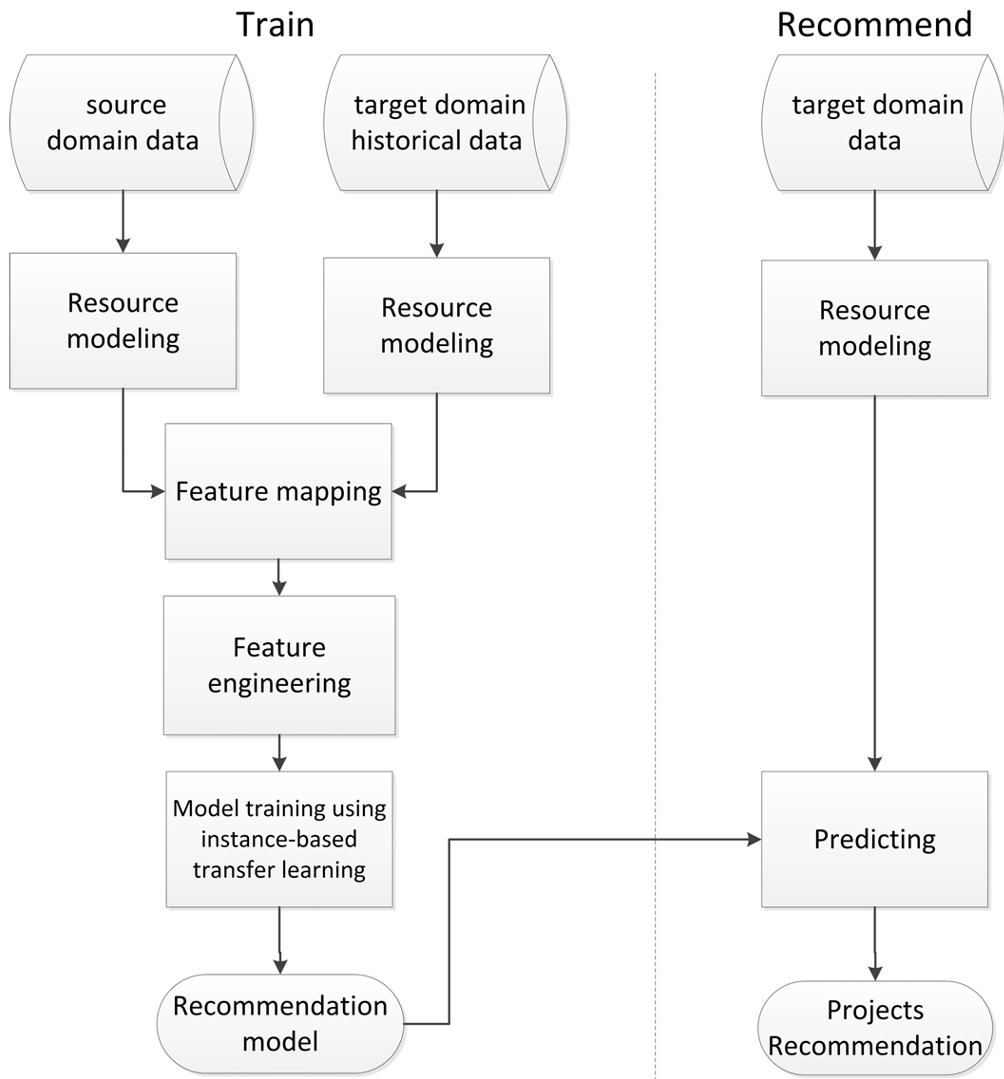
The core of the paper is the Weight-SCL (Weighted Structural Correspondence Learning) algorithm. The intuition is simple: use "pivot features" (words that appear frequently in both platforms) as a bridge.
1. Feature Dual-Modeling
The system models projects and users using two distinct feature sets:
- Important Features: Explicit tags (e.g., "Java", "UI").
- Unimportant Features: Keywords extracted from descriptions via TF-IDF.
2. Weighting and Mapping
Weight-SCL introduces a transformation where "unimportant" keywords in the target domain can be mapped to "important" tags in the source domain. This increases the pool of pivot features—the "anchors" used to understand the relationship between different domains.
3. Latent Space Projection
Using Singular Value Decomposition (SVD) on the weights of linear predictors for these pivots, the algorithm creates a low-dimensional latent space. Both platforms’ features are projected here, effectively "translating" a new platform's data into the language of a mature platform.
Experiments & Results
The authors validated the model by transferring knowledge from Zhubajie (6,000 projects) to JointForce (2,800 projects).
Key Findings:
- Performance Scaling: As shown in Fig 2, increasing the number of pivot features (m) directly correlates with higher precision (P@10).
- Superiority Over Baselines: Weight-SCL outstripped the traditional ICBNN (Single-source) by 60% and the standard SCL by 20%.
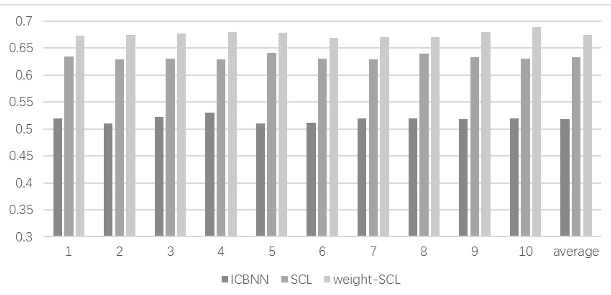
Fig: Comparisons of Accuracy (P@k) and Recall (R@k) across different recommendation strategies.
Critical Insight: Why it Works
The brilliance of Weight-SCL lies in its recognition of Feature Genealogy. In a new platform, a developer might not have tags, but their written profile (keywords) might match the professional tags of a veteran developer on a mature platform. Weight-SCL captures these cross-feature-type correlations, whereas traditional SCL only looks for "tag-to-tag" or "keyword-to-keyword" matches.
Summary & Future Outlook
Takeaway: For technical leads building new marketplaces, this paper proves that data scarcity can be mitigated by "borrowing" the feature correlations of market leaders.
Limitations: The reliance on manual weights (λ) for different relationship types (apply vs. win-bid) suggests a need for automated hyperparameter tuning.
Future Directions: The transition to Hybrid RS (combining CF and content-based transfer learning) and the integration of large-scale knowledge bases (like GitHub or StackOverflow) to further enrich the latent space are the next logical steps for this research.