
Stacking the Deck: Transfer Learning for Precision Emotion Intensity in Tweets
A Transfer Learning Approach for Emotion Intensity Prediction in Microblog Text
This paper presents a robust ensemble model for predicting emotion intensity (0 to 1 scales) in tweets across four categories: anger, fear, joy, and sadness. By leveraging a Transfer Learning approach, the authors integrate features from state-of-the-art models like DeepMoji and Skip-Thought, achieving a top-tier Pearson correlation score on the SemEval-2018 Task 1 benchmark.
TL;DR
Researchers from Nile University have developed a high-performing ensemble regressor that moves beyond simple "sentiment analysis" to predict the intensity of specific emotions in tweets. By stacking traditional linguistic features with deep embeddings transferred from models like DeepMoji, the system achieved a competitive 3rd place finish in the SemEval-2018 Affect in Tweets competition with an average Pearson correlation of 0.7745.
Context: Beyond Positive/Negative
While standard sentiment analysis tells us if a tweet is "negative," it fails to distinguish between a user who is mildly annoyed and one who is experiencing blind rage. This distinction is critical for crisis management, customer service, and public health monitoring. However, Twitter's "noisy" data—filled with hashtags, emojis, and unconventional grammar—makes traditional NLP models struggle.
The authors' central insight is that Transfer Learning is the key. Just as Computer Vision models use ImageNet-pretrained backbones, Emotion NLP can benefit from models like DeepMoji, which were trained on over 1.2 billion tweets to understand the subtle relationship between text and emotional expression (via emojis).
Methodology: The Power of Stacking
The system doesn't rely on a single "silver bullet." Instead, it uses Ensemble Stacking, a hierarchy where multiple specialist models pass their predictions to a final "meta-learner."
1. Feature Engineering Specialist
This module captures the "surface" and "manual" cues of language:
- N-grams: Specifically Bigrams with sublinear TF scaling to capture local context.
- Lexicon Features: Utilizing a massive suite of affective lexicons (AFINN, NRC, EmoLex) to flag known emotional keywords.
- Manual Trophies: Emoji scores, hashtag hits, and average word length.
2. The Transfer Learning Specialists
The core innovation lies in extracting latent knowledge from three state-of-the-art architectures:
- DeepMoji: Provides 2304-dimensional vectors from its attention layer, capturing which parts of a sentence contribute most to emotional tone.
- Skip-Thought & Sentiment Neuron: Provide sentence-level representations that understand semantic structure, even when specific emotional keywords are absent.
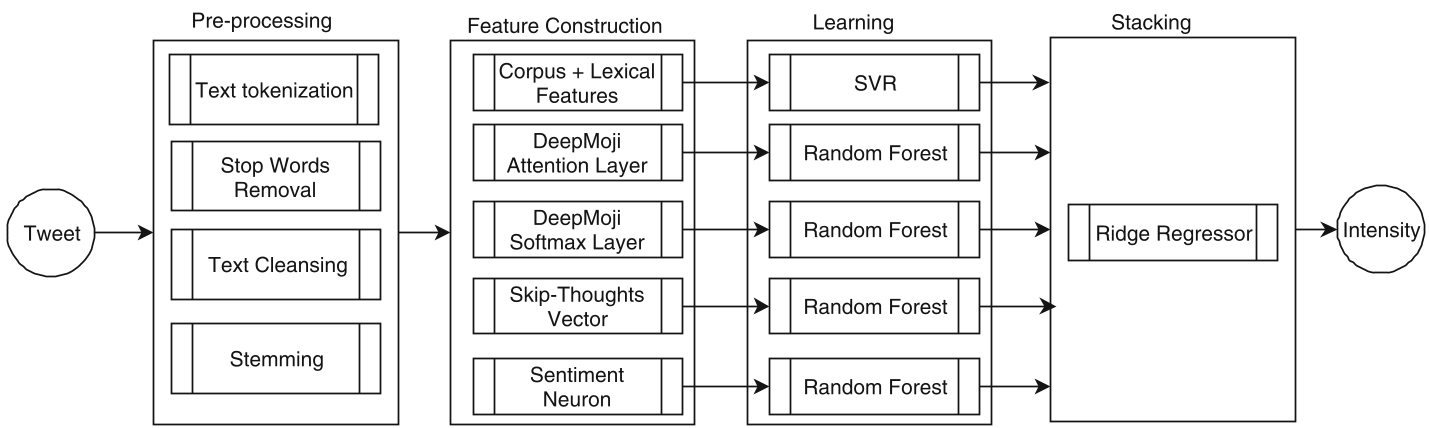 Fig 1: The architecture showing the flow from raw data to stacked regression.
Experiments & SOTA Results
The authors evaluated their model against the SemEval-2018 gold standard. The results confirm that deep learning embeddings are significantly more powerful than traditional statistical features alone.
- Baseline SVM: 0.569 Pearson Correlation
- DeepMoji (Attention Layer) alone: 0.704 Pearson Correlation
- The Full Proposed Ensemble: 0.7745 Pearson Correlation
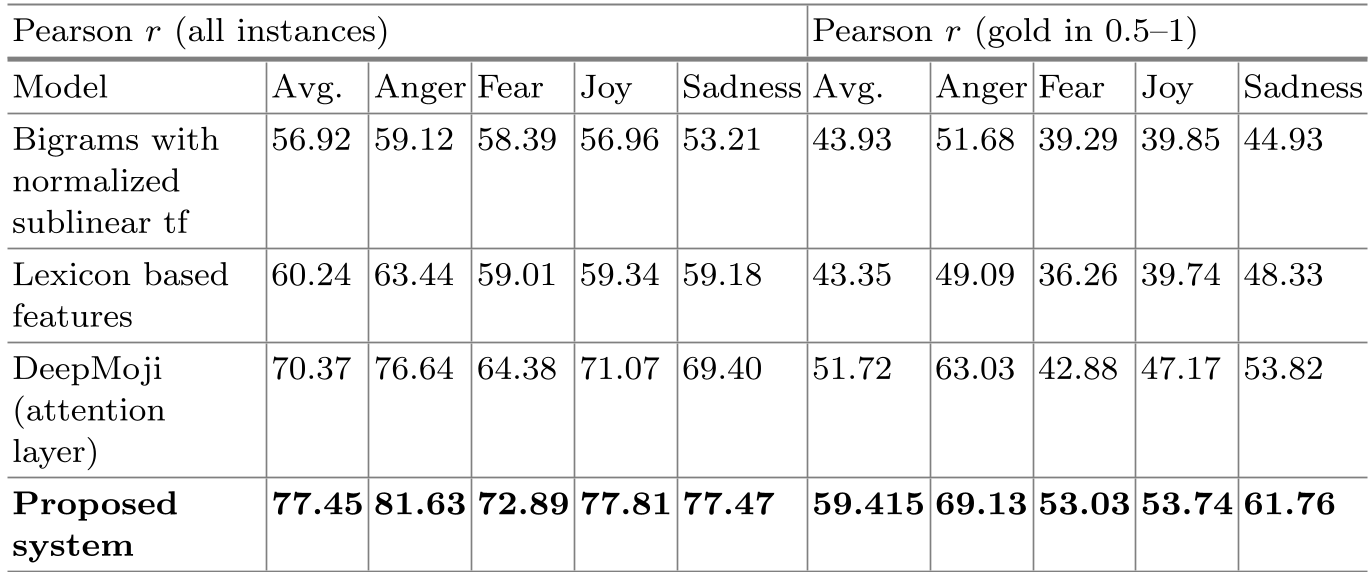 Table 1: Performance comparison showing the synergy of combining lexicons and transfer learning.
Critical Insight: Where Do Models Fail?
The authors' error analysis reveals the "frontier" of current NLP. The model still struggles with:
- Complex Context: Interpreting "My heart is so happy I want to explode" as Anger simply because of the word "explode."
- Sarcasm and Negation: Dealing with phrases where "never dull" implies excitement, but the model fixates on the negative word "dull."
Conclusion
This work demonstrates that for niche regression tasks like emotion intensity, we should stop trying to train small models from scratch. Instead, the future lies in feature fusion—combining the broad semantic "intuition" of large pretrained models with the precise "keyword focus" of traditional lexicons. For practitioners, this provides a clear blueprint for building production-ready emotion detectors that are robust to the chaos of social media.