
FullExpression: Bringing Real-Time Emotion Recognition to the Browser via Transfer Learning
FullExpression Using Transfer Learning in the Classification of Human Emotions
The paper presents "FullExpression," a facial emotion classification system utilizing Transfer Learning on a Deep Learning model. By fine-tuning a MobileNet V1 architecture, the authors achieved an 80% accuracy in classifying the seven universal emotions within a browser-based environment.
TL;DR
FullExpression is a research-driven ecosystem that bridges the gap between complex Deep Learning (DL) models and accessible web applications. By utilizing Transfer Learning on a MobileNet V1 backbone, the authors developed a system capable of identifying seven core human emotions with ~80% accuracy directly within a web browser using TensorFlow.js.
Problem & Motivation
Human-Computer Interaction (HCI) is becoming increasingly emotional. However, the industry faces a dilemma: traditional FACS (Facial Action Coding System) methods are often rigid and sensitive to lighting or ethnicity, while modern DL models are typically too "heavy" to run without specialized server-side hardware.
The authors observed that most state-of-the-art (SOTA) works achieve high accuracy (up to 98% on controlled datasets like CK+) but fail to provide a practical, cross-platform tool. Their insight was to leverage MobileNet, an architecture designed specifically for resource-constrained environments, and adapt it for facial expressions using a hybrid dataset.
Methodology: The Core
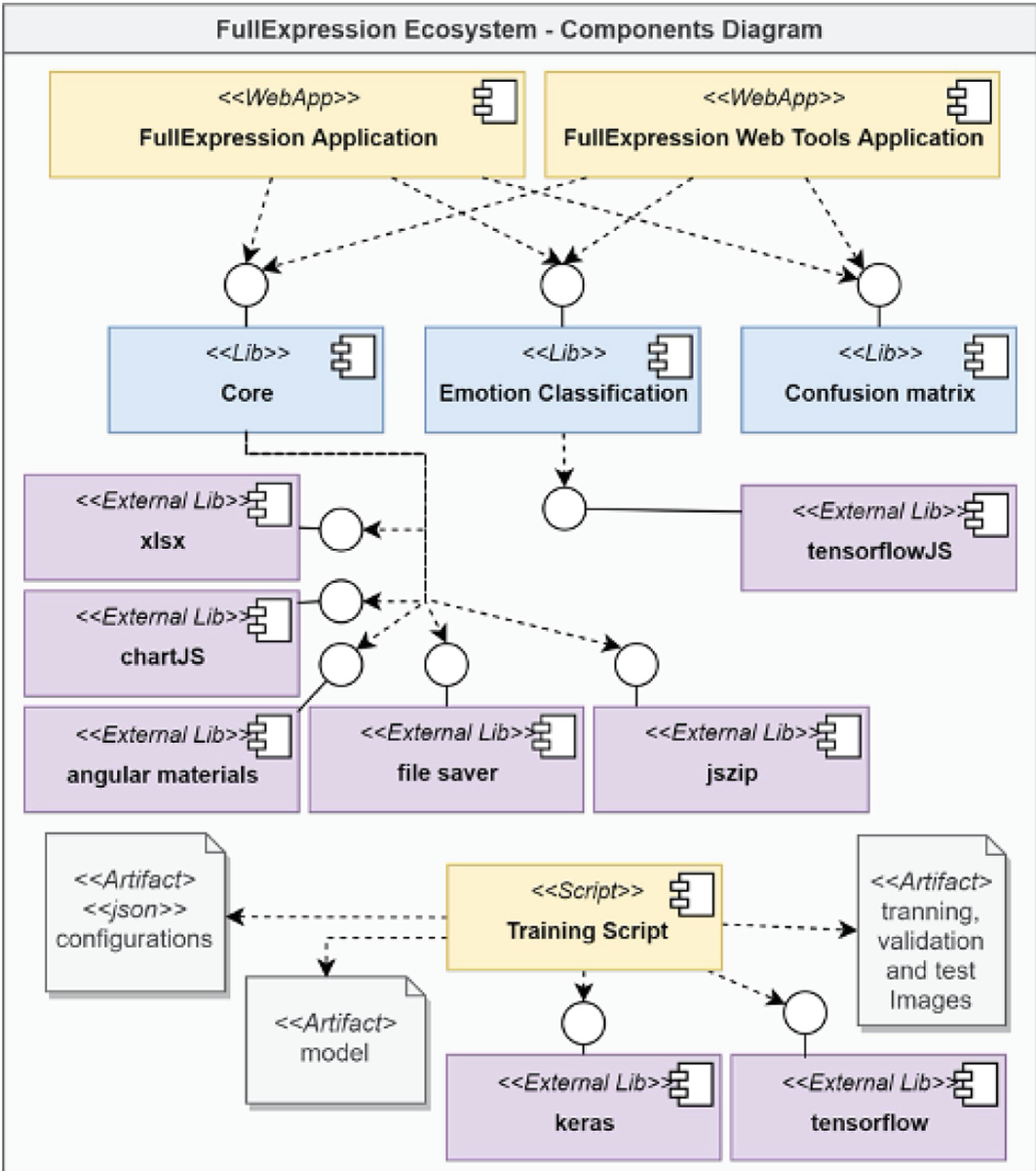
The "FullExpression" ecosystem is built on a modular architecture that separates concern between UI, data handling, and the DL model.
1. The Model Architecture
Instead of building a model from scratch, the team used Transfer Learning. They took a pre-trained MobileNet V1 and performed the following modifications:
- Input Layer: Set to 224 x 224 x 3.
- Bottleneck: Retained the 89-layer structure to leverage features already learned from large-scale image sets.
- Output Layer: Replaced the final classification layer with a 1 x 1 x 7 layer, representing the seven universal emotions (Joy, Sadness, Surprise, Fear, Anger, Disgust, and Contempt).
2. The Browser Pipeline
To achieve real-time inference, the application follows a strict pipeline:
- Detection: Face extraction via the Viola-Jones algorithm.
- Normalization: Resizing to 300x300 and grayscale conversion to reduce dimensionality.
- Inference: Running the model via TensorFlow.js, utilizing the client's local GPU/CPU.
Experiments & Results
The model was trained on a combined database of 4,699 images (including KDEF, TFEID, and JAFFE).
SOTA Comparison
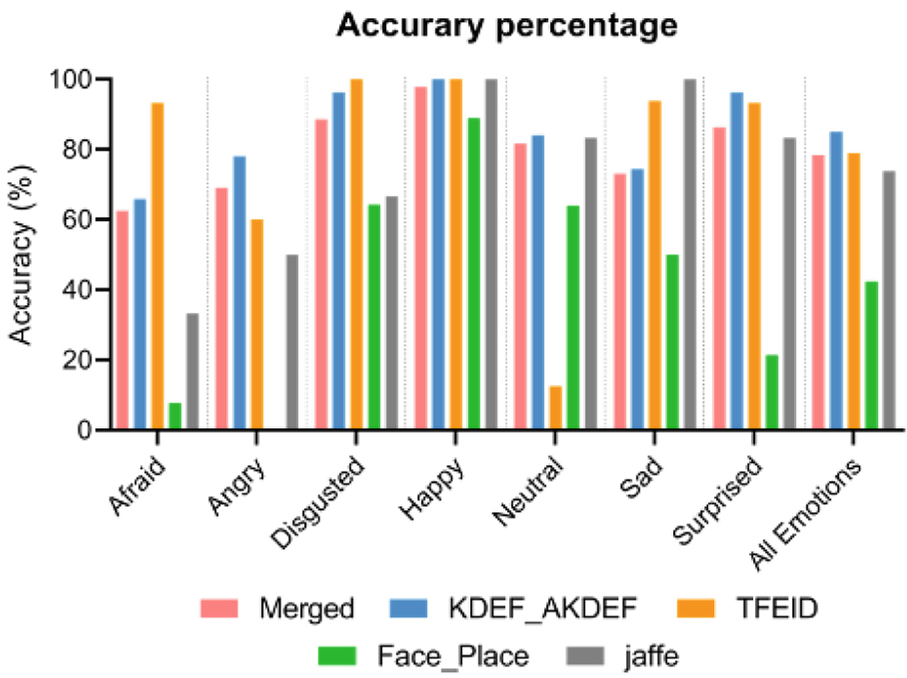
FullExpression achieved a performance of ~78.4%, which is highly competitive considering it is a browser-based solution. Notably, it outperformed EmotionDan (~75% accuracy) despite using significantly less training data, proving that data quality and transfer learning efficiency can outweigh sheer volume.
Performance by Emotion
The study revealed a common "bias" in emotion AI:
- "Happy" was identified with near-perfect accuracy (97.8%).
- "Afraid" proved the most elusive (62.5%), often confused with surprise or sadness.
Critical Analysis & Conclusion
The core achievement of this paper isn't necessarily a new "highest score" in accuracy, but a proof-of-concept for deployment. By moving the inference to the browser, the authors address privacy concerns (images don't need to be uploaded to a server) and reduce infrastructure costs.
Takeaways
- Efficiency over Size: A well-tuned lightweight model (MobileNet) can outperform larger models if the transfer learning process is handled correctly.
- Transfer Learning is Key: Retraining all 89 layers of MobileNet for a niche task like emotion recognition allows the model to adapt generic visual features to subtle muscle movements.
Limitations & Future Work
The accuracy drop on the "Face Place" database (down to 43%) suggests that the model still struggles with heavily disguised or highly varied facial structures. Future research should likely move toward Multi-modal Affective Computing, combining facial analysis with voice or physiological signals (heart rate, skin conductance) to clear up the ambiguity between overlapping emotions like "Anger" and "Disgust."