
Lex Rosetta: Breaking the Language Barrier in Legal AI with Multilingual Embeddings
Lex Rosea: transfer of predictive models across languages, jurisdictions, and legal domains
The paper introduces Lex Rosetta, a cross-jurisdictional framework for the functional segmentation of adjudicatory decisions. By utilizing Language-Agnostic Sentence Representations (LASER) and GRU-based sequence labeling, the authors demonstrate that legal predictive models can effectively transfer across 6 languages and 7 countries.
TL;DR
Is it possible for an AI trained on American administrative law to understand the structure of an Italian criminal court decision? This paper introduces Lex Rosetta, a groundbreaking study proving that multilingual sentence embeddings allow legal predictive models to generalize across languages, jurisdictions, and legal systems. By pooling data from various countries, the researchers created a model that is more robust and accurate than those trained on local data alone.
Context: The Silo Problem in AI & Law
The legal domain is notoriously fragmented. A model developed for the US Supreme Court is typically useless for a French appellate court due to differences in language, procedure, and legal tradition (Common Law vs. Civil Law). This fragmentation creates a massive "annotation bottleneck": every new jurisdiction requires expensive, manual labeling by legal experts.
The authors of Lex Rosetta asked a radical question: Can we leverage the underlying "functional" logic of judicial decisions that remains constant across borders?
The Methodology: LASER and Sequence Labeling
To test this, the authors used LASER (Language-Agnostic Sentence Representations). Unlike standard word embeddings, LASER maps sentences into a 1024-dimensional space where sentences with the same meaning are close together, regardless of the language they are written in.
The Model Pipeline
- Preprocessing: Removing "Out of Scope" metadata and "Headings" to force the model to rely solely on the semantic meaning of sentences.
- Embedding: Converting sentences into language-agnostic vectors.
- Sequence Labeling: Using a Bidirectional GRU to predict whether a sentence belongs to Background, Analysis, or Outcome.
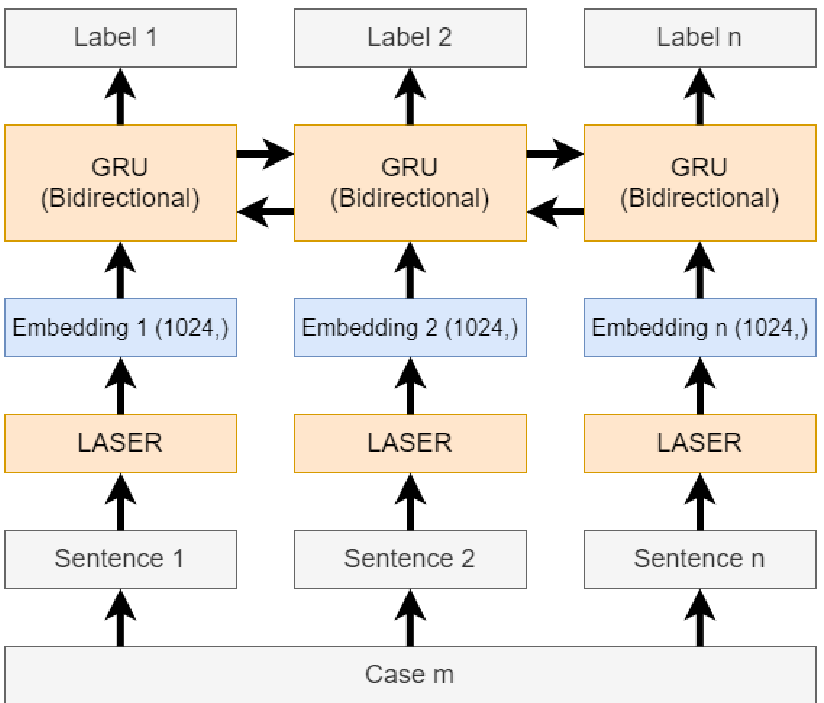 Figure 1: The sequential model architecture utilizing LASER embeddings and Bi-GRU for functional segmentation.
Key Insights: Cross-Border Generalization
The researchers tested three core hypotheses across 807 documents from 7 countries (Canada, Czech Republic, France, Germany, Italy, Poland, USA).
1. Zero-Shot Transfer (H1)
Can a model trained on Czech law work in Poland? Yes. The results showed that models trained in one context outperformed random baselines in almost every instance. Interestingly, models performed better between languages of the same family (e.g., Slavic or English).
2. The Power of Pooling (H2 & H3)
The most striking finding was that pooling data from different countries (e.g., training on US, Italy, and France to predict Germany) made the models significantly more robust.
- Pooled Out-Context: Models trained on multiple "foreign" contexts often performed as well as models trained on "local" data.
- Global + Local: Adding foreign data to local training sets further boosted performance, helping the model learn the "universal" structure of legal reasoning.
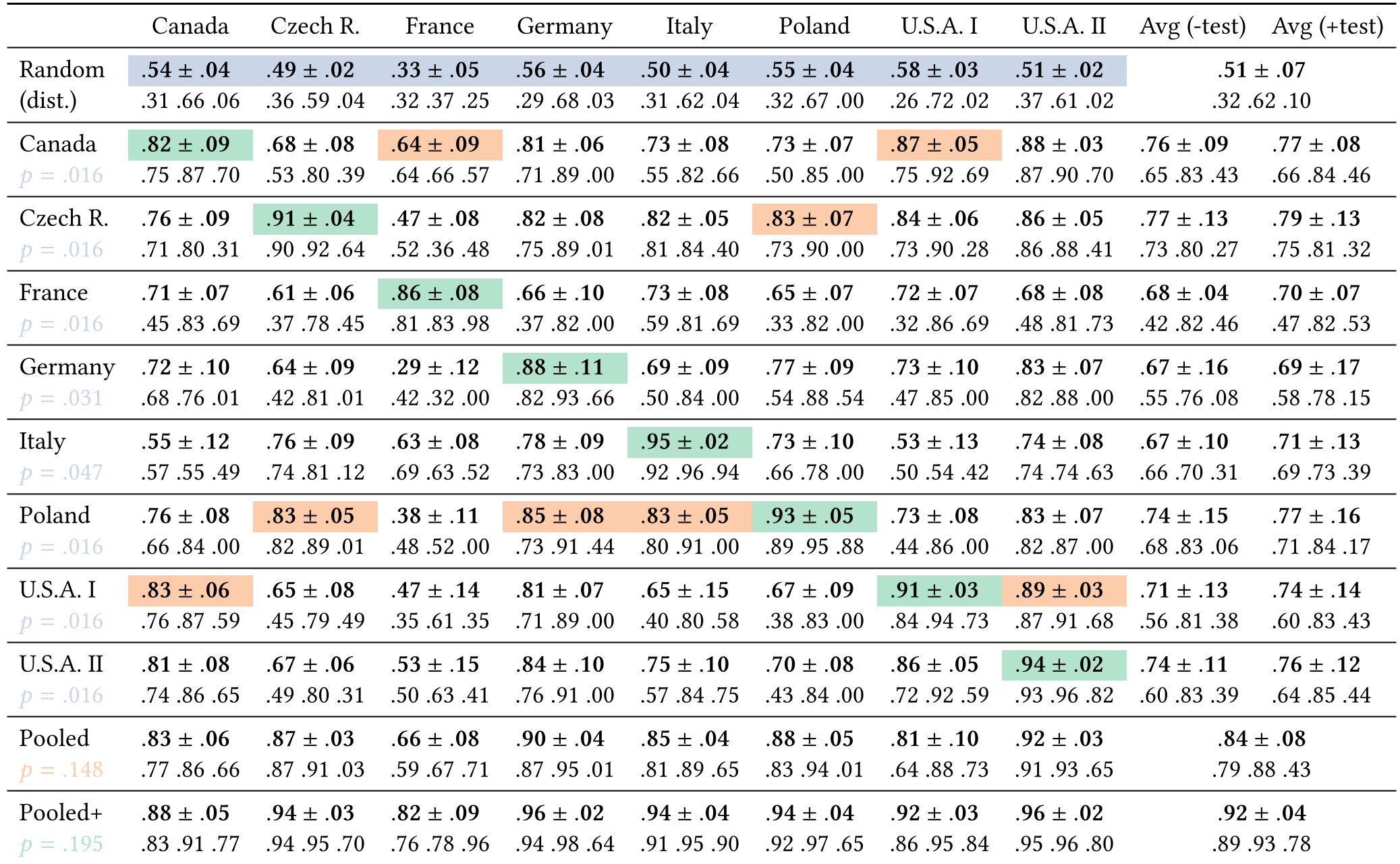 Table: Performance metrics across different training/testing configurations. Note how 'Pooled+' consistently achieves high F1-scores.
Visualizing the Legal Manifold
The paper uses PCA to visualize the "semantic clusters" of documents. Cases from the same jurisdiction naturally cluster together, but there is significant overlap between related systems. For instance, Czech and Polish documents occupy almost the same space, likely due to shared Slavic roots and similar Civil Law traditions.
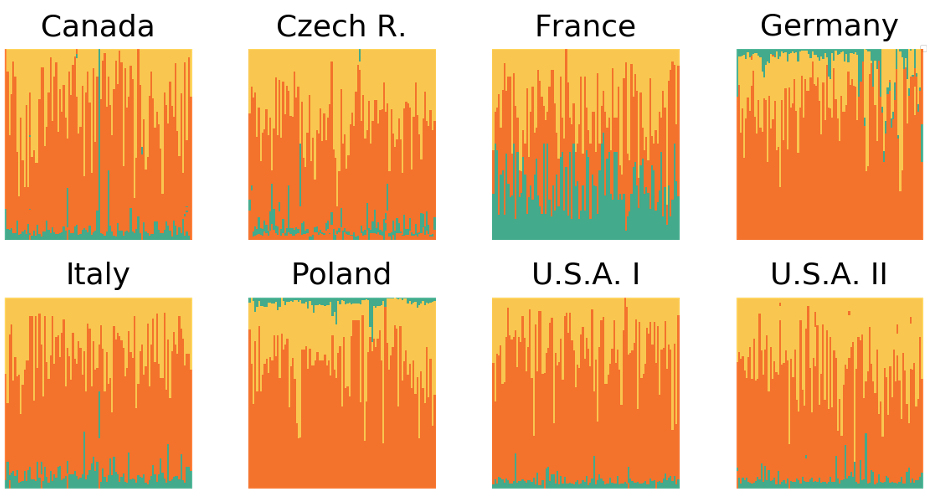 Figure 2: PCA reduction of document embeddings showing clusters by jurisdiction and language.
Limitations: The "Outcome" Challenge
Despite the success, the models struggled with detecting the Outcome of cases in certain jurisdictions. This is largely due to the "structure mismatch"—in Polish and German courts, the outcome often appears at the very beginning of the document, whereas in others, it appears at the end. The GRU model, being sensitive to sequence, had to learn to navigate these two distinct modes of legal writing.
Conclusion: Toward a Global Legal AI
Lex Rosetta proves that the "legal logic" of a factual background or a legal analysis is remarkably similar across the globe when viewed through the lens of multilingual embeddings.
Why does this matter? It means that international researchers can collaborate on a single "Mega-Dataset." Instead of each country building its own tiny, niche model, we can build a massive, shared model that understands the universal language of law. This significantly lowers the barrier to entry for developing legal tech in countries with fewer resources.
Takeaways
- Multilingual is Mandatory: Future legal AI shouldn't be built for one language at a time.
- Data Pooling works: Semantic Commonality outweighs local linguistic variance.
- Functional Universality: While laws change, the way judges write about facts and analysis is surprisingly universal.