
TRAIL: Solving the Cold-Start Problem in LBSNs through Collective Link Transfer
Transferring heterogeneous links across location-based social networks
This paper introduces TRAIL (TRAnsfer heterogeneous lInks across LBSNs), a supervised collective link prediction framework designed for newly established Location-Based Social Networks (LBSNs). By leveraging anchor links to align target and source networks, TRAIL predicts both social ties and location check-in links simultaneously, outperforming independent link prediction baselines (SOTA).
TL;DR
The emergence of new Location-Based Social Networks (LBSNs) often faces the "New Network" problem: a lack of sufficient social ties and check-in data to provide quality recommendations. TRAIL (TRAnsfer heterogeneous lInks across LBSNs) breaks this bottleneck by transferring knowledge from established networks (like Twitter) to new ones (like Foursquare) using anchor links. It doesn't just predict links; it predicts social and location links collectively, recognizing that who you know and where you go are fundamentally intertwined.
Problem & Motivation: The Isolation Paradox
Most link prediction algorithms suffer from two critical flaws:
- Task Isolation: They treat "Who will I follow?" and "Where will I eat?" as unrelated questions. In reality, your social circle dictates your mobility, and shared locations often foster new social connections.
- The Information Desert: New networks lack the historical density required for traditional features (like the Jaccard Coefficient or Adamic/Adar) to function. Without existing links, there is no "neighborhood" to analyze.
The authors' insight is simple yet powerful: users are rarely native to only one platform. By identifying "anchor users" who exist in both an established source network and a nascent target network, we can bridge the information gap.
Methodology: The TRAIL Framework
TRAIL operates on a heterogeneous graph structure involving Users, Locations, Time, and Words.
1. Information Accumulation for Locations
Since locations (latitude/longitude) are often data-poor, TRAIL accumulates "auxiliary information" from posts. For instance, a bar and a zoo have distinct temporal patterns (night vs. day) and textual themes (drinks vs. animals). This allows the model to build a rich profile for a location even if a specific user hasn't visited it yet.
2. Cross-Network Feature Extraction
TRAIL extracts four categories of features: Social, Spatial, Textual, and Temporal. Crucially, it introduces the Pseudo Label: if User A and User B are friends on Twitter (source), that link serves as a strong feature (pseudo label) for predicting their friendship on Foursquare (target).
3. Collective Iterative Prediction
Instead of a single pass, TRAIL uses an iterative approach. Predicted social links are used to refine location link features, and vice versa.
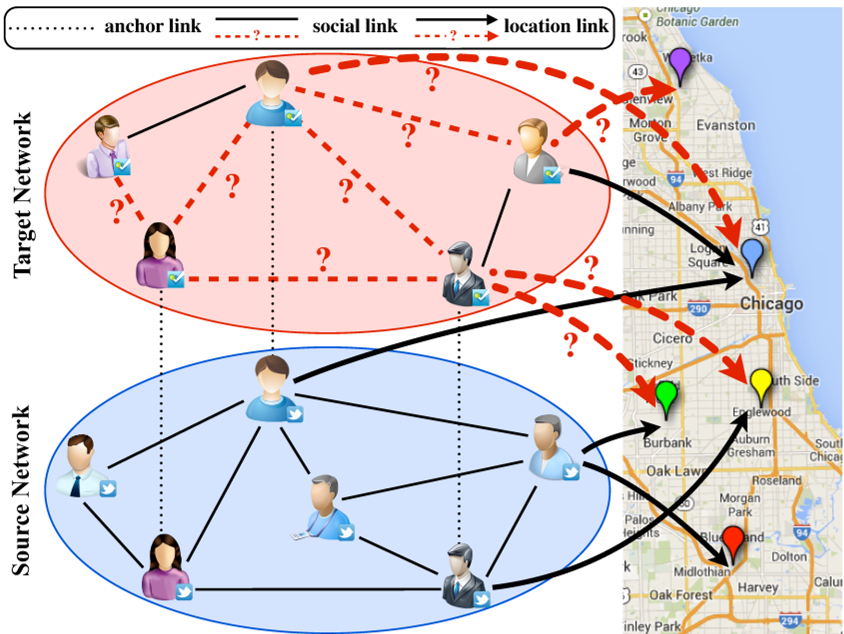 Figure 1: Collective link transferring across aligned networks.
Experiments & Results
The researchers tested TRAIL on partially aligned datasets of Foursquare and Twitter.
SOTA Comparisons
In scenarios where the target network was extremely sparse (only 10% to 50% information available), TRAIL consistently crushed baseline models:
- Social Link Prediction: Achieved an AUC of 0.81-0.85, whereas traditional unsupervised methods (CN, JC, AA) hovered around 0.50 (random guess levels) due to sparsity.
- Location Link Prediction: Reached an AUC of ~0.90 when the network was 50% densified.
Convergence Speed
A vital metric for production systems is efficiency. TRAIL's collective mechanism stabilizes quickly, usually reaching peak performance within 3 to 5 iterations.
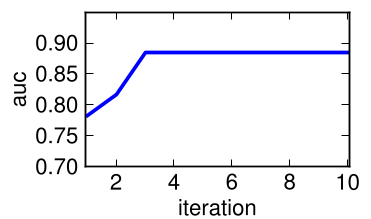 Figure 2: Convergence curves for Social and Location link prediction.
Critical Insight & Conclusion
The core value of TRAIL lies in its Inductive Bias: it assumes that human behavior is consistent across platforms. By formalizing the "Anchor Link" and "Pseudo Label," the authors provided a roadmap for how modern platforms can utilize "Data Grappling" to launch new services in crowded markets.
Limitations: The model relies on the availability of anchor links. In a privacy-first era where cross-platform tracking is restricted, identifying these anchors becomes the primary hurdle. Future work likely lies in "Privacy-Preserving Transfer Learning" where user alignment is done via encrypted or federated identifiers.
Takeaway: If you are building a new social product, don't look at your graph in a vacuum. Look at the graphs your users have already built elsewhere.