
transFORM: Reclaiming the Urban "Agora" Through Kinetic Cyber-Physical Robotics
transFORM - A Cyber-Physical Artefact Augmenting Social Interaction in Residual Public Spaces
The paper introduces transFORM, a large-scale cyber-physical architectural installation designed as a robotic origami. It aims to revitalize under-used "residual" public spaces by augmenting social interaction and place attachment through responsive physical transformation, color, and sound.
TL;DR
In an era where digital social networks have hollowed out the social utility of physical public squares, transFORM emerges as a "cyber-physical" remedy. Developed by researchers at Cornell, it is a room-scale, robotic origami installation that dynamically changes its shape to encourage strangers to interact, play, and reconnect with their physical surroundings.
Context: This work positions itself at the intersection of Human-Computer Interaction (HCI) and Responsive Architecture, moving beyond small devices to treat the city itself as an interface.
The Problem: The Death of the Physical "Agora"
Public spaces like plazas were traditionally the "Agora" (gathering place) of society. However, the paper argues that our current digital society has caused a "disconnection" from physical place. When people spend their transit time on smartphones, the physical square becomes a "residual space"—a place merely to pass through, not to inhabit.
The core challenge is: How can we reintegrate technology into the built environment to create "fresh urban relationships" rather than letting it distract us from them?
Methodology: From Origami to Social Engineering
The authors didn't just build a statue; they built a responsive environment. The project utilizes two distinct but integrated approaches:
1. Robotic Origami Engineering
The physical structure is based on Kirigami (a variation of origami involving cuts). Using MATLAB, the team performed intensive geometric and gravitational force analysis to ensure that this large-scale "pop-up" structure could maintain static equilibrium while changing shapes.
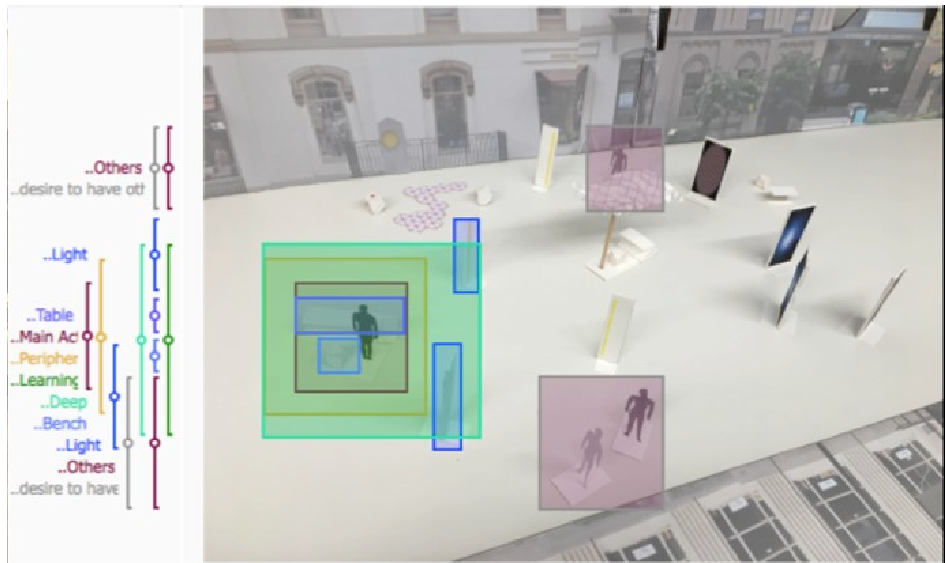 Figure: The team utilized MATLAB to calculate the reaction forces needed for the origami hinges to remain stable during transformation.
2. The Co-Design Process
To ensure the robot actually met human needs, the researchers conducted co-design sessions. They asked participants to design spaces for three conditions:
- Alone (Seeking privacy/info)
- With Friends (Socializing)
- With Strangers (The most difficult design challenge)
They mapped these needs into an Actor-Activity-Component matrix, determining exactly when the structure should deploy a bench, a canopy, or an interactive screen.
Key Insights: The Taxonomy of Interaction
One of the most valuable findings was the discovery of how strangers interact with large-scale tech. The paper identifies a behavioral funnel:
- Observing Others: Watching the installation and users from a distance.
- Exploring Surroundings: Approaching to learn the "affordances" (what can the robot do?).
- Socializing/Playing: The final stage where the artifact becomes a bridge for communication between strangers.
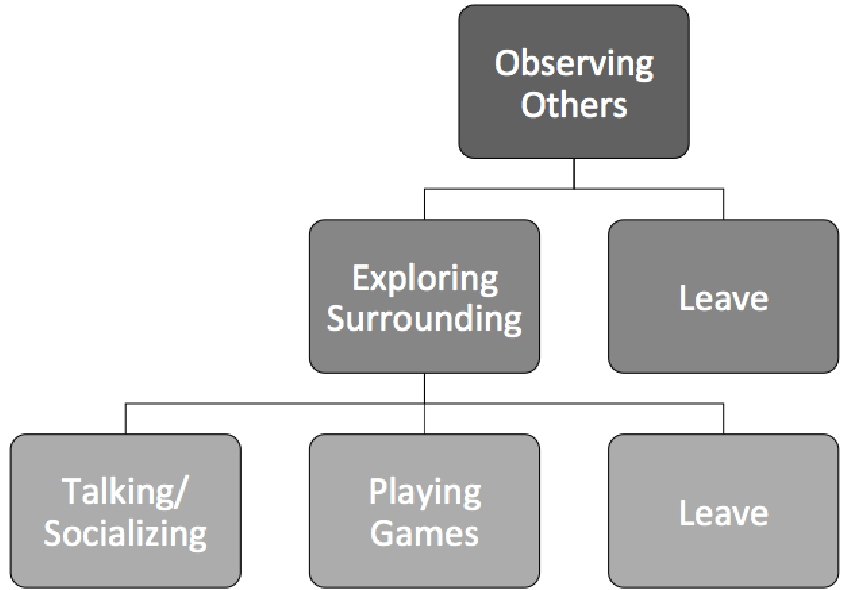 Figure: The proposed taxonomy showing the progression from passive observation to active social engagement.
Experiments and Expected Results
The paper outlines a quasi-experimental setup to measure Place Attachment. By observing a space before, during, and after the installation of transFORM, the authors hypothesize that the "Cyber-Physical" presence will create a measurable spike in how "attached" citizens feel to an otherwise boring public square.
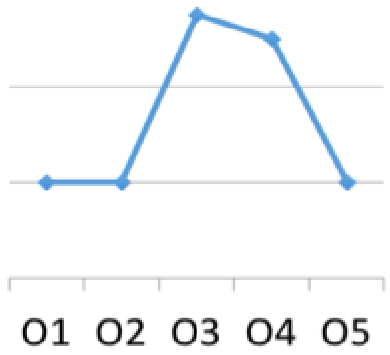 Figure: The experimental design predicts that place attachment will drop once the interactive artifact is removed, proving its role as a social catalyst.
Critical Analysis & Conclusion
The transFORM project is a bold step toward Ubiquitous Computing (Ubicomp) at an architectural scale.
- Strengths: Unlike many interactive art pieces, transFORM is grounded in "functional" social needs (like providing library information and physical shelter).
- Limitations: The paper is a work-in-progress (TEI '19), so the long-term durability of these robotic hinges in outdoor weather and the potential for "vandalism" remain valid concerns for such complex machinery.
- Future Impact: This research suggests that future smart cities shouldn't just be about "sensors" and "data," but about kinetic hardware that physically adapts to the people moving through them.
Takeaway
Technology shouldn't just be in our pockets; it should be the very walls and benches of our cities, moving and breathing to bring us back together.