
Beyond the Flat Screen: Transitioning to 3D Social Networking for Innovation
Transition to 3 D social networking
The paper proposes a 3D Virtual World (VW) framework as part of the Euro-SouthHub project to facilitate social innovation and communities of practice. It introduces a quadrant-based architectural model that bridges the gap between "flat" 2D social networks and real-life collaborative entrepreneurship.
TL;DR
This research explores the transition from "flat" 2D social networks to 3D Virtual Worlds (VWs) to drive social innovation. By proposing a four-quadrant model—comprising guidance, social interaction, co-creation, and gaming—the authors aim to create a "Virtual Hub" that replicates and augments the collaborative power of physical coworking spaces without geographic constraints.
Background & Positioning
While we often think of social networking as a series of profile pages and newsfeeds, this paper argues that the future of collective problem-solving lies in Immersive Environments. Positioned within the Euro-SouthHub project, this work sits at the intersection of Intelligent Environments and Alternate Reality Games (ARGs), moving beyond entertainment to leverage "game-like" mechanics for real-world social impact.
The Problem: The Limitations of "Flat" Socializing
Current 2D platforms are victims of their own architecture. The "stateless" nature of web pages prevents the development of true Social Capital in the same way that physical spaces or MMORPGs (like World of Warcraft) do.
The authors identify two main friction points:
- Lack of Embodiment: 2D interactions lack the non-verbal cues (gestures, proximity) that build trust.
- Risk Aversion: Real-world innovation is expensive and risky. Without a "safe" simulation space, many transformative ideas never leave the brainstorming phase.
Methodology: The Four-Quadrant Architecture
The core contribution of this paper is a structured design for a Virtual Hub, divided into four functional zones:
- Guided Tour: Uses "Host agents" to onboard users, bridging the familiarity gap between the 2D web and 3D space.
- Social Connections: A space for strengthening ties and curating public discussions into reusable knowledge structures.
- Co-Creation: A sandbox for rapid prototyping. Users can build 3D models of solutions (products, urban plans) at a fraction of the cost of physical prototyping.
- The Game: Leveraging ARG mechanics (like World Without Oil) to solve missions. This "Massively Multiplayer Science" approach turns social innovation into an engaging, iterative process.
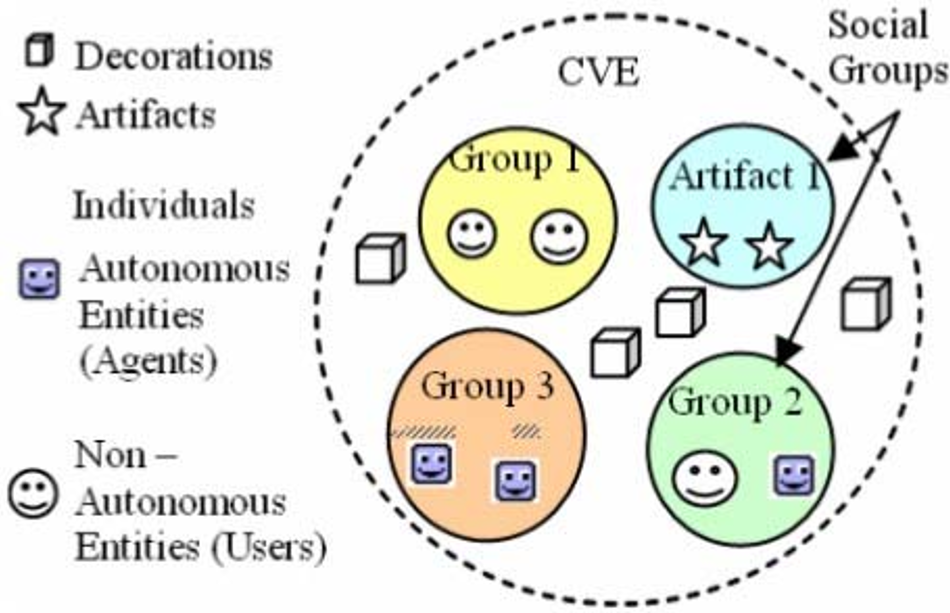 Fig 1: The conceptual model of a Collaborative Virtual Environment (CVE) highlighting the interaction between individuals and artifacts.
Why 3D Works: The Secret Sauce
The authors highlight Transformed Social Interaction. In a 3D space, an avatar can perform gestures, run, or collaborate on a shared 3D object. Data shows that:
- Groups in 3D VEs solve more problems than individuals.
- Virtual teamwork has a "priming effect," enhancing face-to-face collaboration that occurs immediately after the digital session.
- ARGs provide a feedback-rich environment through scores and rewards, making it clear who the most effective collaborators are.
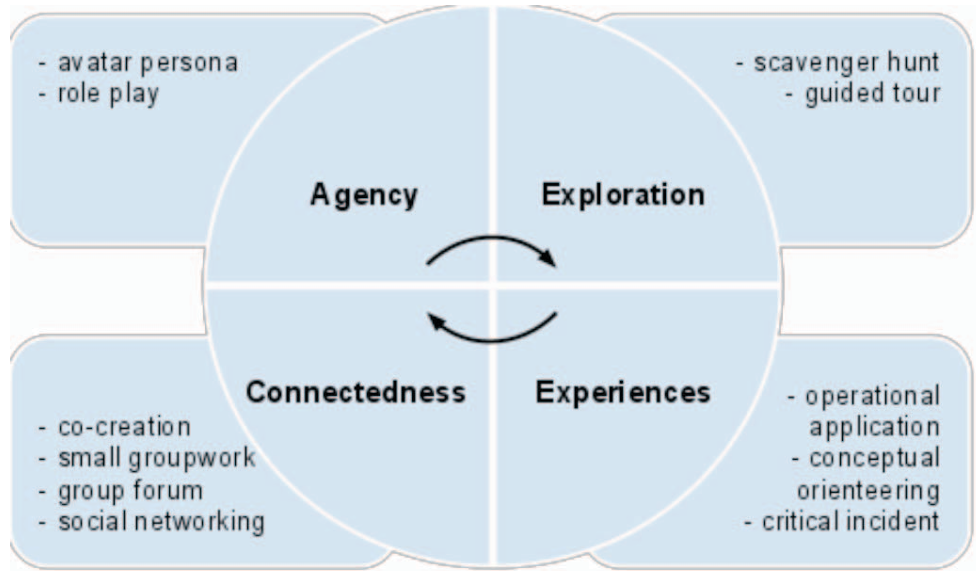 Fig 2: Mapping learning archetypes onto the four-quadrant 3D macrostructure (Adapted from Kapp & O'Driscoll).
Critical Insight & Future Outlook
The most striking takeaway is the concept of "Massively Collaborative Science." By treating a global crisis (like an oil shortage or social inequality) as a "quest," we can harvest the collective intelligence of thousands of participants.
Limitations: The authors acknowledge that current 3D technology still struggles to capture the full nuances of human body language and that "Knowledge Management"—actually filtering the vast amount of data generated in these worlds—remains a major technical hurdle.
Conclusion
As we move further into the decade, the boundary between "playing" and "working" continues to blur. This paper provides a roadmap for using 3D affordances not just for escapism, but as a high-fidelity engine for Social Innovation.