
The Topology of Friendship: Decomposing Social Cohesion with the Transitivity Matrix
Transitivity matrix of social network graphs
This paper introduces the "Transitivity Matrix," a novel microscopic graph metric that measures the individual contribution of each link to a network's global transitivity index. By extending transitivity to weighted graphs and applying differential analysis, the authors provide a mathematical framework to distinguish between cohesive redundant ties and strategic bridging links.
TL;DR
Transitivity—the idea that "a friend of a friend is my friend"—is a cornerstone of social network analysis. However, while we’ve long had a single number to describe a whole network's transitivity, we lacked a way to score individual links. This paper introduces the Transitivity Matrix, a mathematical tool that breaks down a graph's global transitivity into microscopic link scores, distinguishing between the "glue" that holds communities together and the "bridges" that connect them.
Problem & Motivation: Beyond Global Averages
In social science, not all friendships are created equal. According to Granovetter's "Strength of Weak Ties" theory, strong ties are often redundant (forming triangles/cliques), while weak ties act as essential bridges between different social circles.
The problem with the classic Transitivity Index is that it's a global average. It tells you if a network is "cliquey," but it doesn't tell you which specific links are responsible for that cliquiness. Most existing tools are node-centric (identifying influential leaders). The authors argue for a link-centric view: if we want to understand social capital, we must measure the redundancy and strategic positioning of the ties themselves.
Methodology: The Calculus of Connections
To move from a single number to a matrix, the authors first redefine transitivity for weighted graphs. They propose a continuous, differentiable function :
By treating transitivity as a differentiable manifold, they can calculate the Gradient (). This allows them to see how much the global transitivity would change if a specific link's weight were slightly modified.
The Transitivity Matrix (T)
The core innovation is the Transitivity Matrix . Each entry tells us the "transitivity score" of the link between node and .
- Positive Score: The link facilitates triangles (redundancy).
- Negative Score: The link actually decreases the overall transitivity (typically a bridge).
 Fig 1: The intuition—triangles (right) increase transitivity, while star-structures (left) decrease it.
Experiments & Results: Finding the Backbone
The authors tested their matrix on well-known datasets like the US College Football network and Zachary’s Karate Club.
1. Identifying Strong vs. Weak Ties
By filtering for only links with positive transitivity scores, the authors could strip away the "bridges" and reveal the highly cohesive core communities. In the football network, this revealed clear, disjoint clusters of teams that play together frequently.
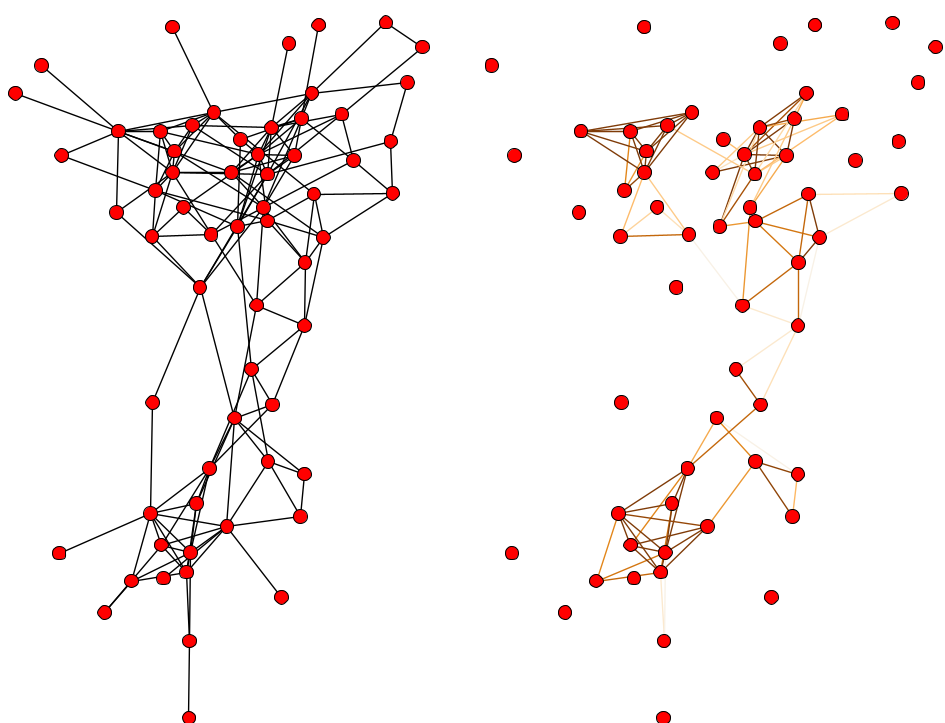 Fig 2: Removing weak ties (negative transitivity) reveals the high-density local clusters in the Dolphin network.
2. Transitivity vs. Clustering Coefficient
A key contribution is showing that the Link Transitivity Score is fundamentally different from the Local Clustering Coefficient. A node might have a high clustering coefficient (its neighbors know each other), but the links connected to it might still have negative transitivity scores if they connect the node to a sprawling, non-triangular part of the graph.
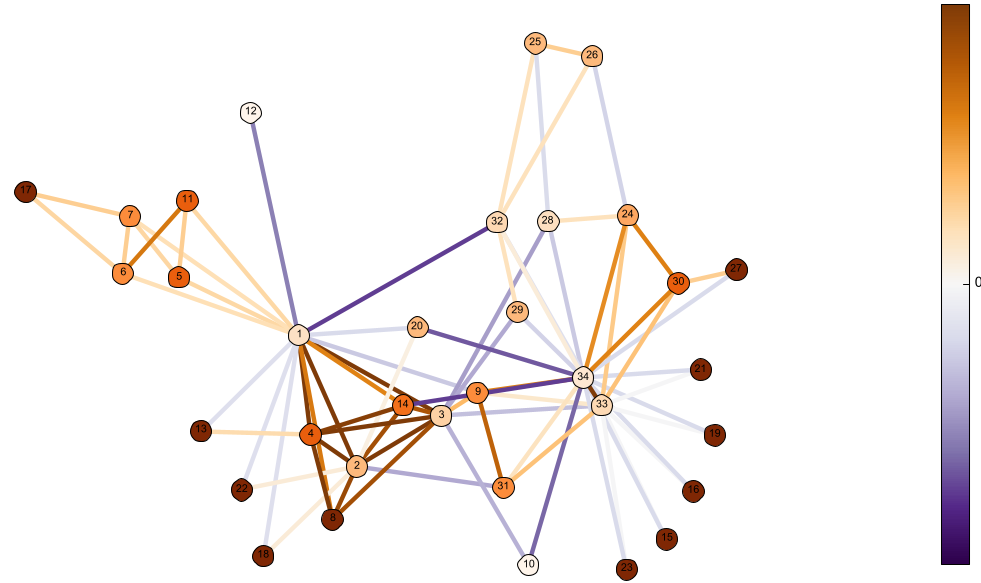 Fig 3: In Zachary’s Karate Club, edge colors (link transitivity) reveal bridge structures that node-based metrics miss.
Deep Insight & Conclusion
This work represents a major shift from descriptive statistics to structural diagnostics. By proving that the sum of the Transitivity Matrix entries equals the global index (), the authors provide a mathematically rigorous way to "blame" or "credit" specific edges for a network's overall topology.
Takeaway: If you are trying to find "bridges" in a network (for information spread) or "redundant links" (for community stability), don't just look at nodes. The Transitivity Matrix allows you to perform surgical analysis on the links themselves, providing a clearer map of how social capital is structured.
Limitations: The current formulation focuses on symmetric (undirected) graphs. Extending this to directed graphs (where does not imply ) would be the next logical frontier for this matrix algebra approach.