
Elevating Mobile QoE: Predicting Upload Times with Support Vector Regression
Transmission Time Estimator for Social and Cloud Applications in Smartphones
This paper introduces a Transmission Time Estimator for mobile devices, utilizing Support Vector Regression (SVR) to predict file upload durations. By integrating multi-dimensional contexts like network, channel, and system status, it achieves up to 85% estimation accuracy in LTE environments.
TL;DR
Mobile users frequently face the "upload frustration"—staring at a progress bar that barely moves, draining the battery in the process. This paper from Samsung Research India presents a machine-learning-based Transmission Time Estimator for Android. By analyzing network congestion, signal strength, and system load, the system predicts upload times with 85% accuracy, enabling smarter scheduling that can save up to 40% in battery life.
The Motivation: Why is Upload Estimation So Hard?
While download optimization has been widely researched (e.g., BitTorrent sharing ratios or range-requests), uploads remain a fragmented challenge. In the Android ecosystem, every app (WhatsApp, Instagram, Dropbox) manages its own HTTPS connection.
The difficulty stems from two factors:
- Unreliable Context: Cellular networks (3G/LTE) are volatile. RSSI (Signal Strength) alone doesn't tell the whole story; network congestion (RTT) and device bottlenecks (CPU/Battery throttle) play huge roles.
- Resource Constraints: Smartphones cannot afford heavy "active probing" (sending dummy data to test speed) as it wastes the very bandwidth and battery it seeks to preserve.
Methodology: The SVR Framework
The authors chose Support Vector Regression (SVR) with a Radial Basis Function (RBF) kernel. SVR is particularly adept at handling non-linear relationships—for instance, the way throughput drops exponentially as RTT increases or how low battery triggers CPU throttling, indirectly slowing down data processing.
1. Feature Engineering (The 6 Pillars)
The model looks at six critical parameters:
- Bandwidth: Estimated using queuing delay theory (calculating the probability of an empty queue based on RTT) smoothed by a Kalman Filter.
- RTT (Round Trip Time): Derived via HTTP head requests (HTTP Ping) to avoid requiring "Root" access.
- RSSI: A raw indicator of the physical channel quality.
- CPU Load & Battery: System-level constraints that impact the device's ability to sustain high-speed data transfers.
- File Size: The primary determinant of duration.
2. Architecture on Android
The system is integrated into the Android framework, specifically hooking into DocListActivity. When a user selects a file to share, the FeatureCollection module gathers metadata, passes it to the Transmission Estimator, and displays the Time to Upload (TTU) directly in the UI.
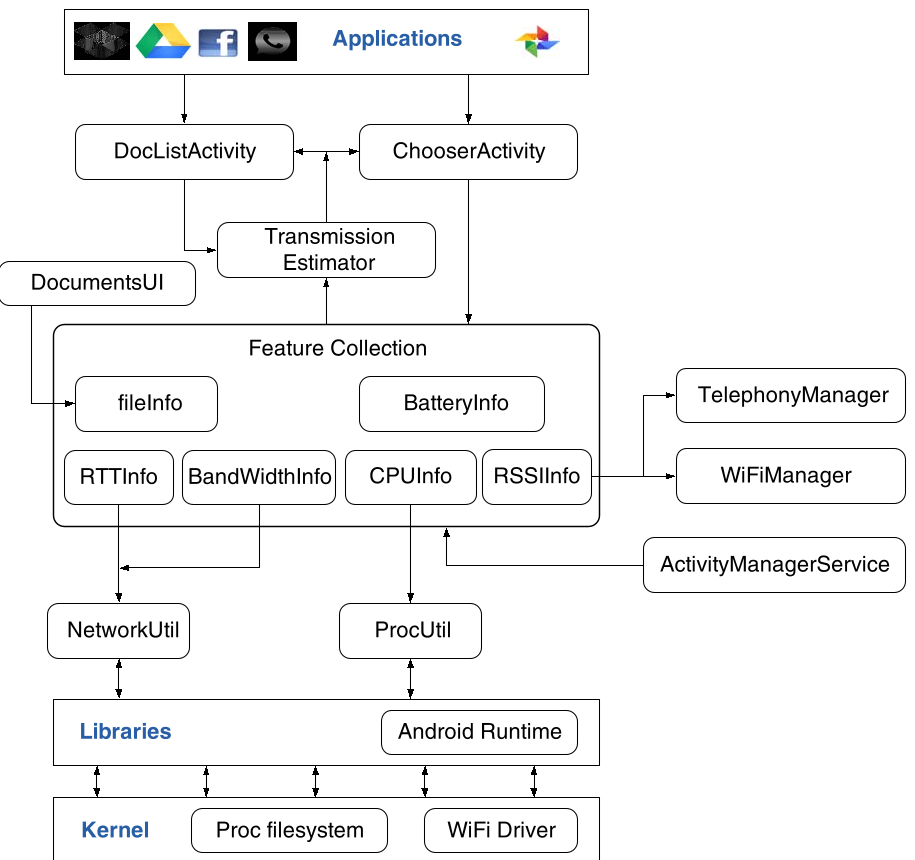 Figure 1: The proposed Android architecture for seamless feature collection and estimation.
Experimental Results & Visualizing Impact
The researchers tested the model on Samsung J7 and Nexus 5 devices across 3G and LTE networks.
Accuracy and Confidence
The model demonstrated high robustness, with 85% of predictions falling within a 20% error margin for LTE.
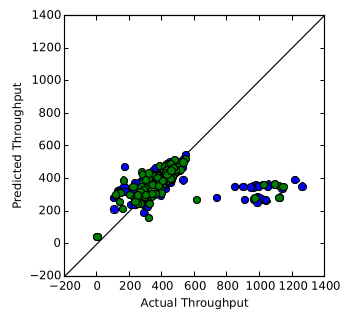 Figure 2: Regression analysis showing the correlation of predicted vs. actual throughput in LTE.
The "Green" Benefit: Power Saving
Beyond user convenience, the real-world value is energy efficiency. By using a Monsoon Power Monitor, the team proved that rescheduling an upload from a bad signal zone (like a crowded cafeteria) to a good signal zone (home/office) based on the estimator's feedback saves 40% of the energy consumed.
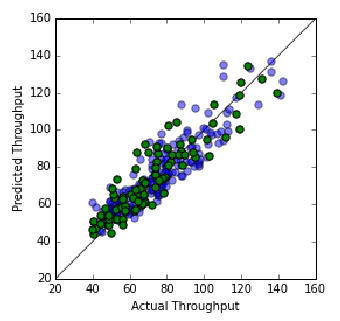 Figure 3: Implementation on a Samsung J7—users see the TTU (Time to Upload) before committing to a share.
Critical Insight: Beyond the Math
The genius of this work isn't just in the SVR implementation, but in the Feature Smoothing. Raw network data is "noisy." The paper’s use of Windowing and Kalman Filtering to stabilize bandwidth estimates (Equations 5-8) ensures that the UI doesn't show jumpy, unreliable numbers to the user.
However, a notable limitation is the reliance on Batch Training. In a real-world deployment, network conditions and server behaviors change. For this to truly scale, Online Learning (where the model updates itself after every completed upload) would be the next logical step.
Conclusion
The Transmission Time Estimator transforms the "Upload" button from a leap of faith into a calculated decision. By bridging the gap between network physics and machine learning, it offers a practical path toward "Context-Aware" smartphones that value both the user's time and the device's battery.