
Transport Complexity: Measuring the Hidden Burden of Social Data Dissemination
Transport complexity of data dissemination in large-scale online social networks
This paper introduces "Transport Complexity" as a novel metric to quantify the fundamental transport difficulty of data dissemination in large-scale Online Social Networks (OSNs). Focusing on the "Social-InterestCast" session type, the study derives scaling laws and theoretical lower bounds for transport load in networks with optimal communication architectures.
TL;DR
As Online Social Networks (OSNs) grow, the strain on underlying communication infrastructures becomes immense. This paper shifts the focus from network capacity to the intrinsic difficulty of the application itself. By introducing Transport Complexity, the authors derive the fundamental scaling laws of data dissemination in OSNs, proving that the load and distance of data travel are dictated by the interplay of social ties and user interests.
Problem & Motivation: Beyond Network Capacity
In the world of network science, we usually ask: "How much data can this pipe hold?" (Capacity). However, the authors argue we should be asking: "How hard is it to push this specific type of social data through any pipe?" (Complexity).
Previous works often treated social dissemination as a simple broadcast. In reality, OSN traffic is interest-driven. A user posts content, and only a fraction of their followers—those interested—actually download it. This study targets the Social-InterestCast model, where geographical distribution and social "clustering" fundamentally change the energy and resources required for transport.
Methodology: The Math of Social Interest
The paper defines transport load as the product of requested data rate and transport distance. To find the Complexity, they seek the minimum load required under an optimal architecture.
1. The Core Variables
The complexity is determined by three critical clustering exponents:
- (Relationship Degree): How the number of friends is distributed.
- (Relationship Formation): How physical distance limits who we follow.
- (Dissemination Pattern): The probability distribution of how many followers are interested in a specific post.
2. Architectural Modeling
The researchers use a Euclidean Minimum Spanning Tree (EMST) to model the most efficient way to link a source to its interested destinations. By analyzing the growth of these trees as the number of users () approaches infinity, they derive the scaling behavior of the network load.
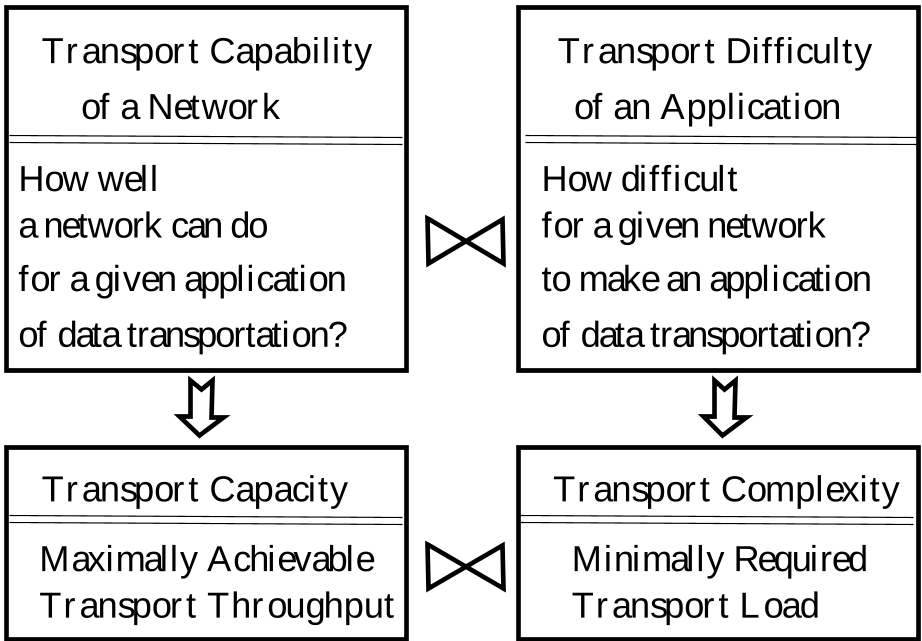 Figure 1: Illustration of Transport Complexity vs. Transport Capacity. Complexity is an inherent property of the application logic.
Experiments & Scaling Results
The authors categorize the complexity into various "regimes" based on how fast the network size grows. The results are summarized in a complex transition table showing the order of growth.
Key Findings:
- Linear Scaling : Occurs when followers are tightly clustered geographically () and interests are highly concentrated ().
- Quadratic Scaling : Occurs in "difficult" networks where users are spread out and interests are broad/uniform.
- The "Interest" Impact: A larger significantly reduces transport load because it limits the likelihood of "viral" messages that require massive, long-distance dissemination.
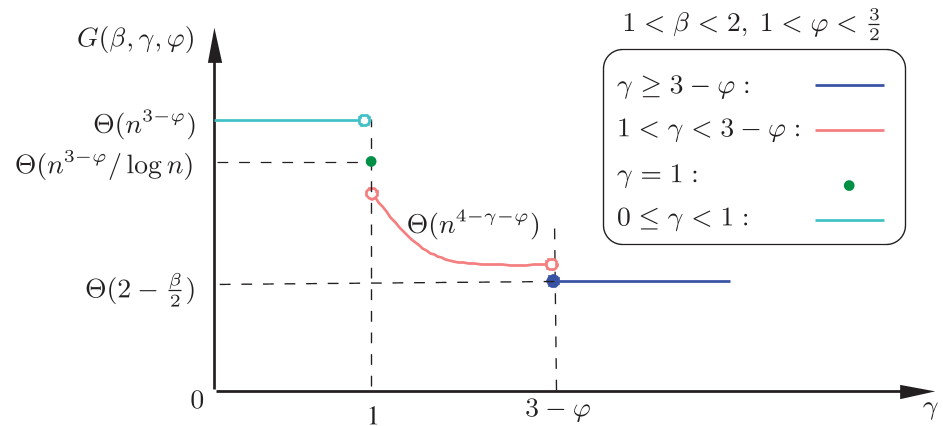 Figure 2: Visualization of the derived lower bounds for specific clustering exponents, showing the non-increasing nature of complexity as exponents rise.
Critical Insight & Conclusion
This work is a theoretical milestone because it provides a lower bound that any carrier network (like the 5G/6G mobile internet) must satisfy to host an OSN.
Takeaway for Architects: If you are building a decentralized social protocol or a new CDN, your efficiency isn't just about bandwidth—it's about how well your node placement mirrors the , , and exponents of your user base.
Limitations: The model assumes a homogeneous Poisson process for user distribution, which ignores the "city-and-wilderness" reality of human geography. Future extensions using Clustering Random Models (CRM) would bring these theoretical bounds even closer to real-world deployment data.