
TSR: Decoding Urban Mobility via Social Media Trajectories
Travel routes recommendations via online social networks
This paper introduces a travel route recommendation system that leverages geo-tagged social media data (specifically tweets) to model human mobility. By formulating recommendation as a ranking problem, the approach combines user similarity in visiting habits with sequential mobility patterns to suggest optimized travel paths.
TL;DR
With the surge of Location-Based Social Networks (LBSNs), our digital footprints—in the form of geo-tagged tweets—reveal the hidden rhythms of the city. This paper presents a novel ranking-based framework that doesn't just recommend where to go, but suggests entire travel routes. By analyzing how similar users move sequentially through London, the system achieves impressive precision and recall by prioritizing the "path" over the "point."
Background: Published in ASONAM '19, this work sits at the intersection of Social Network Analysis and Intelligent Transportation Systems (ITS). It transitions from static Point-of-Interest (POI) recommendation to dynamic path synthesis.
Problem & Motivation: Beyond the Check-in
Existing recommender systems often suffer from "spatial myopia." They look at individual check-ins as isolated events. However, human mobility is fundamentally sequential: if you visit the Trevi Fountain, you are mathematically more likely to head toward the Pantheon next.
The author identifies three major gaps in prior art:
- Lack of Sequential Context: Traditional Collaborative Filtering (CF) ignores the order of visits.
- Oversimplified Similarity: Using simple city-distance (Haversine) doesn't account for user preferences.
- Social Neglect: Many systems fail to weigh the influence of social circles (friends) on movement patterns.
Methodology: The Core Architecture
The proposed method centers on the Travel Route Similarity (TSR) strategy. Instead of a User-Location matrix, it constructs a User-Route vector space.
1. Route Representation
A user 's travel history is represented as a vector where each element is the normalized frequency of a specific route .
2. Ranking Function
The interest of a target user in a new route is predicted by calculating the similarity between and other users who have traveled . The higher the similarity between their overall mobility profiles, the higher the weight given to the candidate route.

3. Social Integration (TSRF)
The model further refines this by filtering similarity through the lens of a social graph, assuming that users are more likely to be influenced by the mobility patterns of their friends ().
Experimental Results
The study utilized a massive dataset of 7.4 million tweets from London. The evaluation compared the proposed TSR/TSRF against three baselines:
- B1: Visit-history similarity (no sequence).
- B2: Route-based popularity.
- B3: Pure spatial distance (Haversine).
Precision vs. Recall
The results provide a clear validation of the "sequential hypothesis":
- Precision: TSR and TSRF maintain significantly higher precision than spatial-only models (B3), which performed the worst. This proves that "proximity" is a poor proxy for "interest."
- Recall: Both TSR variants show a steep upward curve, effectively capturing nearly all ground-truth movements as the list size grows.
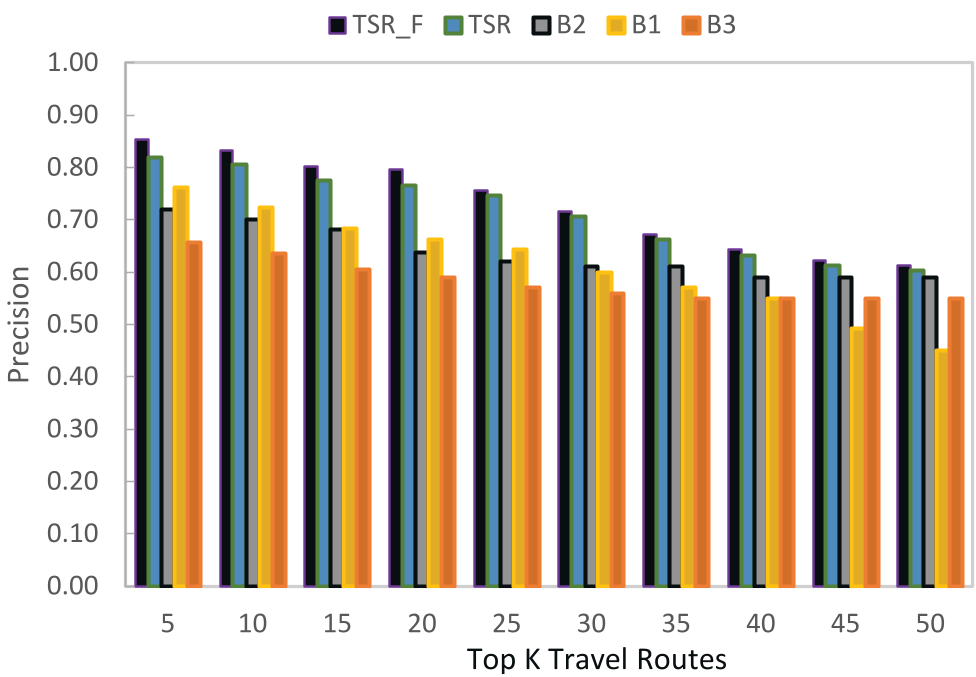 Figure 1: Comparison of Precision across different list sizes. TSR and TSRF (Top lines) show superior stability.
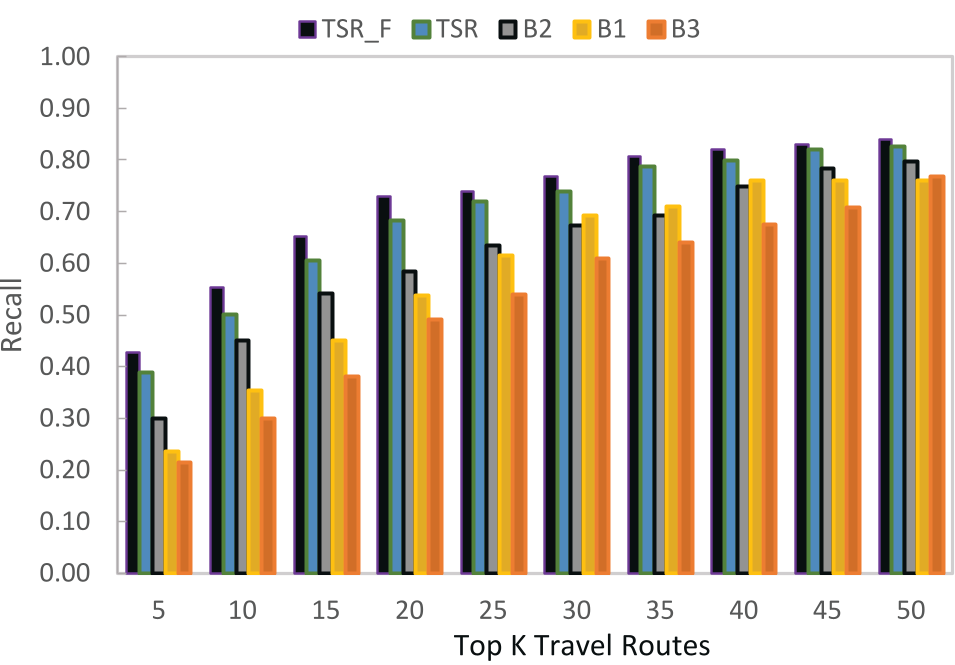 Figure 2: Recall performance demonstrating the effectiveness of trajectory-based matching.
Critical Insight & Conclusion
The true value of this work lies in its Inductive Bias: it assumes that human movement is patterned and socially correlated.
Takeaway for Practitioners:
- For App Developers: Improving travel apps requires moving from "nearby attractions" to "predicted itineraries."
- For Urban Planners: Social media trajectories provide a low-cost, high-resolution alternative to traditional surveys for understanding urban flow.
Limitations: The reliance on Twitter Streaming API might introduce demographic bias (skewing towards younger users). Future work could integrate external factors like weather or transport mode (tube vs. bus) to further refine the transitions between locations.