
DiSE-growth: Efficiently Mining Influential Entities Across Diverse Social Domains
A Tree-based Algorithm for Mining Diverse Social Entities
This paper introduces DiSE-growth, a tree-based pattern-growth algorithm designed to mine DIverse Social Entities from complex social networks. By utilizing a specialized "DiSE-tree" structure, the method identifies groups of influential users who exhibit consistent significance across multiple social domains.
TL;DR
Social networks are not monolithic; a user might be a "guru" in Computer Science but a "novice" in Arts. This paper introduces DiSE-growth, a sophisticated tree-based algorithm that uncovers groups of social entities who maintain high influence and prominence across various domains. By solving the mathematical challenge of non-monotonicity in "diversity" metrics, the authors provide a scalable way to find multi-talented influencers in massive datasets.
Problem & Motivation: Beyond Simple Popularity
In the era of Linked Data, identifying "important" users is common. However, existing methods usually look at:
- Frequency: How often do they interact?
- Single-domain prominence: Are they experts in one specific field?
The real value lies in Diversity. A user who is influential across Sports, Technology, and Finance offers more strategic value for viral marketing or knowledge sharing than a specialist.
The Technical Hurdle: In data mining, we rely on the Downward Closure Property (if a set is rare, all its supersets are rare). Diversity violates this. A single person might not meet the diversity threshold, but when combined with a specific friend group, the group's collective diversity might cross the bar. This "non-monotonic" behavior usually necessitates a brute-force search—which is impossible for millions of users.
Methodology: The DiSE-tree and Pruning Upper Bounds
The authors solve the search space problem by introducing Mathematical Upper Bounds.
1. The Metric System
The algorithm considers three pillars:
- Prominence: Weighted expertise in a domain.
- Influence: The product of Prominence and Frequency.
- Diversity: The average influence across all d-domains.
2. The DiSE-tree Structure
Instead of standard FP-trees that store one counter, the DiSE-tree stores an array of counters (one for each domain) at every node. This preserves the multi-dimensional context of social links.

3. Overcoming Non-Monotonicity
To prune the tree effectively, the authors use Global Maximum Prominence (GMProm). By assuming a user could have the maximum possible prominence in a domain, they create a "Diversity Upper Bound" (). If even this upper bound doesn't reach the threshold, the user and all their possible group combinations are safely pruned.
Experiments & Results
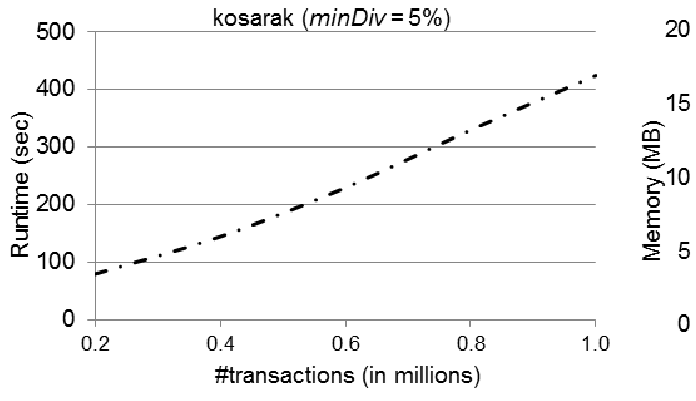
The researchers tested DiSE-growth against weighted association rule mining on both synthetic IBM datasets and real-world datasets like mushroom and kosarak.
- Efficiency: DiSE-growth consistently beat Apriori-based methods because the tree-based approach avoids the "candidate generation" bottleneck.
- Scalability: The runtime scales linearly with the number of transactions, making it suitable for "Big Data" social analysis.
- Memory: Despite storing multiple counters per node, prefix sharing keeps the DiSE-tree footprint remarkably small.
Critical Analysis & Conclusion
Takeaway
DiSE-growth is a powerful bridge between Weighted Pattern Mining and Social Network Analysis. Its ability to handle non-monotonic constraints using "Tightened Upper Bounds" (Lemma 2) is a masterclass in optimization for irregular metrics.
Limitations
The current approach relies on a pre-defined set of domains. In dynamic social media (like Twitter/X), domains shift rapidly. Future iterations would benefit from automated domain discovery via Topic Modeling (like LDA) before building the DiSE-tree.
Future Outlook
As social platforms become more "multi-hyphenate" (where users are simultaneously creators, sellers, and experts), algorithms like DiSE-growth will be essential for identifying the "connective tissue" of the social web—the truly diverse entities.