
The Tree of Knowledge: Visualizing the Pulse of Localized Intellectual Life
The Tree of Knowledge: a localized collective intelligence tool
The paper introduces "The Tree of Knowledge," a localized collective intelligence tool designed to foster informal interaction and knowledge sharing within a physical building. It utilizes a biological metaphor—a growing digital tree—to visualize ongoing academic discourse and expertise awareness in real-time.
TL;DR
The "Tree of Knowledge" is a CSCW project that transforms abstract academic discourse into a living digital ecosystem. By visualizing building-wide knowledge sharing as a growing tree, the system aims to bridge the gap between digital interaction and physical, face-to-face collaboration through "Expertise Awareness."
Why Physical Locality Matters in a Digital World
While we have mastered global collaboration through tools like Slack or GitHub, we often remain strangers to the person in the office next door. The authors identify a "search-transfer problem": even in research-heavy buildings, people struggle to find local experts or understand the "on-going activities" of their neighbors.
Existing tools are either too formal (official partnerships) or too global (Twitter). There is a missing middle: a localized, informal, and semi-open tool that makes the invisible intellectual labor of a community visible to those standing within its walls.
Methodology: Biomimicry as an Interface
The core innovation is the use of a tree metaphor to represent complex data structures.
1. Growth through Interaction
The tree is not static. Its vitality is a direct function of human input:
- Leaves: Individual postings (questions, comments, or notes).
- Branches: Categorical tags that group related knowledge.
- Aesthetics: A flourishing tree with many leaves signals a vibrant research environment, while a "harsh environment" (snow or falling leaves) indicates a lack of recent interaction.
2. The Interaction Loop
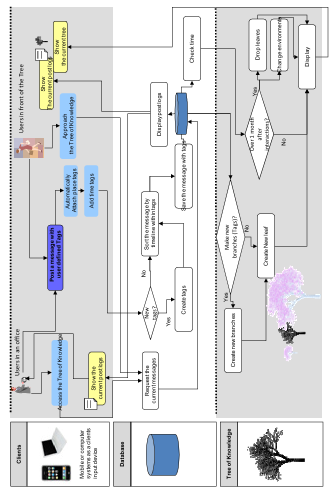
Users interact via a web interface or mobile devices. When a user posts a message, it appears as a new leaf in real-time. The system automatically attaches location and time tags, allowing users to navigate "threads" of conversation physically and digitally.
Designing for Motivation and Openness
The authors emphasize three pillars for successful localized collective intelligence:
- Informality: Unlike formal papers, the tree captures "serendipitous interactions"—the raw ideas often lost in hallways.
- Semi-Openness: Unlike public social media, this is "localized openness." It is built for a specific community, increasing the level of trust and responsiveness.
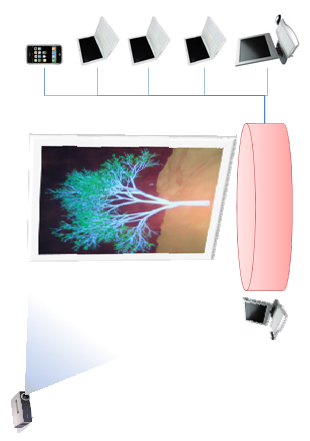
- Visual Curiosity: The tree rotates and changes state (windy, rainy) based on activity levels, serving as an ambient display that "nudges" passersby to contribute.
Evaluation and Impact
The study suggests that by providing a "sense of contribution," people are more likely to participate. The scenario of "Suzy," a student who discovers a computer graphics expert in her own building via a tree leaf, illustrates the goal of the project: turning a digital post into a physical handshake.
Key Performance Indicators:
- Awareness: High visibility of "who knows what" via tag-based leaf clusters.
- Mobility: Integration between localized kiosks and mobile services ensures the "Tree" is always accessible.
Critical Analysis & Future Outlook
While a 2011 project, the Tree of Knowledge anticipates the current trend of "Digital Twins" and "Phygital" (Physical + Digital) spaces.
Limitations:
- Scalability: In a building with thousands of daily interactions, a single tree might become visually cluttered ("information silos" of leaves).
- Long-term Retention: How does the tree handle "old" knowledge? The authors mention falling leaves, but an archival mechanism is needed to ensure valuable insights aren't lost to "autumn."
Future Prospect: Imagine this system integrated with Large Language Models (LLMs) today—where the "Tree" could summarize local expertise or suggest collaborators automatically based on the "growth" of specific branches.
Summary
The Tree of Knowledge remains a poetic yet practical reminder that the most valuable collective intelligence is often the one that helps us talk to the person standing right next to us.