
TREK: Breaking the Reasoning Stall via Exploration Support Expansion
TREK: Distill to Explore, Reinforce to Refine
TREK (Teacher-Routed Exploration via Forward KL) is a staged post-training framework designed to enhance mathematical and agentic reasoning in LLMs. It identifies "hard" prompts where the student model fails, uses a proposal source (external teacher or self-context) to find verified solutions, and expands the student's exploration support via a targeted forward-KL divergence phase before returning to standard Group Relative Policy Optimization (GRPO).
TL;DR
Reinforcement Learning (RL) for Large Language Models often hits a wall when the model can't "stumble" upon the right answer to a hard problem. TREK (Teacher-Routed Exploration via Forward KL) solves this by using a teacher model as a "scout" rather than a "master." It identifies where the student is lost, uses the teacher to find a path, pulls that path into the student's reach via Forward-KL, and then lets the student take over the learning via GRPO.
The "Stall" Problem in Modern RLVR
Modern reasoning models are often fine-tuned using Group Relative Policy Optimization (GRPO). While GRPO is efficient, it has a fatal flaw: it is strictly on-policy. If your model has a 0% chance of sampling the correct solution to a complex AIME math problem, GRPO has nothing to reinforce. You can increase the group size or the training steps, but you are effectively "searching for a needle in a haystack where the needle doesn't exist."
Methodology: Distill to Explore, Reinforce to Refine
TREK introduces a staged procedure that treats distillation as an exploration support expansion tool.
1. Hard Prompt Routing
The system first samples a batch of prompts. If the student’s unaided pass rate () is below a threshold (e.g., ), the prompt is flagged as "hard."
2. Proposal Generation & Reachability Selection
For these hard prompts, TREK queries a Proposal Source. This could be:
- Black-Box Teacher: A stronger model like DeepSeek-V4.
- Self-Context: The student model itself, but given "failure lessons" or extra reasoning time.
Crucially, it only keeps the top-r verified proposals that are "closest" (lowest NLL) to the student's current policy. This ensures the student isn't trying to imitate something completely alien to its architecture.
3. Forward-KL Consolidation
Instead of standard RL, TREK uses a short Forward-KL (Negative Log-Likelihood) phase.
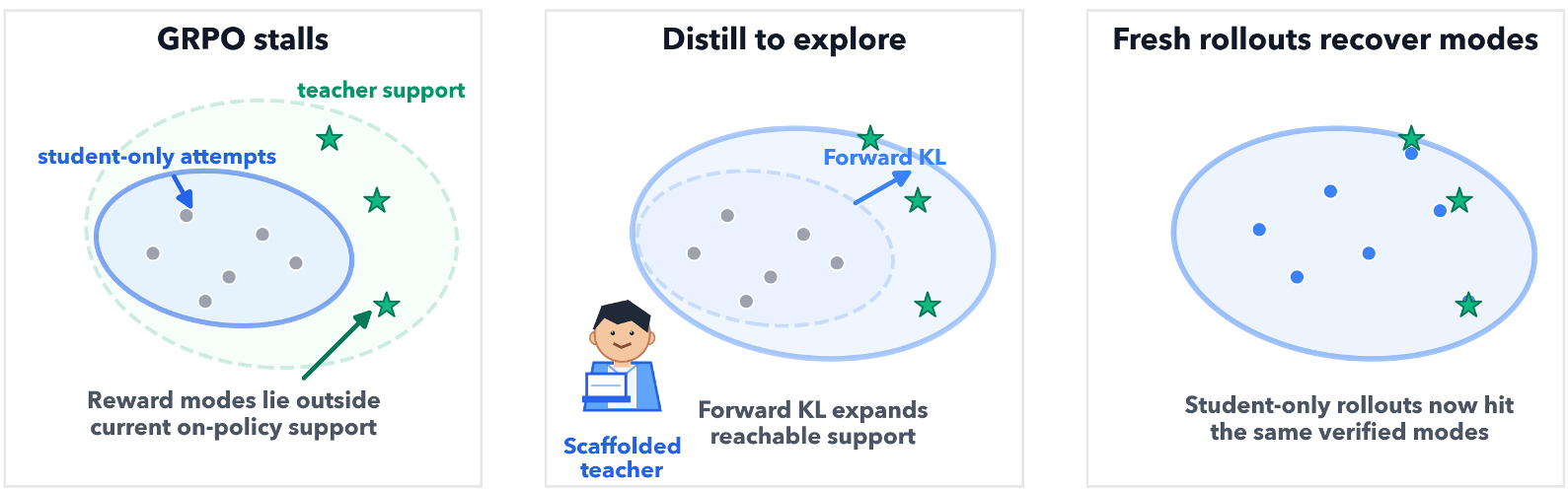 Figure 1: TREK architecture. Note how the proposal source expands the support, allowing the student to finally "reach" the verified reward modes.
Experimental Battlecard
The authors tested TREK across the Qwen3 family on high-difficulty math (AIME) and agentic benchmarks (ALFWorld, ScienceWorld).
- Mathematical Reasoning: TREK consistently outperformed direct GRPO across all scales. Notably, the "Self-Context" version—using the model's own failure lessons—offered significant boosts even without a larger teacher.
- Agentic Efficiency: In ScienceWorld, TREK more than doubled the baseline success rate. More impressively, Figure 3 shows that TREK allows models to reach peak performance 5x faster than standard GRPO.
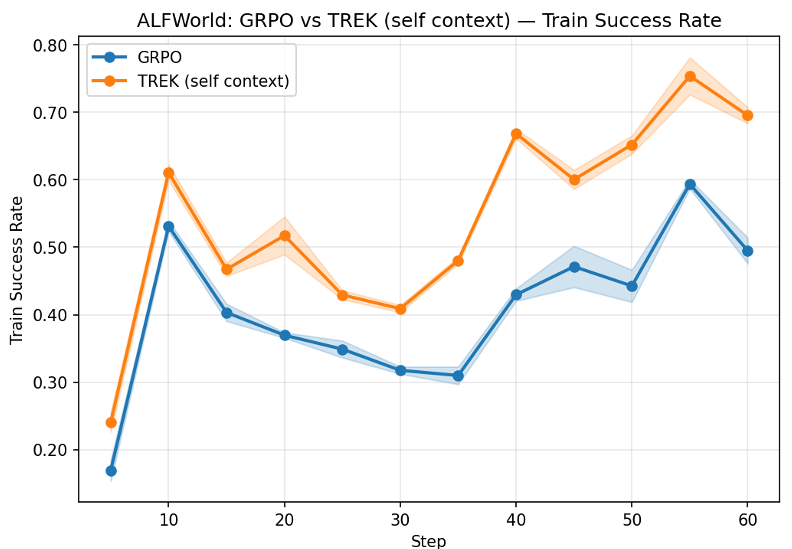 Figure 2: Training success rates. TREK (Self-Context) achieves early-stage acceleration, proving that "pre-loading" correct modes is more efficient than random exploration.
Deep Insight: Why Forward KL?
The paper highlights a critical distinction: Forward KL vs. On-Policy Distillation (OPD). OPD-style methods focus on shaping credit for tokens the student already produces. TREK's Forward-KL explicitly penalizes the student for not having the teacher's correct mode in its distribution. Mathematically, it "pushes" the student's probability mass toward the verified success, making it "sampleable" for the subsequent RL phase.
Critical Analysis & Conclusion
TREK represents a shift from "teaching by imitation" to "teaching by expanding boundaries."
Limitations:
- The method relies on a reliable Verifier. In domains where ground truth is hard to check (like creative writing), the proposal ranking may fail.
- The Trimmed NLL metric for reachability is a proxy and might still favor more "verbose" or "surface-level" similar outputs rather than logically reachable ones.
Future Outlook: TREK provides a blueprint for Continual Skill Acquisition. When a model encounters a totally new task, it doesn't need to start RL from zero; it can use a context-augmented "proposal" phase to seed its own exploration, effectively "learning how to learn" the new domain.