
[ICLR 2025] TriAttention: Breaking the KV Cache Bottleneck via Trigonometric Wisdom
TriAttention: Efficient Long Reasoning with Trigonometric KV Compression
TriAttention is a novel KV cache compression method for LLMs that leverages a "pre-RoPE concentration" phenomenon to estimate token importance. By using trigonometric series and Q/K centers, it achieves up to 10.7x KV memory reduction and 2.5x throughput speedup while matching Full Attention accuracy on complex reasoning tasks like AIME25.
In the era of "Long Reasoning" (think DeepSeek-R1 or O1), Large Language Models (LLMs) are generating massive Chains of Thought (CoT). This creates a nightmare for deployment: the KV Cache grows linearly with sequence length, quickly consuming all available GPU memory. While many have tried to "prune" this cache, most methods break the model's "brain" during complex tasks. Enter TriAttention, a method that uses the hidden geometric stability of Transformers to achieve 10x compression without losing a single IQ point.
TL;DR
- The Discovery: Q and K vectors are weirdly stable before they get rotated by RoPE.
- The Method: Use "Trigonometric Series" to predict which tokens are important based on their distance to future queries.
- The Result: 10.7x KV memory reduction on AIME reasoning benchmarks; 2.5x throughput boost; zero-drop accuracy.
The "Post-RoPE" Instability Trap
Most current KV compression tools (like H2O or SnapKV) look at post-RoPE attention scores. They ask: "Which tokens did the last few queries look at?" and keep those.
The problem? RoPE (Rotary Position Embedding). RoPE rotates vectors in space based on their position. This means a query at position 100 sees the world through a completely different window than a query at position 1000. These "post-RoPE" observations are fleeting and unstable. If a token is critical for a calculation 5000 steps later but isn't "hot" right now, these methods evict it. In complex reasoning, this is fatal—the "Chain of Thought" snaps.
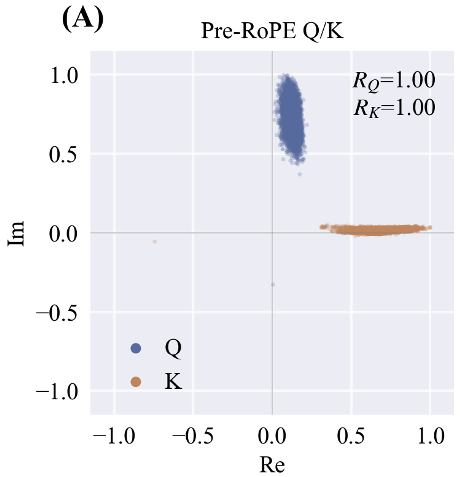 Fig 1: Pre-RoPE concentration (A) vs. Post-RoPE dispersion (B). The rotation makes importance estimation a moving target.
The Insight: Pre-RoPE Concentration
The authors of TriAttention found that if you look at Q and K before the RoPE rotation (the Pre-RoPE space), they aren't random. They are highly concentrated around a fixed non-zero center.
This concentration is:
- Stable: It stays the same across different positions and even different datasets (Math vs. Code).
- Predictable: Because these vectors cluster around a center, the entire attention mechanism simplifies into a Trigonometric Series.
Essentially, the model has "pre-programmed" distance preferences. Some heads always prefer looking at things "nearby," while others act as "sinks" for things far away. This preference is encoded in the centers of the Q/K distributions.
Methodology: Putting Trigonometry to Work
TriAttention scores each key in the cache using two primary signals:
- Trigonometric Series Score (): By using the fixed "Query Center" as a proxy for all future queries, the model calculates a curve that predicts how much attention a token at a certain distance will receive.
- Norm-Based Score (): Since the concentration isn't perfect, it uses the magnitudes (norms) of the vectors as a fallback.
The clever part is the Adaptive Weighting. Using a metric called Mean Resultant Length (R), TriAttention checks how "clustered" a specific head is. If a head is tightly clustered (R ≈ 1), it trusts the Trigonometric math. If a head is messy (R < 1), it relies more on the vector norms.
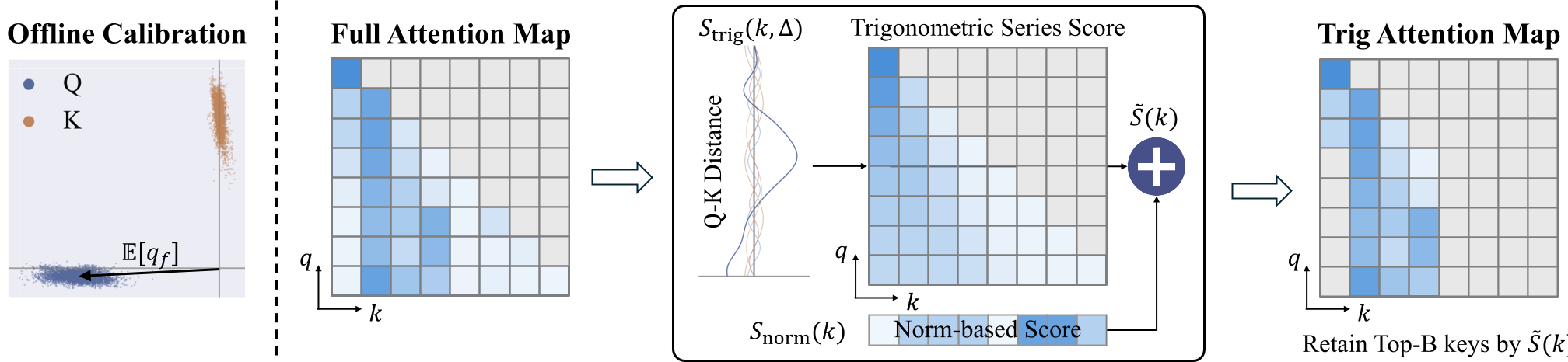 Fig 2: The TriAttention pipeline: Offline Calibration → Importance Scoring → Informed Pruning.
Performance: No More Reasoning Degradation
The most impressive part of TriAttention is its performance on AIME (American Invitational Mathematics Examination). Reasoning models usually collapse when their KV cache is pruned.
As shown in the charts below, TriAttention (the blue line) stays remarkably close to the Full Attention (dotted line) performance, even when the memory budget is slashed. Baselines like R-KV (the orange line) show "catastrophic forgetting" as the budget decreases.
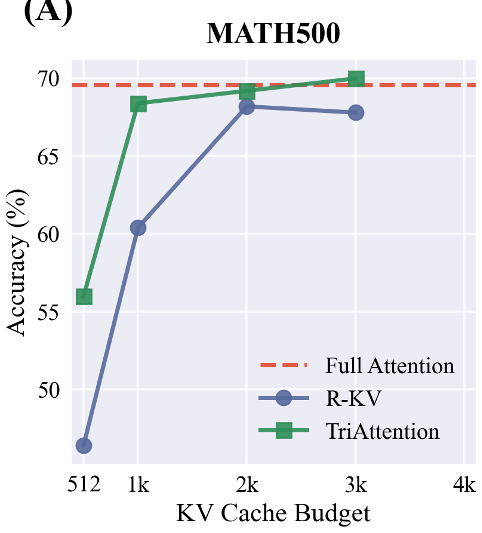 Fig 3: Accuracy vs. KV Budget. TriAttention maintains high accuracy where others fail.
Key Quantitative Wins:
- 10.7x Memory Reduction: Achieve the same reasoning accuracy as a full-cache model with less than 1/10th the memory.
- 2.5x Throughput: Faster generation because the GPU isn't choked by memory movements.
- Cross-Architecture: It works on standard GQA (like Llama/Qwen) and even the advanced MLA (Multi-head Latent Attention) used in DeepSeek models.
Critical Insight: Why This Matters
TriAttention proves that Attention is not just about content; it's about geometry.
By realizing that Transformer heads have "intrinsic personalities" (distance preferences) that exist independently of the specific prompt, we can move away from reactive, heuristic pruning and toward provable, geometric cache management.
For practitioners, this means we can finally run 30B+ reasoning models on consumer hardware (like a single RTX 4090) for complex, multi-turn agentic tasks without the dreaded "Out of Memory" error or the "Stupid Model" effect caused by over-aggressive pruning.
Conclusion
TriAttention represents a shift in LLM efficiency. It stops treating the KV cache as a black box of moving scores and starts treating it as a predictable trigonometric system. As we push toward 1-million-token reasoning chains, techniques that exploit these model-intrinsic stabilities will be the only way to keep our GPUs—and our budgets—sane.
Takeaway: The next time your model needs to think long and hard, the answer might just lie in high-school trigonometry.