
Reconstructing the Journey: Using Spatio-temporal Continuity to Search Trip Tweets
Trip Tweets Search by Considering Spatio-temporal Continuity of User Behavior
The paper introduces a novel search and organization framework for "Trip Tweets," which are fragmented microblog posts describing travel experiences. By leveraging the Spatio-temporal Continuity of user behavior, the method constructs dynamic co-occurrence dictionaries to link location-based queries with related tweets that lack explicit keywords. Achieving an average F-measure improvement of 5x over keyword-based baselines, the system effectively reconstructs continuous travel narratives from sparse data.
TL;DR
Twitter is a goldmine for travel experiences, but its 140-character limit (at the time of the study) makes these experiences fragmented and hard to search. This paper proposes a method that looks beyond keywords, using the Spatio-temporal Continuity of travel to find and organize tweets. By understanding that a user visiting "Temple A" is likely to visit "Shrine B" nearby within a specific timeframe, the system reconstructs a cohesive travelogue from scattered posts.
The Problem: The "Implicit Keyword" Gap
When people travel, they don't always tag every tweet with a location. A user at Yasaka-jinja might tweet about a "beautiful sunset" or "buying an oracle (Omi-kuji)" without mentioning the shrine's name. Traditional search engines miss these tweets because they rely on exact keyword matches.
The challenge is two-fold:
- Fragmented Information: A trip is a sequence, but tweets are isolated points.
- Contextual Omission: Short-form content often omits the "Where" and "When" that searchers actually care about.
Methodology: The Three Pillars of Relatedness
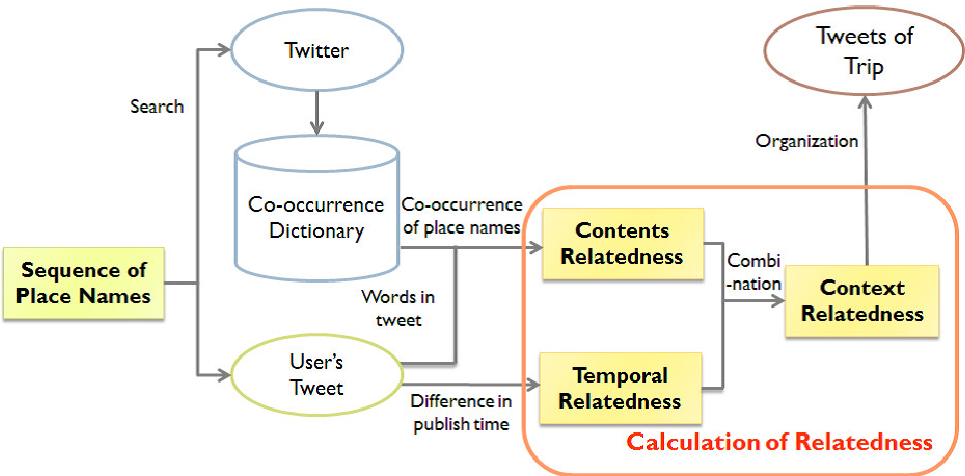
The core innovation lies in how the authors calculate three distinct "relatedness" scores to determine if a tweet belongs to a specific trip experience.
1. Dynamic Co-occurrence Dictionary (Content)
Instead of a static dictionary, the authors build one that evolves. If "Omi-kuji" frequently appears in tweets near "Yasaka-jinja" during New Year's (Hatsu-mode), the dictionary gives these terms a high co-occurrence weight for that specific time and place.
2. Spatio-temporal Continuity (The "Merge" Logic)
The system merges dictionaries based on:
- Temporal Continuity: Events at tourist spots change with seasons (e.g., cherry blossoms). Dictionaries from adjacent days with high similarity are merged.
- Spatial Continuity: If two locations are physically close (e.g., Sannen-zaka and Kiyomizu-dera), their dictionaries are cross-weighted to reflect that travelers often visit both.
3. Contextual Influence
The method recognizes that if the tweet before and the tweet after are both about a trip, the middle tweet—even if it just says "Having a great time!"—is likely part of the same experience.
Experiments & Breakthrough Results
The researchers tested their model on Kyoto's popular tourist routes. They compared their method against a standard Keyword-based "OR" search.
Key Findings:
- Recall Explosion: The proposed method was able to find nearly 10x more relevant tweets than keyword search. While keyword search only found tweets containing the specific location names, this system found the "narrative filler" tweets.
- F-Measure Dominance: In all test cases (Trip A, B, and C), the F-measure (a balance of precision and recall) was significantly higher, peaking at nearly 5x the baseline.
 The figure above demonstrates how the similarity between dictionaries decreases as physical distance increases, validating the "spatial continuity" hypothesis.
Performance Table
| Experience | Method | Precision | Recall | F-measure |
|---|---|---|---|---|
| Trip A | Our Method | 0.66 | 0.90 | 0.76 |
| Trip A | Keyword | 0.72 | 0.08 | 0.14 |
Critical Insight & Conclusion
The true power of this paper isn't just in the search algorithm; it’s in the Inductive Bias that human behavior is continuous. By modeling travel as a physical trajectory through time and space, the authors successfully turned "noise" into "knowledge."
Takeaway: Future social media miners shouldn't just look at what was said (Content), but when and where it fits into the flow of human life. While the current model relies on manual "anchor" selection for some parameters, it paves the way for fully automated "Life-log" reconstruction from public social data.
Limitations: The system still struggles with varying popularity of spots (famous vs. obscure), suggesting a need for better weighting based on tweet density in future iterations.