
The Triumph of Rationality: Why Game Theory is the Bedrock of Multiagent AI
10548_The Triumph of Rationality.
This article explores the foundational intersection of Game Theory and Artificial Intelligence, detailing how mathematical models of rational interaction between self-interested agents inform multiagent system design. It highlights core concepts such as Nash Equilibrium and the Prisoner's Dilemma, establishing a framework for decision-making in environments where outcomes depend on the collective choices of multiple participants.
TL;DR
Artificial Intelligence is fundamentally about decision-making, but "intelligent" decisions cannot be made in a vacuum. This article explores how Game Theory provides the mathematical rigor needed to model interactions between self-interested agents. By analyzing classic dilemmas and equilibrium concepts, we uncover how AI can navigate competitive and collaborative environments.
The Multiagent Motivation
In the early days of AI, researchers focused on solitary agents solving static puzzles. However, as Michael Wooldridge points out, human intelligence is social. To build robust computer programs for the real world—from eBay bidding bots to international treaty simulators—we must model strategic interaction.
The core difficulty is two-fold:
- Strategic Interdependence: My best move depends on what I think you will do, knowing that you are also thinking about what I will do.
- Computational Complexity: Finding the optimal strategy is often an NP-hard optimization problem.
Methodology: High-Stakes Logic
A "Game" in this context isn't just a pastime like Poker; it is a formal model consisting of:
- Players: The decision-makers.
- Strategies: The available "moves."
- Outcomes & Utilities: A mapping of move combinations to a numeric value representing "happiness" or "payoff."
The Core Framework: Solution Concepts
How do we predict what rational agents will do? We use Solution Concepts. The goal is to find an Equilibrium—a state where no player wants to change their mind after seeing what others have done.
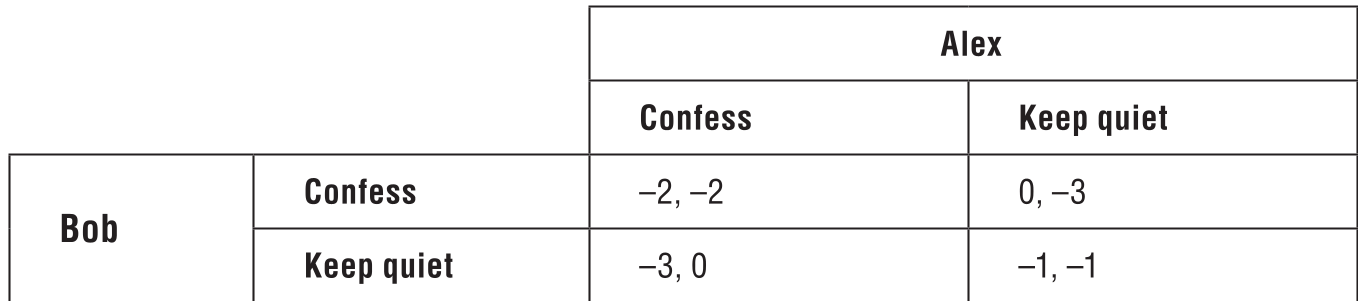
Deep Dive: The Prisoner's Dilemma & Matching Pennies
The paper utilizes two classic examples to illustrate the limits and triumphs of rationality.
1. The Prisoner's Dilemma
In this game, individual rationality leads to collective failure. If both players "Confess," they both get a worse outcome than if they had both "Kept Quiet."
- The Lesson: In a Dominant Strategy Equilibrium, an agent chooses their best response regardless of the opponent. This explains the "Tragedy of the Commons" and the difficulty of nuclear disarmament.
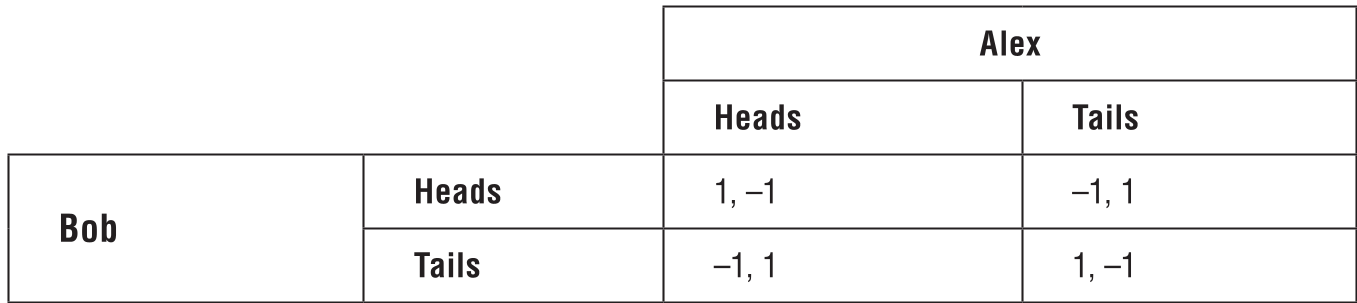
2. Matching Pennies & Mixed Strategies
Unlike the Dilemma, this game has no stable "pure" strategy. If I play Heads, you want Tails; if I switch to Tails, you want Heads.
- The Breakthrough: John Nash proved that if we allow randomization (e.g., flipping between Heads and Tails with 50/50 probability), an equilibrium always exists. This "Mixed Strategy Nash Equilibrium" is the cornerstone of modern AI strategy.
Critical Analysis: Are We Actually Rational?
While the math is elegant, the article acknowledges a standard criticism: humans are "Predictably Irrational." Using Dan Ariely’s experiments (e.g., the lure of "Free" chocolate), the author demonstrates that human choice often deviates from utility maximization.
Why this matters for AI: If we design AI to be "perfectly rational" using pure Game Theory, they may fail to interact effectively with humans, who are driven by psychological biases. Future AI must account for both the mathematical equilibrium of Nash and the behavioral messiness of biology.
Conclusion & Future Outlook
The "Triumph of Rationality" isn't that it perfectly predicts the world, but that it provides the universal language for negotiation, competition, and coordination. As we move toward more autonomous multiagent systems, the interplay between Algorithmic Game Theory and AI will only deepen, moving from simple 2x2 matrices to complex, dynamic global networks.