
Proactive Defense: Predicting Troll Vulnerability in Social Networks
Troll vulnerability in online social networks
The paper introduces "Troll Vulnerability Prediction," a novel task focused on identifying posts likely to attract trolls before attacks occur. It proposes TVRank, a metric based on Random Walks with Restarts (RWR), and evaluates a proactive classification framework using real-world Reddit data.
TL;DR
Instead of hunting for trolls after they've already ruined a discussion, what if we could predict which posts are "troll magnets" before the trouble starts? This paper shifts the focus from detecting trolls to predicting vulnerability, introducing a metric called TVRank to identify high-risk posts on platforms like Reddit. Using a combination of graph theory (Random Walks) and machine learning, the authors demonstrate that they can recall a high percentage of vulnerable posts using history and participant data.
Problem & Motivation: The Reactive Trap
Most modern moderation systems are reactive. A troll posts a comment, a filter catches a keyword, or a human reports it, and the content is deleted. However, the damage—disruption of dialogue and harassment—is already done.
The researchers argue that the discourse environment itself has an "Inductive Bias" for trolling. Certain topics or authors act as lightning rods. If we can identify these "Vulnerable Posts" early, moderators can monitor them closely or apply stricter filtering rules preemptively.
Methodology: Quantifying Vulnerability
The authors model social media interactions as a Conversation Tree, where nodes are comments and edges represent replies. To quantify vulnerability, they propose three core properties:
- Trolling Volume: More troll descendants = higher vulnerability.
- Proximity: Close-proximity troll replies are more damaging than distant ones.
- Popularity: A post must have a minimum "engagement" (K descendants) to be worth moderating.
The TVRank Metric
To capture these properties, they use Random Walk with Restarts (RWR). The intuition is beautiful: the vulnerability of a node is the probability that a random walker, starting at and potentially "teleporting" back to it, will land on a troll comment.
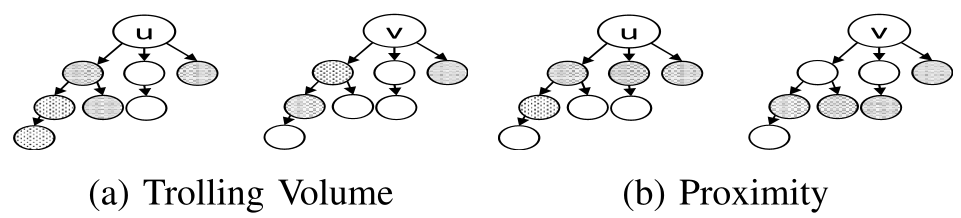
Figure 1: Illustration of Trolling Properties. Shaded nodes represent troll comments.
Predictive Modeling
The team extracted four categories of features:
- Content: Textual features of the post.
- Author: The history and reputation of the person posting.
- History: Structural features of the conversation tree.
- Participants: Data about who else is involved in the thread.
One of the most striking findings is that Content features were the weakest predictors. It turns out that who is talking and who is watching matters more than what is actually said when it comes to attracting trolls.
Experiments & Results
The model was tested on a massive Reddit dataset (over 500k comments). While the dataset is highly imbalanced (only ~1.7% of comments are trolls), the model achieved impressive Recall and AUC scores.

Table 1: Performance across different sensitivity thresholds (K and θ).
By adjusting the threshold (vulnerability intensity) and (popularity), they reached an AUC of 0.92. This proves that proactive identification isn't just a theory—it's statistically viable.
Critical Insight & Conclusion
Takeaway
The shift from "User-centric" detection to "Context-centric" prediction is a game-changer for platform safety. It acknowledges that trolling is often a systemic failure of a specific thread's dynamics rather than just isolated bad actors.
Limitations
- Labeling: The study relies on an automated offensive content classifier to label "trolls," which might miss subtle, non-offensive baiting (the classic "sophisticated" troll).
- Static Features: The model uses a Logistic Regression classifier; modern Graph Neural Networks (GNNs) could likely capture the structural nuances of the conversation tree even more effectively.
Future Outlook
This work lays the groundwork for "Early Warning Systems" in social media. Future iterations could integrate real-time sentiment shifts to dynamicially update a post's TVRank as a conversation evolves.