
Enhancing Bipartite Social Networks: The Power of Trust and Ratings in Recommendations
Trust- and Rating- based Recommendations for On-line Social Networks
This paper introduces trust-aware and rating-based enhancements to Probabilistic Spreading (ProbS) and Heat Spreading (HeatS) algorithms in bipartite on-line social networks. By integrating inter-user trust and explicit object ratings, the authors aim to balance the trade-off between recommendation accuracy and diversity.
TL;DR
Bipartite network recommendations—specifically Probabilistic Spreading (ProbS) and Heat Spreading (HeatS)—have long struggled with a specific trade-off: ProbS finds what you like but lacks variety, while HeatS finds variety but often misses the mark on accuracy. This paper introduces a framework to inject social trust and explicit ratings into these spreading processes, resulting in recommendations that are both more accurate and highly personalized.
Background: The Limits of Structural Spreading
Most bipartite recommendation systems view the world as a graph where users and objects are nodes. If you bought a book, there's an edge. However, these models traditionally suffer from two "blind spots":
- Trust Anonymity: They treat a recommendation from a total stranger the same as one from a close friend.
- Preference Flattening: They treat a "1-star" rating the same as a "5-star" rating (binary interaction).
The authors argue that by weight-adjusting the "resource" being spread across the network based on how much we trust a peer and how much they actually liked an item, we can significantly refine the recommendation quality.
Methodology: Trust and Rating Integration
The core of the paper lies in modifying the redistribution matrices () that dictate how "recommendation power" flows.
1. The Trust Factor
Instead of distributing resources equally among neighbors, the algorithm weights the flow based on a trust rate (). If users and have overlapping histories, the trust is higher, and user 's influence on user 's recommendations increases.
2. The Rating Factor
By normalizing integer ratings (e.g., 1-5) into a [0, 1] range, the initial resource vector becomes a gradient of interest rather than a simple 0 or 1.
3. The Combined Algorithm
The "Trust-Rating-Aware" variant combines these, allowing a random walk where the "heat" or "probability" flows more strongly through nodes that are highly rated by trusted peers.
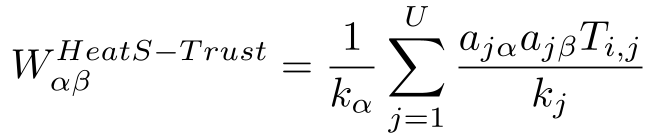 The modified redistribution matrix integrating trust ().
Experimental Insights
The research utilized the MovieLens dataset (100k ratings) to test these enhancements against standard metrics.
Performance Highlights:
- Probabilistic Spreading (ProbS): The combined approach (ProbS-R+T) yielded the best precision and recall. It effectively filtered out popular items that had low user satisfaction by factoring in the ratings.
- Heat Spreading (HeatS): While naturally less accurate due to its focus on the "long tail" (unpopular items), trust-based HeatS (HeatS-T) showed a significant jump in Hamming Distance, indicating that the recommendations became much more personalized to individual user social circles.
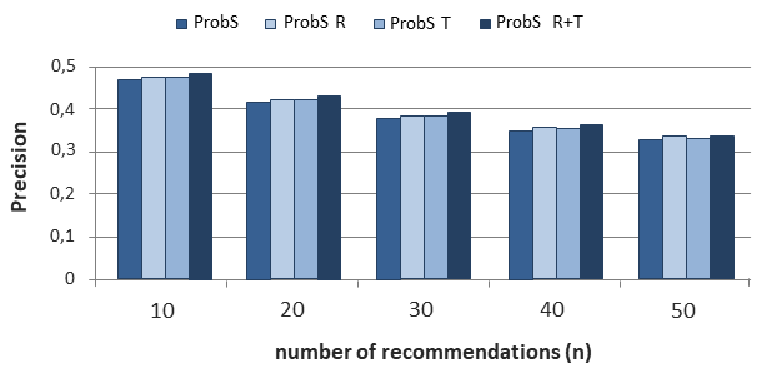 Figure: The effect of the number of recommended objects () on accuracy metrics in ProbS.
Critical Analysis: Accuracy vs. Diversity
The study highlights a fascinating phenomenon: In HeatS, adding ratings actually reduced accuracy for small recommendation lists (). Why? Because HeatS is designed to find unpopular items. High ratings are usually correlated with popular items. By injecting ratings, you force HeatS to look at "better" items, which inadvertently makes it act more like ProbS, thus conflicting with its original design goal of pure diversity.
Summary and Future Work
The paper confirms that in social networks, who provides the information (trust) and how much they liked it (rating) are just as important as the structural link itself.
Key Takeaways:
- For Accuracy-focus: Use ProbS-R+T (Combine trust and ratings).
- For Diversity-focus: Use HeatS-T (Trust only) to keep recommendations niche yet personalized.
Future research should look into dynamic trust—how trust changes over time—and how these bipartite models compare against modern Graph Neural Networks (GNNs) in terms of computational efficiency.