
TBS: Shifting from Detection to Anomaly Prevention in Social Networks via Trust Modeling
A trust-based detection scheme to explore anomaly prevention in social networks
The paper introduces a Trust-Based Anomaly Detection Scheme (TBS) for social networks, focusing on "anomaly prevention" rather than post-hoc detection. It utilizes a similar trust graph and an improved spectral clustering algorithm to identify collective malicious behaviors (Spam, DDoS, Botnets) before they escalate.
TL;DR
As social networks grow, individual anomalies evolve into sophisticated "collective attacks" like Botnets and coordinated Spam campaigns. This paper presents TBS (Trust-Based Scheme), a proactive framework that models user similarity through a multi-attribute trust graph. By improving the sensitivity of spectral clustering, the authors demonstrate that malicious groups can be isolated before they inflict significant damage, achieving superior accuracy over traditional graph-partitioning baselines.
Problem & Motivation: The "Prevention Gap"
Most current security research follows a "Detective" paradigm: an attack occurs, a pattern is matched, and a user is banned. However, in the case of DDoS or Sybil attacks, the damage—be it server downtime or reputation loss—is done once the behavior is "detected."
The author argues for Anomaly Prevention. The intuition is that anomalous users must coordinate to be effective (Collective Anomaly). By measuring the "Trust" between users based on behavioral attributes, we can spot suspicious clustering of "too-similar" entities that deviate from the general network population, essentially stopping the attack during its "infect and control" stage.
Methodology: The Trust-Based Architecture
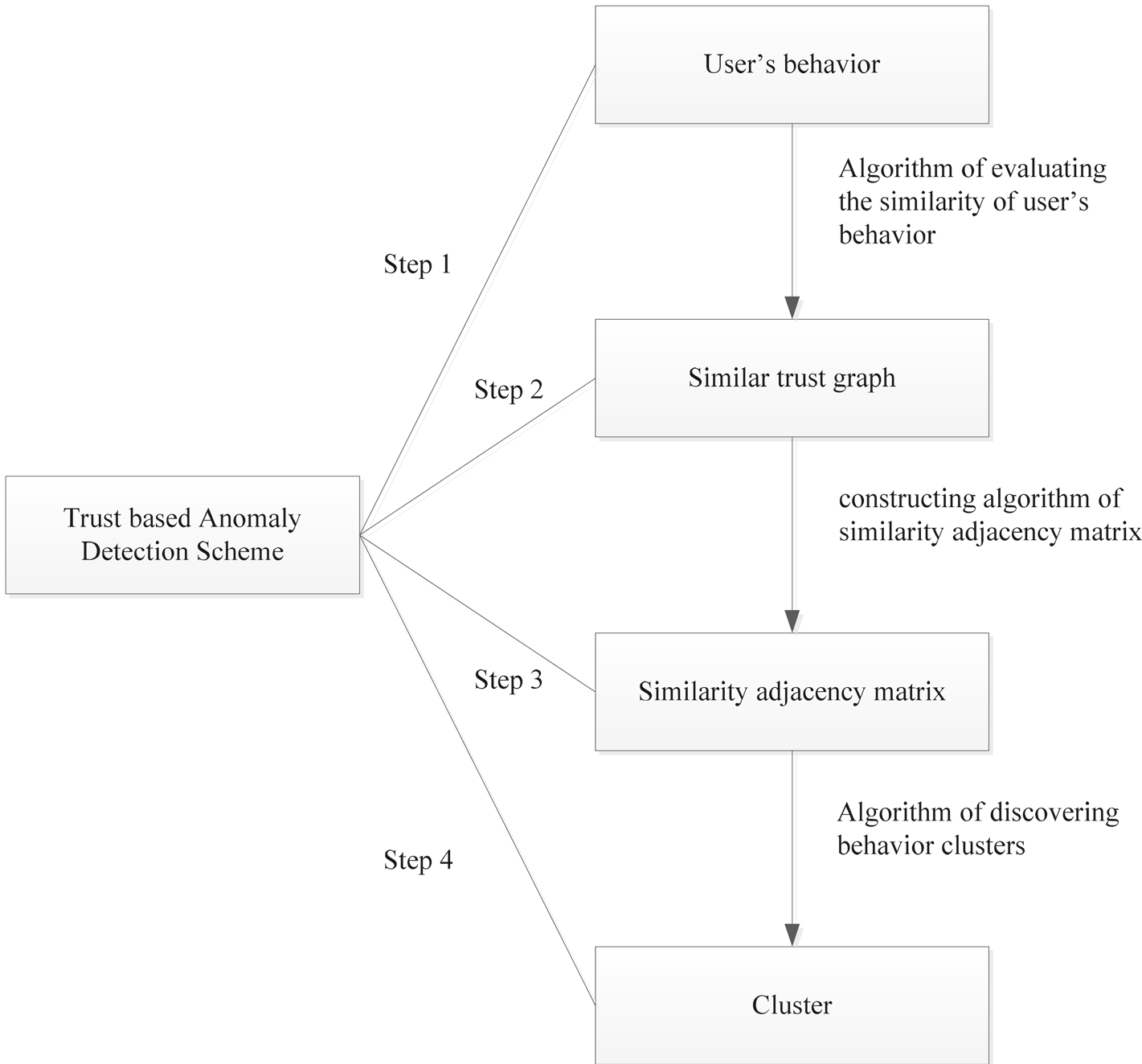
1. Constructing the Similar Trust Graph
Instead of a simple "Friendship" graph, the paper constructs a Similar Trust Graph. The weight of each edge () is not just a binary connection but a score derived from four dimensions:
- Topic: Shared discussion subjects (Food, Travel, etc.).
- Location: Geolocation similarity.
- Interest: Shared targets in past interactions.
- Following: Direct subscription relationships.
2. Solving Graph Fragments via Virtual Edges
Real-world social data is often fragmented. The authors solve this by identifying "hub nodes" using Betweenness Centrality. They link disconnected subgraphs via "Virtual Edges" between these hubs, ensuring the Laplacian matrix used later is mathematically stable and representative of the whole network.
3. Improved Spectral Clustering
Standard spectral clustering requires a pre-defined number of clusters (). Previous automated methods used rigid eigenvalue constraints that often grouped attackers and victims together. The authors introduce a relaxed constraint formula: This allow the system to "see" smaller, more precise malicious clusters that previous algorithms (like BGA) would overlook.
Experimental Evidence: Botnets and DDoS
The scheme was tested on a dataset crawled from Douban, simulating three major attack vectors.
Key Performance Metrics:
- Spam Detection: TBS reached 100% detection accuracy once the attack user percentage crossed a threshold of 7.7%, significantly outperforming traditional Behavioral Graph Analysis.
- Botnet "Infect and Control" Stage: A critical finding was that TBS could cluster infected nodes before they launched a DDoS attack. In the early stages of control, TBS maintained an accuracy of over 80%, while the baseline BGA dropped to 36% due to "cluster merging."
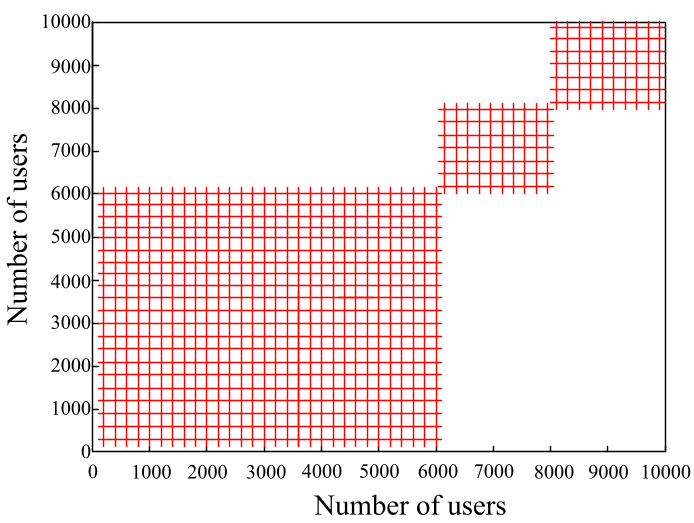
In the figure above, (c) and (d) show the clear isolation of the attack cluster (large shadow) as the attack intensity increases, validating that spectral characteristics shift recognizably during collective anomalies.
Critical Insight & Conclusion
The core value of this work lies in its philosophical shift: treat social network security like an immune system that recognizes "foreign" clusters before the "fever" (the attack) starts.
Takeaway: Trust is more than a social metric; it is a mathematical weight that reveals the hidden coordination required for modern cyberattacks. While the paper notes limitations in distinguishing between natural high-frequency interactions and malicious control behaviors, the use of Relaxed Spectral Clustering provides a blueprint for next-generation, real-time social network firewalls.
Future Directions: The author points toward optimizing the weighting factors (, etc.) and exploring the system's vulnerability to "On-Off" attacks where malicious users simulate normal behavior to evade trust score decay.