
Trust-Based Coalition: Bridging Social Reliability and Service Composition
Trust-Based Coalition Formation for Dynamic Service Composition in Social Networks
This paper presents a trust-based dynamic coalition formation process for Web service composition in social networks using a Multi-Agent System (MAS). The proposed decentralized approach, guided by an incremental broker-based model, enables self-interested agents to autonomously form overlapping coalitions to fulfill complex user queries while maintaining high quality of service (QoS) and social trust.
TL;DR
This research tackles the challenge of combining multiple Web services in a social network environment. By treating each service provider as an autonomous, self-interested agent, the authors propose a Trust-Based Coalition Formation Process (CFP). Unlike static models, this system is incremental, overlapping, and dynamic, allowing agents to leave a group if they don't trust their new partners.
Context & Motivation: The Social Gap
Current Web service composition frameworks often treat providers as passive components. However, in the age of decentralized social networks, two major issues arise:
- Social Neglect: Prior works ignore whether a requester actually trusts a provider based on social ties.
- Lack of Autonomy: Most systems do not allow a provider to say "No" to a partner they deem unreliable.
- Static Rigidity: Once a composition is formed, it's often set in stone, even if a member becomes unsatisfied.
The authors argue that for a composition to be successful in the real world, it must respect the individual autonomy and social trust of all participating agents.
Methodology: The Three Pillars of Trust
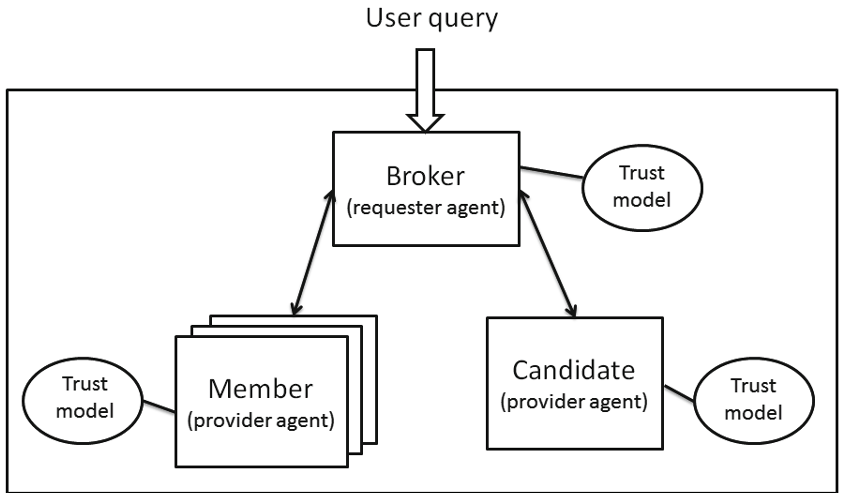
The paper defines an architecture where a Broker (the requester) manages the formation but does not dictate it.
1. The Multi-layered TRSN
Instead of searching the whole network, the broker builds a Trust-Relation Social Network (TRSN) tree. This tree organizes providers by "layers" based on their distance and trust score relative to the requester.
2. Autonomous Decision Making
The core of the "How" lies in two mathematical definitions that guide agent behavior:
- Trust in Cooperation (CT): Measures how often a candidate has actually joined a coalition when asked.
- Trust in Coalition (evalC): A candidate evaluates the average trust level of the existing members before deciding to join.
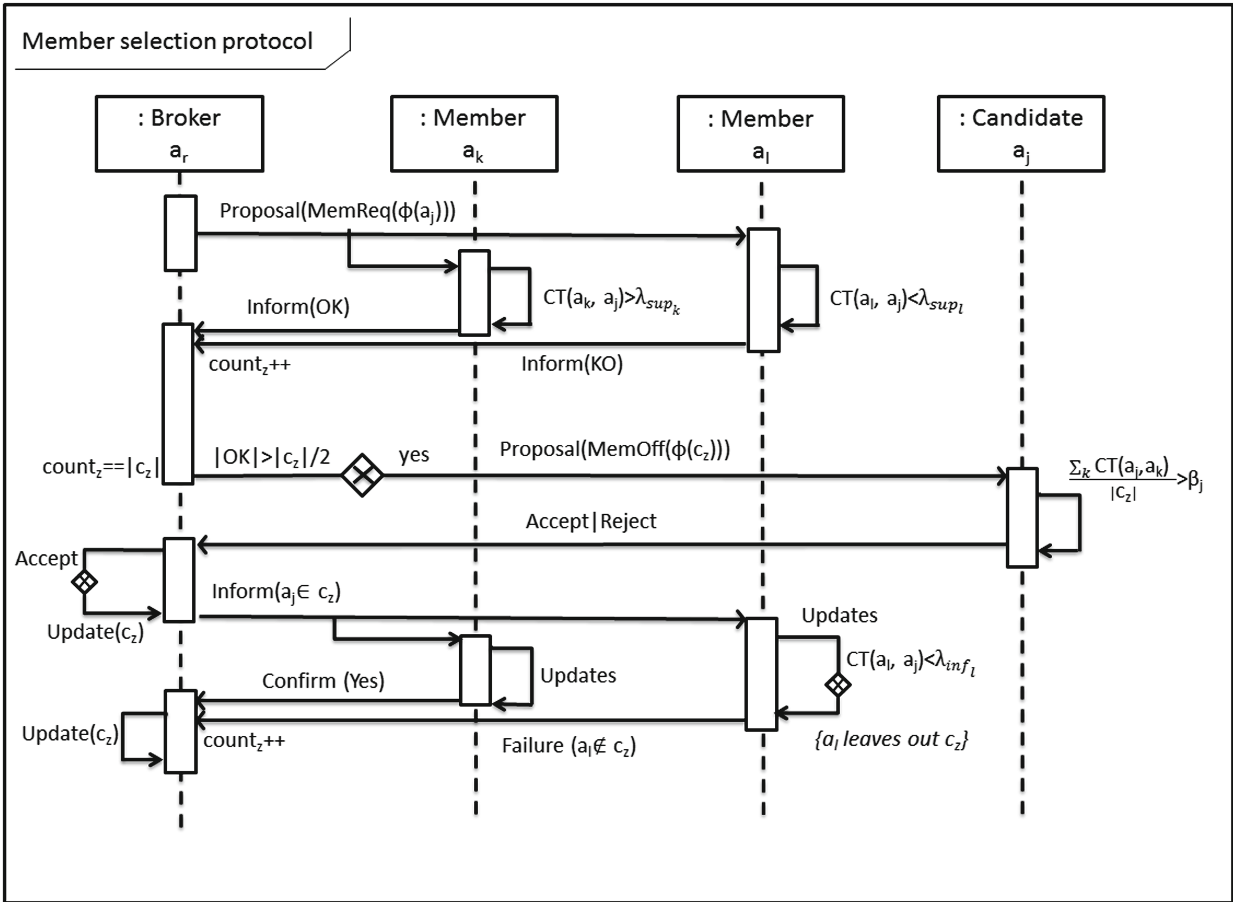
If a new member joins that an existing member dislikes, that member can autonomously leave, triggering the broker to find a replacement. This ensures the final coalition is not just functional, but stable.
3. The 3-Phase Process
- Phase 1: Generation: Identifies nearest-neighbor providers to start "seed" coalitions.
- Phase 2: Member Selection: An iterative process where members vote on candidates using a majority rule.
- Phase 3: Best Choice: Once multiple complete coalitions are formed, the broker selects the one with the highest Trust in Expertise (derived from QoS).
Experiments & Results
The authors validated their approach using the Facebook dataset, simulating agents with various service categories.
- Scalability & Communication: As the number of required functionalities (Query size) grows, the number of exchanged messages increases linearly to moderate queries, then more sharply as instability sets in.
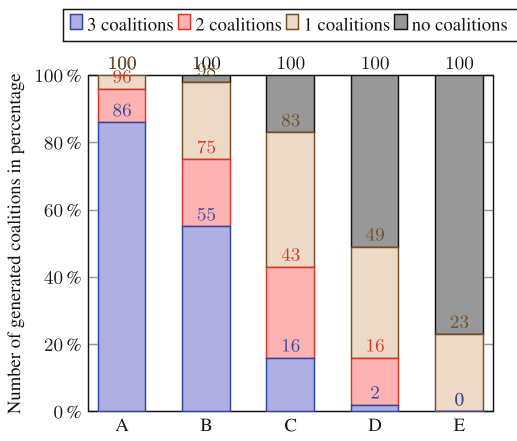
- Success Rate: For smaller queries (Scenario A), 86% success was achieved. However, for complex queries (Scenario E), the success rate dropped significantly to 23%.
Why the drop? The authors insightfully point out that in large coalitions, the "satisfaction" threshold is harder to meet. The more members there are, the higher the chance someone will exercise their autonomy to leave, potentially causing the coalition to time out before it can be completed.
Critical Analysis & Conclusion
Takeaway
This paper represents a significant step toward human-centric AI. By allowing agents to have "opinions" (Trust) and "veto power" (Autonomy), the resulting service compositions are more likely to reflect the nuanced reliability requirements of real-world social networks.
Limitations
- Instability in Large Groups: The current "leave" mechanism can lead to infinite loops (Ping-pong effect) if thresholds aren't set carefully.
- Static Thresholds: The trust thresholds (λ, β) are currently fixed. In a real-world scenario, these would likely need to be adaptive.
Future Outlook
The move from simple QoS-based Selection to Socially-Aware Selection is crucial. Future research involving Reputation Systems and Adaptive Learning of agent behaviors could further stabilize these dynamic coalitions in even larger, noisier networks.