
CTDR: Revolutionizing Social Recommendations with Trust and Domain Expertise
A comprehensive trust-based item evaluation model for recommendation in social network
The paper introduces CTDR, a comprehensive item evaluation model for social network recommendations that integrates user trust, domain inclination, and item reputation. By combining these three dimensions, the model achieves a more accurate rating prediction compared to traditional collaborative filtering, specifically within the Epinions dataset.
TL;DR
In the era of information overload, social networks often struggle to provide relevant recommendations due to data sparsity and the "Cold Start" problem. This paper proposes CTDR, a novel evaluation model that integrates Trust, Domain Inclination, and Item Reputation. Moving beyond simple Collaborative Filtering, CTDR achieves a massive 600%+ improvement in precision for new users by understanding who provides the item and where the user's expertise lies.
Problem & Motivation: The Limits of Similarity
Most traditional recommendation systems rely on Collaborative Filtering (CF). CF operates on the logic: "If User A and User B liked the same thing in the past, they will like the same thing in the future."
However, this logic breaks down in two scenarios:
- Cold Start: New users have no history, leaving CF with no "similarity" to calculate.
- Context Blindness: Traditional models ignore the social context—such as the reputation of the person providing a service or the category-specific interests of the user.
Prior trust models like AUTrust attempted to solve this but relied on static metrics (like follower counts) that are easily "gamed" and don't reflect the actual quality of a user's contributions.
Methodology: The Three Pillars of CTDR
The authors propose that an item's value isn't just about its features, but the context of its recommendation. They break this down into three modules:
1. The Trust Module (T)
CTDR refines user trust by combining three factors:
- Similarity: Measured via Cosine Similarity of rating vectors.
- Interaction: Both Explicit (rating an item provided by someone) and Implicit (rating the same items).
- User Reputation: A dynamic score based on the average quality of ratings their items receive.
2. Domain Inclination (DI)
People aren't experts in everything. CTDR calculates Domain Activity (how active you are in a category) and Domain Popularity (how trending that category is) to predict if a user is likely to value an item in a specific field.
3. Item Reputation (IR)
Simple but effective: It calculates the ratio of "good" ratings to total ratings, providing a baseline of the item's inherent quality.
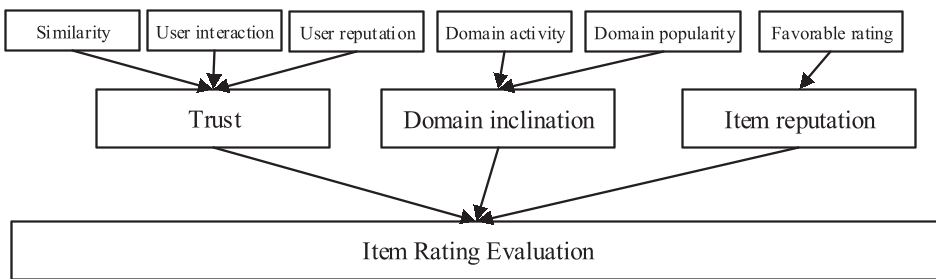 Figure 1: The CTDR framework showing the integration of Trust, Domain, and Reputation modules.
Experiments & Results: Crushing the Cold Start
The authors tested CTDR on the Extended Epinions dataset, which contains over 13 million ratings.
The Cold Start Victory
The most striking result is in the handling of new users (those with fewer than 10 ratings). While Collaborative Filtering struggled with a precision (PR) of just 5.32%, CTDR achieved 36.7%. By utilizing domain inclination and the provider's reputation, CTDR could provide meaningful scores even when user history was nearly non-existent.
SOTA Comparison
Comparing general performance, CTDR maintained a consistently higher precision and a significantly lower RMSE (Root Mean Square Error) than traditional CF, proving that its multi-dimensional approach is more aligned with actual user behavior.
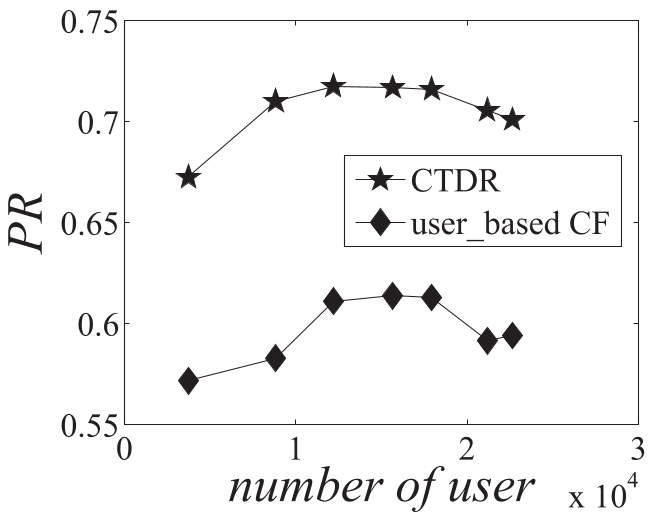 Figure 2: Precision (PR) of CTDR vs. Collaborative Filtering across different user counts.
Critical Analysis & Conclusion
Takeaway
The genius of CTDR lies in its Inductive Bias: it assumes that trust is not universal but domain-specific. By quantifying "Domain Inclination," the model successfully captures the intuition that a tech expert's recommendation on a laptop is more valuable than their recommendation on gardening tools.
Limitations
While effective, the model's reliance on manual weight tuning ( parameters) suggests a potential bottleneck. In modern production environments, these weights would likely need to be learned dynamically through a neural network (e.g., an Attention Mechanism) rather than fixed values.
Future Outlook
The authors suggest that Time is the next frontier. User interests and reputations fluctuate; integrating temporal decay to weigh recent interactions more heavily could further boost the model's accuracy in the fast-moving landscape of Online Social Networks (OSNs).
Editor's Note: This work serves as a foundational bridge between classical statistical trust models and contemporary context-aware recommendation engines.