
CoTCoDepth: Solving the Recommender Privacy Paradox via Local Trust Propagation
Trust-based local and social recommendation
The paper introduces CoTCoDepth, a decentralized trust-based recommender system designed for social networks. It achieves SOTA performance on the Epinions dataset by utilizing local score propagation and default scoring strategies to outperform traditional Global Collaborative Filtering and established trust-based models.
TL;DR
CoTCoDepth is a decentralized recommendation algorithm that operates strictly on local social links. By using a "k-depth" propagation strategy and smart default scoring, it solves the Cold Start problem and improves coverage without requiring a central server to see all user data. In head-to-head tests on Epinions data, it outperformed global Collaborative Filtering by a massive margin in both accuracy and reach.
The Conflict: Recommendation vs. Privacy
Most modern recommender systems (think Amazon or Netflix) are "Global." They need to ingest the entire matrix of users and ratings to find patterns. While effective, this creates two massive roadblocks:
- Privacy: Users must surrender their personal preferences to a central authority.
- Architecture: These systems cannot run on Peer-to-Peer (P2P) or decentralized networks (like Diaspora or FreedomBox) where no single node sees the whole graph.
The authors' insight is provocative: We don't need global data. If I want a book recommendation, my friends' opinions—weighted by how much I trust them and how similar our tastes are—are often more relevant than a global average.
Methodology: The CoTCoDepth Framework
The core of the paper is the CoTCoDepth (Confident Trust Correlative k-Depth) Scorer. Instead of building a global similarity graph, it propagates a request through the social network up to a distance of k.
1. Local Score Propagation
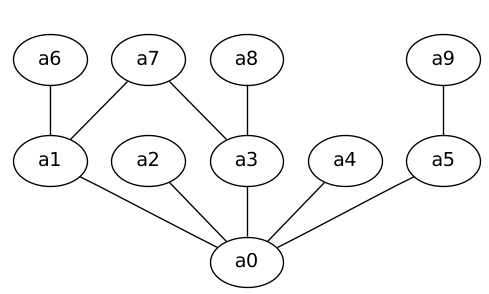
When a user wants a score for item , they ask their friends. If the friends haven't rated it, they ask their friends, and so on. The logic is defined by: Where is a composite weight of Trust () and Correlation ().
2. The Confidence Metric
To prevent "noise" from distant friends (friends of friends of friends), the authors introduce a Confidence () value. As a score travels further from its source, its confidence decays. The original requester uses this to down-weight scores that have traveled through too many hops.
3. Smart Default Scoring
Data sparsity is the "Trust-based system killer." If no one in your 3-hop circle has rated a movie, you get zero results. CoTCoDepth fixes this by allowing nodes to return a Default Score (such as the node's average rating or the item's global average) with a low probability and low confidence, ensuring the system rarely returns "null".
Experimental Results: Dominating the Cold Start
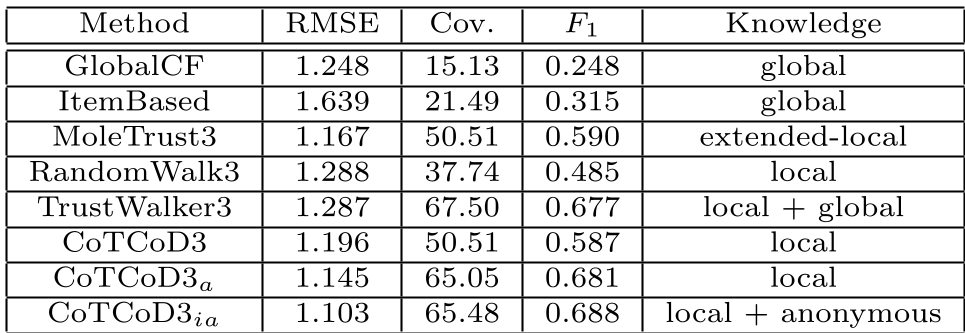
The authors tested CoTCoDepth against five major baselines, including GlobalCF and TrustWalker, using the Epinions dataset.
Key Findings:
- Cold Start Excellence: For users with fewer than 5 ratings, CoTCoDepth achieved an F1-measure of 0.809, significantly higher than TrustWalker (0.788) and GlobalCF (0.703).
- Coverage: By using the "Item Mean + Actor Mean" default strategy (CoTCoD3ia), the system reached 90.5% coverage for cold start users—nearly double that of RandomWalk.
Critical Insight & Future Outlook
The most striking takeaway is that local knowledge (1-3 hops) plus a clever fallback strategy often beats global "Big Data" approaches in sparse environments. This is a win for decentralization.
However, there are limitations. The "Item Average" default strategy requires some level of anonymous global knowledge, which slightly compromises the "purely local" ideal. Additionally, as increases, the network traffic (message flooding) could become a bottleneck in real-world P2P deployments.
Moving forward, the implementation of CoTCoDepth in decentralized protocols like Mastodon or Nostr could provide a privacy-first alternative to the algorithmic feeds of traditional social media.
Conclusion
CoTCoDepth proves that we don't need to sacrifice privacy for personalization. By mimicking the way humans naturally seek advice—relying on a trusted local network—we can build recommendation engines that are faster, more private, and better at helping new users find their footing.