
Quantification of Trust: Leveraging Measurement Theory for Social Network Security
Trust based Mechanisms for Social Networks
The paper introduces a novel trust framework for social networks based on physical measurement theory, utilizing "Impression" and "Confidence" as dual metrics. It achieves robust information filtering and optimized advertisement targeting by modeling trust transitivity and aggregation through error propagation mathematics.
TL;DR
This research bridges the gap between human psychology and mathematical rigor by treating trust as a physical measurement. By introducing a framework that accounts for both the "Impression" of a person and the "Confidence" in that judgment, the authors provide a robust mechanism to filter malicious information and optimize social influence, outperforming popularity-based metrics on real-world datasets like Epinions.
Motivation: The Trust Scaling Problem
In the physical world, trust is built slowly through repeated face-to-face interactions. In the digital world, we encounter a "Trust Explosion." How can we trust a "friend of a friend" when our social graph contains thousands of nodes?
Prior systems often treated trust as a binary (trust/ignore) or a simple scalar. The authors argue this is insufficient because it ignores Uncertainty. Knowing how sure we are about someone is just as important as the trust score itself.
Methodology: Trust as a Physical Quantity
The core innovation lies in applying Error Propagation Theory to social links.
1. The Metrics
- Impression (m): The mean value of trustworthiness (0 to 1).
- Confidence (c): The degree of certainty.
- Uncertainty (r): Derived from confidence (), acting like the standard deviation in a measurement.
2. Trust Arithmetic
To compute the trust between two strangers ( and ) connected via a mutual friend (), the framework uses two primary operations:
- Transitivity (): When trust is passed along a chain (). The uncertainty increases as the chain grows longer, much like errors compounding in a physical experiment.
- Aggregation (): When receives opinions about from multiple sources (e.g., and ). The framework uses a weighted average where sources with higher confidence carry more weight.
Note: The framework characterizes trust transitivity using the product of impressions and the geometric sum of relative uncertainties.
Experiments: Filtering and Influence
Defense Against "Internet Water Armies"
The authors tested the framework against two attack models:
- Simple Attack: Attackers send the same malicious message. The framework uses "voting weighted by trust" to neutralize these.
- Intelligent Attack: Attackers send varied messages to bypass simple filters.
The results showed that External Attackers (those with low confidence/strangers) are easily neutralized. Interestingly, the research proves that Internal Attackers (trusted nodes turned malicious) are far more dangerous, as their messages bypass initial trust filters.
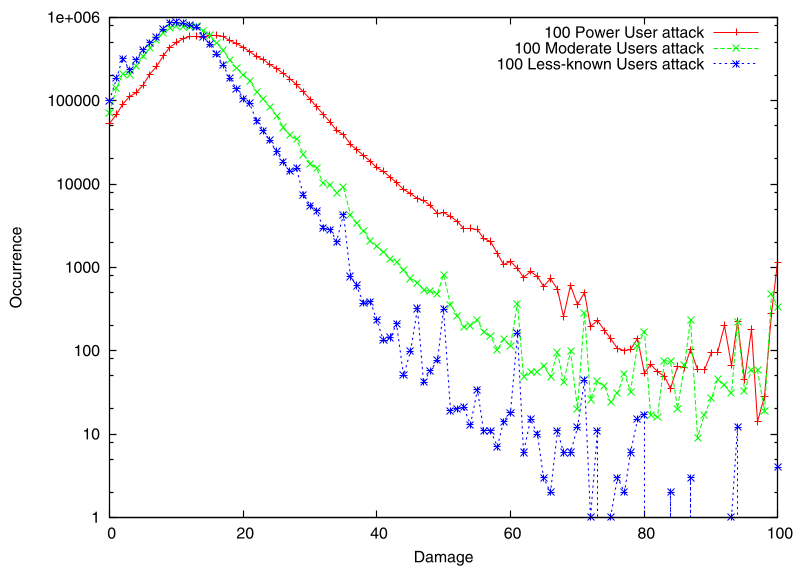 Fig: Occurrence of damage in the Epinions dataset. Higher trust correlates with higher potential impact, used here to filter out low-confidence malicious actors.
Maximizing Advertisement ROI
Instead of giving free products to "Power Users" (those with the most followers), the authors propose targeting "Trust Leaders."
- Result: Advertisements spread through trust-based paths reached a much higher "combined impression" in the population than those spread through simple high-ranking nodes. Trust is a more effective vector for influence than mere visibility.
Critical Insight: Why it Works
The brilliance of this approach is its Inductive Bias toward caution. By using (Impression times Confidence) as a filter, the system naturally penalizes both the "bad" (low ) and the "unknown" (low ). It mimics the human intuition that we should be skeptical of someone we don't know well, even if they haven't done anything wrong yet.
Conclusion
This paper transforms trust from a vague social concept into a computable, engineering metric. While the experiments were performed on older datasets like Epinions, the underlying logic is more relevant than ever in the age of Sybil attacks on blockchain networks and "Water Armies" on social media.
Future Outlook
The next step for this research involves integrating Distrust Propagation (negative trust) and adapting the algorithms to handle the dynamic, time-varying nature of trust in real-time streaming environments.