
Trust-Based Discovery: Bridging Strangers in OSNs Without Sacrificing Privacy
A trust-based privacy-preserving friend recommendation scheme for online social networks
This paper proposes a trust-based privacy-preserving friend recommendation scheme for Online Social Networks (OSNs). It leverages social attributes and multi-hop trust chains to connect strangers while preserving identity and attribute privacy through secure kNN computation and anonymous communication channels.
TL;DR
In the world of Online Social Networks (OSNs), we often expand our circles via "friends of friends." However, revealing our attributes or identities to find matches can be a privacy nightmare. This paper introduces a Trust-Based Privacy-Preserving Friend Recommendation Scheme that allows users to find compatible strangers through 1-hop trust relays and secure attribute matching, effectively turning "strangers" into "trusted connections" without leaking private coordinates.
The Problem: The Privacy-Connectivity Paradox
Modern social networks rely on homophily—the idea that "birds of a feather flock together." We find new friends based on shared attributes (colleagues, hobbies, etc.). However, current systems face a dilemma:
- ID-Based Scanning: Only works for immediate circles and exposes social graphs.
- Attribute Exposure: To find a "Cardiologist in New York," you must broadcast your medical needs or location, inviting identity theft and profile leakage.
- Trust Gaps: It is difficult to verify the reliability of a recommendation that comes from several hops away.
Methodology: How the Multi-Hop Trust Chain Works
The authors propose a system where Central Authority (CA) handles key distribution, but the discovery remains decentralized and privacy-centric.
1. Secure Social Coordinate Matching
Instead of comparing profiles in plain text, every user's attributes are converted into a binary vector (Social Coordinate). These are encrypted using invertible matrices and random scaling factors.
 Algorithm 1: Detail of the Secure kNN scheme used to calculate similarity without decrypting vectors.
The "Progressive Matching" intuition (Definition 2) ensures that a request is only forwarded if the next candidate is more similar to the target than the current one, providing a logical "gradient" toward the destination.
2. Anonymous Communication via Close Friends
To hide network addresses (IP/MAC), the scheme uses "Close Friends" as relays. By utilizing Pedersen Commitments and ID-based signatures, users can authenticate their trust level to a friend without revealing the actual numeric value of that trust.
Experiments: Performance and Reachability
The authors tested their scheme against real-world data from Facebook (Caltech, Reed, Haverford) and INFOCOM 2006.
- Reachability Boost: In the Haverford dataset, the reachability between strangers jumped from a baseline of 5.70% to a staggering 89.19% using multi-hop chains.
- The Power of Hops: Most connections were established within 3 hops, adhering to the "small world" phenomenon while filtering "unqualified" recommenders at each step.
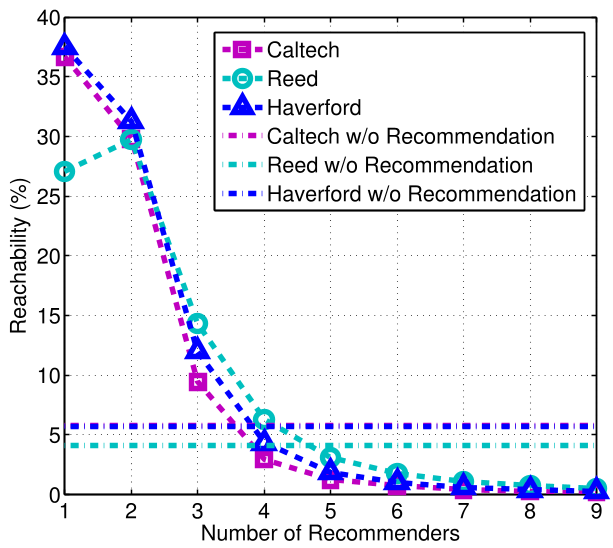 Figure 4: Comparison showing how the proposed scheme significantly outperforms existing friendship structures in terms of network reachability.
Critical Insight: Why This Matters
The most impressive part of this work is the Trust Level Derivation. Calculating an average trust level (e.g., Alice trusts Bob 0.9, Bob trusts Carol 0.8) across a chain typically requires a central entity to see all values. This paper uses a cryptographic aggregation trick: This allows the querier to compute the average trust of the path without ever knowing how much any individual link trusts the next.
Limitations & Future Work
While the system is robust against Type I-IV adversaries (identity theft, fabrication, etc.), it relies on an always-online Central Authority for coordinate updates. Future iterations might explore fully decentralized (Blockchain/DHT) coordinate management to remove this single point of failure.
Conclusion
This paper provides a blueprint for the next generation of "Private Social Networks." By combining social intuition (homophily and trust) with advanced cryptography (Secure kNN and commitment schemes), it proves we don't have to choose between finding new friends and keeping our private lives private.