
Beyond Binary Sharing: A Trust-Driven Framework for Co-Owned Photo Privacy
Trust-Based Privacy-Preserving Photo Sharing in Online Social Networks
The paper proposes a trust-based privacy-preserving mechanism for sharing co-owned photos in Online Social Networks (OSNs). It utilizes social trust values to automatically determine which stakeholders should be anonymized (e.g., blurred) and introduces an adaptive threshold tuning method to balance privacy loss with the utility of photo sharing.
TL;DR
Sharing a group photo on Instagram or Facebook isn't just about the person clicking "upload"—it involves the privacy of everyone in the frame. This paper introduces a Trust-Based Privacy-Preserving mechanism that uses social relationships to decide who to blur in a photo. By modeling trust as a dynamic resource that depletes when privacy is leaked, it creates a self-regulating ecosystem where publishers choose to protect friends to maintain their social reputation.
Background: The Multi-Party Privacy Trap
In current OSNs, if Alice uploads a photo of herself, Bob, and Charlie, she usually has the final say. If Bob doesn't know the recipient, his privacy is compromised. Prior research focused on "All-or-Nothing" access control—either everybody is visible, or the photo is blocked. This work shifts the focus to fine-grained anonymization: protecting individuals based on their specific relationship with the viewer and the publisher.
Methodology: Trust as a Metric for Privacy
The core innovation lies in the mathematical coupling of Privacy Loss and Social Trust.
1. Estimating Privacy Loss
The Service Provider (SP) estimates the potential harm to a stakeholder when a photo is shown to recipient using: Where is the trust stakeholder has in recipient , and is the sensitivity. If you don't trust the person looking at the photo, your privacy loss is higher.
2. The Anonymization Rule
The system uses a publisher-specified threshold to decide if a person stays in the photo:
- Identify: If (Publisher trusts you and the risk is low).
- Anonymize: If the risk is too high.
3. Trust Dynamics
Trust is not static. If Alice (publisher) exposes Bob's face and he suffers privacy loss, his trust in Alice drops. If Alice protects him, his trust in her increases. This creates a mathematical incentive for Alice to be a responsible sharer.
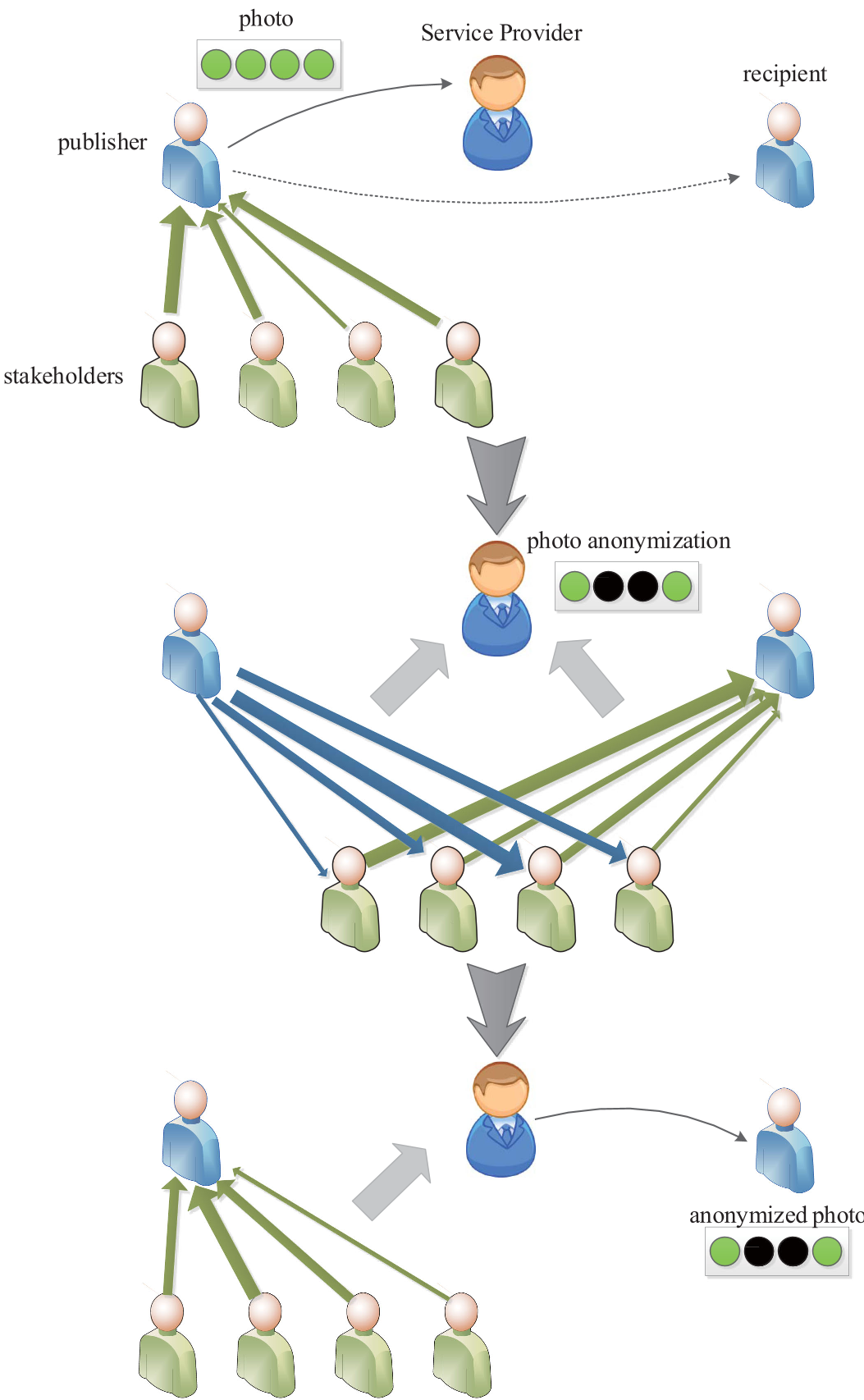 Figure 1: The proposed photo-sharing lifecycle involving stakeholders, publishers, and the Service Provider.
Balancing Utility: The -Greedy Threshold Tuning
If a publisher blurs everyone, the photo is useless. If they blur no one, they lose reputation. The authors propose an -Greedy method where the Service Provider helps the publisher find the "sweet spot" for the threshold , maximizing a payoff function that balances "Information Shared" vs. "Reputation Maintained."
Experimental Validation
The authors tested their model across three network topologies: Scale-Free, Small-World, and a real-world Facebook dataset.
- Finding 1: The trust-based mechanism consistently resulted in lower privacy loss than random selection of whom to blur.
- Finding 2: Adaptive tuning (learning from the past) provided significantly higher payoffs than using a fixed threshold for every photo.
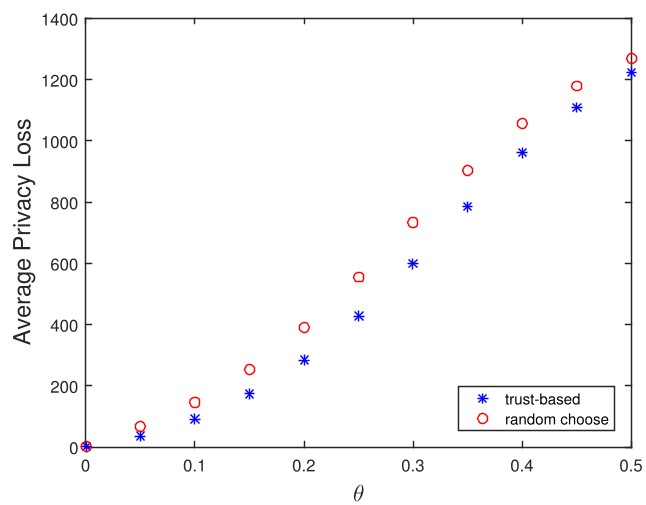 Figure 2: Performance comparison on the Facebook dataset showing the reduction in privacy loss using trust metrics.
Critical Insight & Future Outlook
While the paper provides a robust framework for self-interested privacy protection, it assumes the Service Provider is a "trusted mediator" who knows all trust values. In the real world, the SP's own privacy policies and their potential to misuse this "social graph" data remain a concern.
The transition from manual tagging to automated Facial Recognition for identifying stakeholders is the industrial logic here. Future extensions might explore One-to-Many sharing (e.g., posting to a public feed vs. a private group), where the risk calculation becomes exponentially more complex.
Conclusion
This research moves us closer to a "socially aware" AI that understands not just what is in a photo, but how the people in that photo feel about each other. It proves that privacy doesn't have to be a wall; it can be a filter that adapts to the strength of our social bonds.