
Trust-Based Security: Detecting Coordinated Fake User Clusters via Measurement Theory
Trust-Based Security Mechanism for Detecting Clusters of Fake Users in Social Networks
This paper introduces a hybrid security framework combining Measurement Theory-based trust metrics with Spectral Clustering to identify fake user groups in social networks. By integrating human intuition (as trust values) with automated machine learning, the system successfully distinguishes malicious clusters from legitimate ones based on interaction patterns.
TL;DR
Social media platforms are under siege by "fake" clusters—coordinated accounts designed to spread misinformation. This paper proposes a novel framework that captures the "physicality" of human trust using Measurement Theory. By combining Spectral Clustering with Temporal Trust Metrics, the authors can pinpoint malicious groups that may appear legitimate to traditional algorithms but exhibit "too perfect" trust indicators.
Background: Why Content Filters Fail
Most current detection systems are either too slow or too rigid. Supervised learning requires massive labeled datasets, and simple graph analysis (like PageRank) can be gamed by bots that follow thousands of real people. The core problem is the lack of human context. The authors argue that trust is a dynamic interaction that develops over time; fake accounts cannot simulate the natural "friction" and volatility of real human relationships.
Methodology: Mapping Intuition to Math
The framework utilizes a three-stage pipeline to bridge the gap between human knowledge and machine efficiency.
1. The Trust Metric (Measurement Theory)
Unlike a simple binary "friend/not-friend" status, the authors define trust through two metrics:
- Impression (): The mean of interactions (likes, retweets, etc.).
- Confidence (): How certain a user is about that impression, inversely related to the variance of interactions.
This allows the model to handle Trust Transitivity—calculating trust between two people who aren't directly connected but share a mutual contact.
2. Spectral Clustering
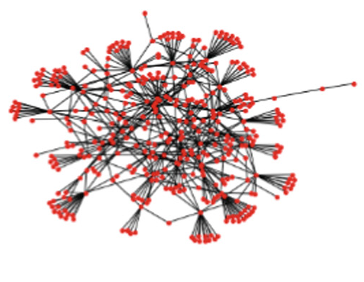
To handle massive data, the system doesn't look at individuals. It uses Spectral Clustering to partition the social graph into "neighborhoods" based on interaction similarity.
3. The "Fake" Red Flags
Once clusters are formed, the system looks for three tell-tale signs of a fake group:
- Hyper-Density: Fake users link excessively to each other to boost credibility.
- Instant Formation: Real communities take years to build; fake clusters appear overnight.
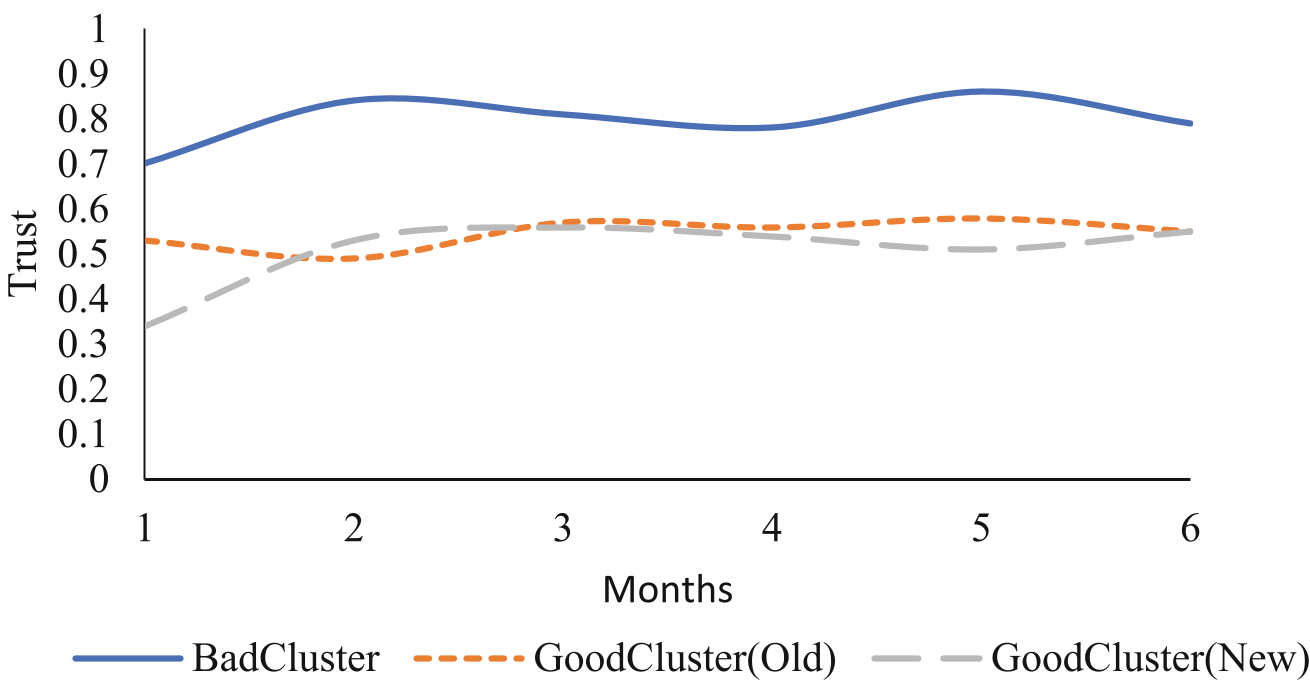
- Zero Fluctuation: Real trust goes up and down. Fake accounts maintain a "steady-state" high trust to avoid detection.
Experimental Results
Using an Erdos-Renyi model to simulate social graphs, the authors compared three types of clusters.
| Properties | Cluster 1 (Real) | Cluster 2 (Real/New) | Cluster 3 (Fake) |
|---|---|---|---|
| Trust | 0.546 | 0.566 | 0.798 |
| Density | 0.019 | 0.006 | 0.621 |
The result was striking: Cluster 3 (the fake group) showed a density 30x higher than legitimate groups. More importantly, the temporal graph (Figure 2) revealed that legitimate trust is a "noisy" signal, while fake user trust is an unnaturally smooth, high-value line.
Critical Insight: The "Too Good To Be True" Paradox
The most profound takeaway is that in social networks, perfection is suspicious. In a real human cluster, people disagree, unfollow, and have inconsistent engagement. Malicious clusters are optimized for efficiency, which creates a "mathematical footprint" of high trust and low variance. By capturing this via Measurement Theory, we can flag groups that are mathematically "too cooperative" to be human.
Conclusion
This research moves beyond static profile analysis into the realm of behavioral physics. While the study used synthetic data, the methodology provides a scalable blueprint for platforms like X (Twitter) or Facebook to detect not just individual bots, but entire "troll farms" by looking at the stability and density of their internal trust networks.
Future Work: The next step for this research should be testing against "adversarial bots" designed specifically to inject noise into their trust variance to better mimic human behavior.