
Hybrid Trust Fusion: Securing Mobile Social Networks via Behavioral and Identity Verification
Trust-based security routing mechanism in mobile social networks
This paper proposes a Trust-Based Security Routing Mechanism for Mobile Social Networks (MSNs) that integrates behavior trust and identity trust. By combining social relationship strength with dynamic trust evaluation and distributed key management, the system effectively identifies and bypasses malicious nodes during message forwarding.
TL;DR
To combat packet-dropping and malicious interference in Mobile Social Networks (MSNs), researchers from Northeastern University have developed a routing mechanism that fuses Behavior Trust (social interactions) with Identity Trust (distributed RSA certificates). This approach improves delivery rates and minimizes message loss by dynamically evaluating and verifying nodes before every hop.
Context: The Social Trust Gap
In an MSN, messages move opportunistically—meaning they rely on humans carrying mobile devices to "encounter" one another. While social features (interests, movement patterns) have been used to improve efficiency, they are often blind to security. Malicious nodes can easily join the network to drop packets or spread misinformation. Prior works usually focus on either behavioral history or static identity, but rarely both.
Methodology: The Dual Trust Architecture
The proposed mechanism operates on two main pillars to ensure a node is both technically legitimate and socially reliable.
1. Behavior Trust through "Forward Utility"
The system calculates a Forward Utility (FU) for potential relay nodes. This utility is a weighted sum of:
- Social Relationship Strength (): Based on contact frequency, duration, and regularity.
- Comprehensive Trust Value (TV): A mix of direct trust (feedback from past interactions) and indirect trust (recommendations from friends).
2. Identity Trust via Distributed Key Management
Since MSNs lack a central Certificate Authority (CA), the authors propose a self-organized public key authentication system.
- Issue: Nodes issue certificates to each other ONLY when their social relationship strength exceeds a threshold.
- Verify: Messages are signed and encrypted using RSA. The "Certificate Chain" is verified at the destination.
- Revoke: If a node's social strength drops below the threshold, its certificates are automatically revoked by its peers.
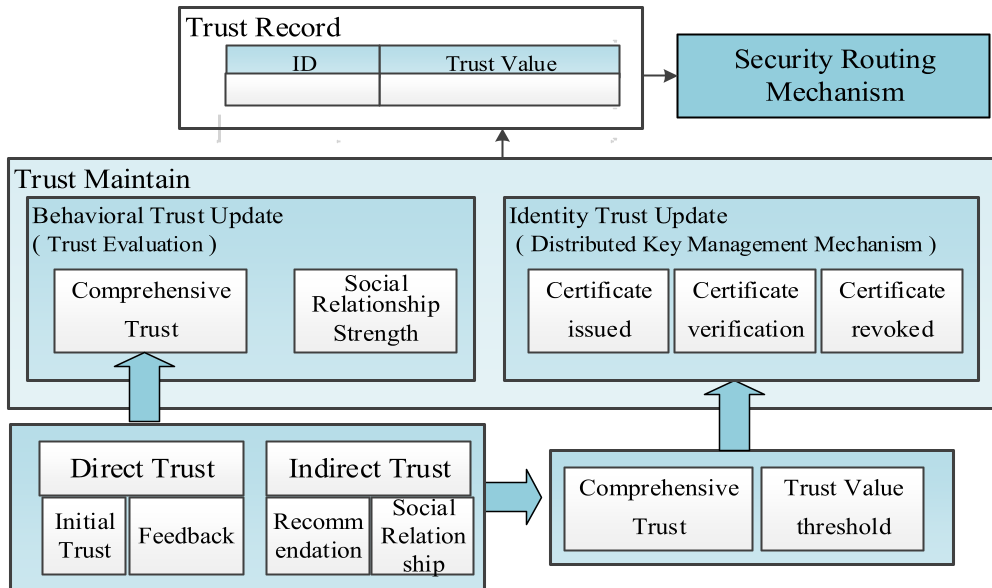 Fig 1: The Trust Model framework illustrating the interaction between evaluation and key management.
Experimental Performance
The mechanism was tested using the Opportunistic Network Environment (ONE) platform against benchmarks like Epidemic, dLife, TRSS, and IRONMAN.
Delivery Probability and Reliability
As the ratio of malicious nodes increases, the "Trust-Based" mechanism significantly outperforms others. While the Epidemic algorithm (flooding) suffers massive packet loss when malicious nodes are present, this proposed system filters out unreliable relays early.
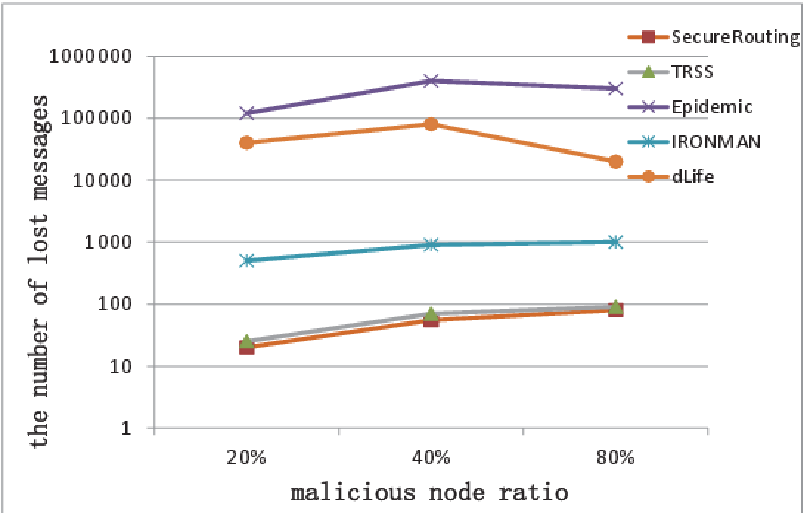 Fig 2: Comparison of lost messages under different malicious node ratios.
Latency and Overhead
A key highlight is the Average Delay. By prioritizing "Friend Groups" (nodes with high contact regularity), the algorithm finds shorter, more reliable paths. While the cryptographic overhead (RSA signatures) increases the "Delivery Cost" compared to simple incentive mechanisms like IRONMAN, it provides a much higher security guarantee.
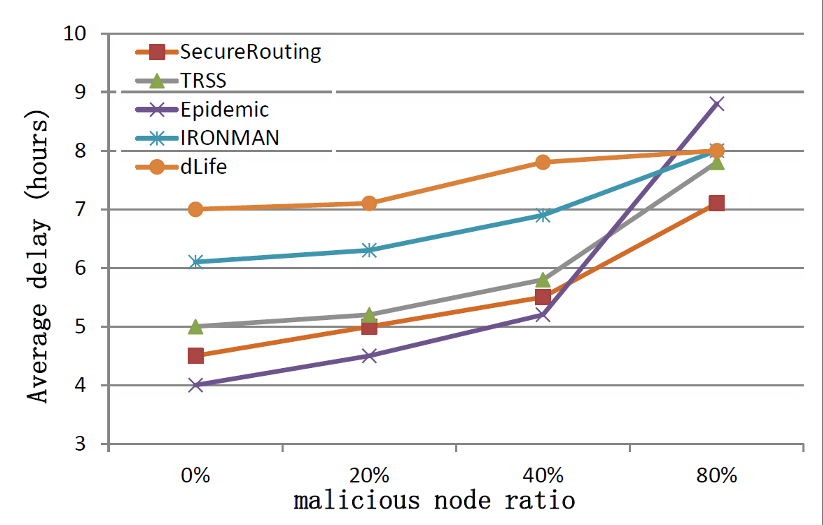 Fig 3: Average delay comparison across different routing protocols.
Critical Insight & Conclusion
The genius of this work lies in using social constraints as a proxy for cryptographic trust. In a central system, you trust a node because a CA says so; here, you trust a node because its "social regularity" indicates it is a real, consistent participant in the network.
Limitations: The RSA encryption and certificate chain verification add computational overhead to mobile devices with limited battery. Future iterations might look into more lightweight Elliptic Curve Cryptography (ECC) or Lattice-based signatures to maintain security in even more resource-constrained environments.
Final Takeaway: Security in decentralized mobile networks cannot rely on math alone; it must incorporate the human element—social behavior—to truly distinguish between a failing node and a malicious one.