
Trust Thy Neighbor: Leveraging Social Networks for Distributed Data Protection
9123_Exploiting Trust-Based Social Networks for Distributed Protection of Sensitive Data.
This paper introduces a distributed framework for protecting sensitive data (e.g., cryptographic keys) by leveraging real-life social trust networks combined with threshold cryptography. It proposes a "two-tier secret sharing" recommended design and formalizes new metrics for complex systems, specifically achieving a quantitative balance between attack-resilience and data availability.
TL;DR
How do you protect your most sensitive data when your own computer is the weakest link? This paper proposes a paradigm shift: instead of trusting hardware vendors or cloud giants, we should trust our real-life friends. By combining threshold cryptography with social trust graphs, the authors create a system where data is only compromised if a significant portion of your social circle is hacked, while ensuring your data remains available even if some friends go offline.
The Core Challenge: The Fragility of Average Users
In the modern security landscape, the "average user" is a constant victim. Their personal devices are prone to malware, yet they hold high-value secrets like private signing keys or system logs. Traditional Threshold Secret Sharing (TSS) can distribute pieces of a secret, but it lacks a formal understanding of how the structure of social relationships—the topology of who trusts whom—affects the overall systemic risk.
The authors identify a critical tension:
- Attack-Resilience: How many nodes can an attacker compromise before "breaking" the secrets?
- Availability: How likely is it that enough "trusted friends" are online at the same time to reconstruct the data?
Methodology: The Two-Tier Defense
The paper recommends a specific architecture to solve this, centered on two concepts:
1. Two-Tier Secret Sharing & Psychological Soundness
Unlike standard sharing where the owner might not hold a "decisive" piece, this design ensures the owner holds a primary share. To use the key, the owner must participate along with a fraction () of their friends. This "psychological soundness" ensures that even if all your friends betray you or are hacked, they cannot steal your key without compromising your device as well.
2. The Remainder Graph Attack
To test this, the authors moved beyond "random attacks." They defined the Remainder Graph Attack (). In this model, an intelligent attacker identifies and hacks the node with the highest degree, then recalculates the "importance" of remaining nodes based on which keys are almost compromised.
 The mathematical definition of Attack-Resilience (AR), measuring the differential between compromised nodes and compromised secrets.
Key Insights: Topology Matters
The research utilized massive real-world datasets from DBLP (co-authorship) and YouTube (social links).
- Regular vs. Random: The study found that Regular Graphs (where everyone has the same number of friends) are far more resilient than Power-law/Random Networks. In power-law networks, the "hubs" (popular users) act as single points of catastrophic failure.
- The Anonymity Bonus: If the social network links are "anonymous" (the attacker doesn't know who is friends with whom), the attacker is forced to use random guessing. This "Security Utility of Anonymity" provides a massive boost to the system’s lifespan.
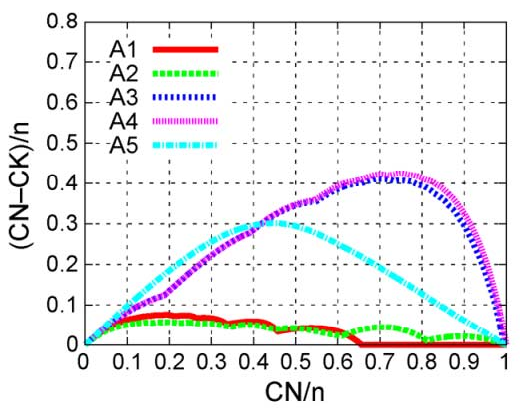 Comparison of attack strategies: The strategy (red line) consistently outperforms others, highlighting the danger of high-degree node compromise.
Balancing Security and Availability
You can make a system perfectly secure by requiring 100% of friends to be online, but you'll never be able to access your data. The paper uses Stochastic Renewal Theory to model node "churn" (uptime/downtime).
The authors provide a breakthrough analytic expression for mean available time:
By plotting and against the parameter , they identify a "Sweet Spot" (often around ), where resilience is high, but the probability of enough friends being online remains practical.
Critical Analysis & Conclusion
Takeaway
This work moves social-based security from a "cool idea" to a "quantifiable science." It demonstrates that by "tuning" or "pruning" our digital trust circles—choosing a consistent number of reliable friends rather than many casual ones—we can create a decentralized vault that is harder to crack than any single server.
Limitations
- Sybil Attacks: The paper briefly touches on Sybil attacks (fake accounts) but largely assumes "real-life trust." In purely digital environments, an attacker could create 1,000 "friends" to bypass the threshold.
- Static Topology: Real social networks evolve. The study models a static snapshot, whereas trust and membership change over time.
Future Outlook
This framework is a precursor to modern Social Recovery in crypto-wallets. Future systems could implement "Adaptive Topology Pruning," where the software automatically suggests which trust links to strengthen or sever to maximize the user's personal Attack-Resilience.