
MWalker: Enhancing Recommender Systems via Social Tagging and Objective Trust
A trust-based Top-K recommender system using social tagging network
This paper introduces MWalker (Modified TrustWalker), a Top-K recommender system based on a social tagging network. It integrates user-item rating matrices derived from browsing statistics with trust values computed from tag-based interest similarity to outperform traditional Collaborative Filtering (CF).
TL;DR
The paper introduces MWalker, a recommendation framework that moves away from subjective "friendship" scores. Instead, it builds a trust-based social network using tags (semantic metadata) and browsing behavior. By applying a modified random walk algorithm on this network, the system achieves higher accuracy (lower RMSE) and better recall than traditional Collaborative Filtering, particularly for "cold start" users.
Problem & Motivation: The Subjectivity Gap
Most online platforms use Collaborative Filtering (CF), but CF breaks down when data is sparse. While "Trust-based" systems were invented to fill this gap, they usually rely on users manually rating their friends. This is flawed because:
- Subjectivity: I might trust my classmate, but we have completely different tastes in music.
- Implicit Data: Users rarely provide explicit ratings; however, they browse, search, and tag items constantly.
The authors' insight is to bridge this gap by using Social Tagging Networks. If two users use the same tags (e.g., "Post-Rock", "Instrumental") on the same items, their "Trust" value should be higher in a music recommendation context, regardless of their real-world friendship.
Methodology: The MWalker Framework
1. From Clicks to Ratings
Since explicit ratings are often missing, the authors convert the number of times a user browses or searches for an item into a normalized rating score (Equation 1). This transforms implicit behavior into a structured User-Item matrix.
2. Tag-Based Semantic Similarity
Instead of treating items as ID-based black boxes, the authors represent items and users as vectors of tags.
- Item Similarity: Computed via cosine similarity of tag vectors.
- User Trust: Computed by comparing the "preference vectors" (how often a user uses specific tags). Trust between User A and User B is only considered if they are friends and have similar tagging patterns.
3. The MWalker Algorithm (Modified TrustWalker)
To recommend the Top-K items, the algorithm performs a Breadth-First Search (BFS) starting from the source user:
- It sorts friends by the new Objective Trust value.
- It prunes the search to only the top friends to boost efficiency.
- It performs a random walk: if a friend hasn't rated the target item, it looks for the most similar item the friend has rated.
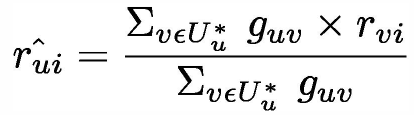
Experiments & Results
The researchers tested MWalker on the Last.fm dataset (1,892 users, 17,632 musicians).
Key Findings:
- Optimal Trust Pruning: Setting (considering only the top 10 most trusted friends) yielded the best RMSE (0.88). Increasing this number actually introduced noise, degrading the prediction quality.
- Superior Recall: MWalker consistently stayed above Item-based and User-based CF in terms of hit-ratio (Recall), proving that "tag-aware trust" is a stronger signal than "neighborhood similarity."
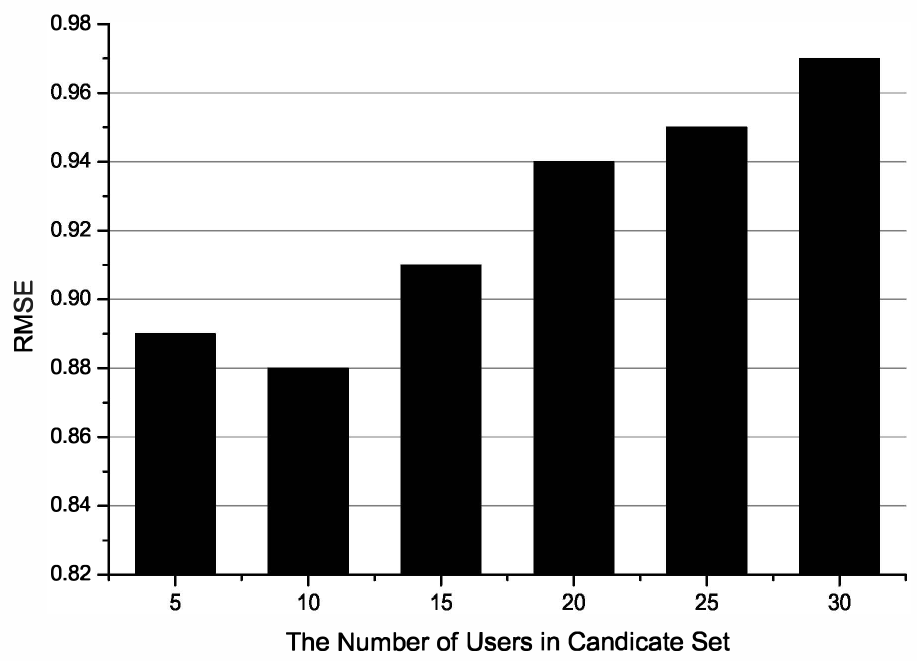 Figure 1: Comparison of RMSE across different K values shows that focusing on highly trusted nodes (K*=10) minimizes error.*
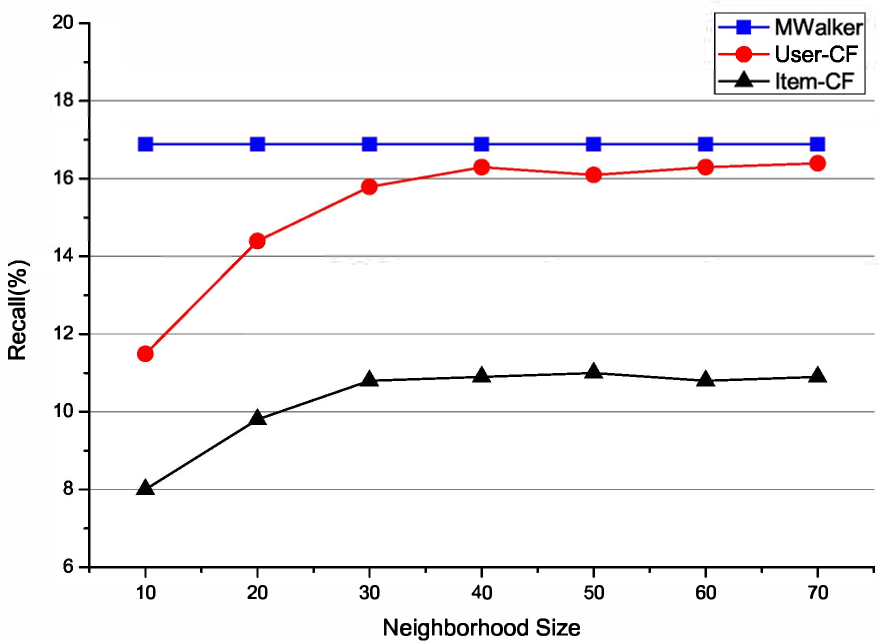 Figure 2: Hit-ratio (Recall) vs. Neighborhood Size. MWalker (top line) outperforms traditional CF methods.
Critical Analysis & Conclusion
Takeaway
MWalker proves that building trust through semantic metadata (tags) and behavioral intensity (browsing counts) creates a more robust recommendation engine than simple social links. It effectively mitigates the cold-start problem because even new users with a few tags can be mapped into the trust network.
Limitations & Future Work
- Tag Redundancy: The current model treats all tags as independent. In reality, "Rock" and "Hard Rock" are redundant. The authors suggest using redundancy elimination in future iterations.
- Scalability: While the 30% efficiency gain is impressive, a BFS-based random walk might still struggle with million-user graphs. The authors propose moving to Hadoop/Cloud infrastructures for future scaling.
In the current era of Graph Neural Networks (GNNs), this paper remains a foundational reminder that the quality of the edges (how we define trust) is just as important as the architecture of the network itself.