
The Chronology of Trust: How Dynamic Social Networks Fuel Crowdfunding Success
Trust Building in Dynamic Process of Internet Entrepreneurial Social Network
This study investigates trust-building dynamics in Internet entrepreneurial social networks using data from 2,214 Indiegogo projects. It proposes a two-stage model (Personal vs. Socialized) to examine how different information-sharing behaviors—affect-based and cognition-based—impact crowdfunding financial outcomes.
TL;DR
Success in crowdfunding isn't just about the project; it's about the timing of the trust you build. Researching 2,214 crowdfunding campaigns on Indiegogo, this paper reveals that affect-based trust (personal sharing) is the king of the pre-launch phase, while cognition-based trust (project data) is the only way to win over the masses once the campaign goes live.
Background Positioning
In the world of Internet entrepreneurship, the "Disadvantage of Newness" is a death sentence. Without a track record, how do you convince strangers to give you money? This paper moves beyond the static view of social capital to provide a dynamic paradigm for entrepreneurial financing. It bridges the gap between social psychology (types of trust) and financial outcomes in the digital "e-commerce" age.
The Core Insight: The Two Faces of Trust
The authors argue that trust isn't a monolith. They categorize it into two distinct types:
- Affect-based Trust: Rooted in emotional bonds and shared identity (e.g., sharing snippets of your personal life on Facebook).
- Cognition-based Trust: Rooted in reliability and competence (e.g., sharing technical updates and project milestone data).
The critical failure of many entrepreneurs is failing to realize that these two types of trust have a "shelf life" and an "activation window."
Methodology: Mapping the Network Evolution
The study divides the entrepreneurial journey into two stages:
- Personal Social Network Stage (Personal & Essential Dyadic Exchanges): Dominated by family and friends (strong ties).
- Socialized Social Network Stage (Socioeconomic Exchanges): Dominated by the general crowd and professional backers (weak ties).
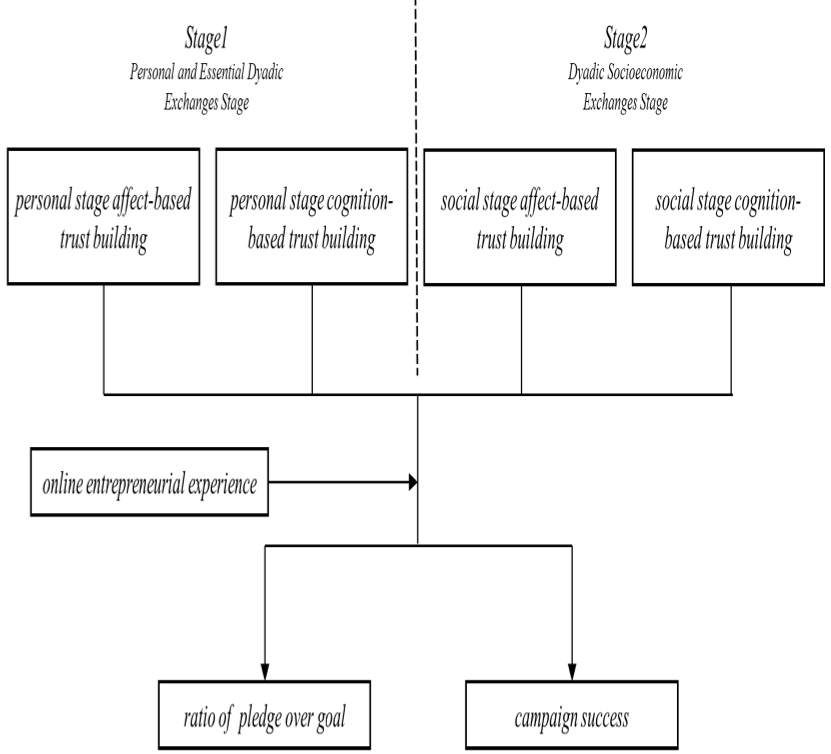
Using crawling technology on Indiegogo.com and LinkedIn/Facebook, the researchers analyzed how information-sharing behaviors at these specific stages correlated with the final funding ratio.
Key Findings: Why "Being Human" Matters Early On
The results from the Tobit and OLS regression analyses are striking:
- Stage 1 (Pre-Launch): Sharing personal, privacy-related information (Affect-based) significantly predicts funding success. Counterintuitively, heavy project-related posting at this stage has no significant effect. Your friends want to support you, not your business plan.
- Stage 2 (Post-Launch): Once the campaign is socialized, the script flips. Campaign-related updates (Cognition-based) become the primary driver of the "Ratio of Possibility to Achieve Goal." The general crowd demands evidence of competence.
- The Experience Factor: Entrepreneurs with prior online experience are significantly better at "mode-switching"—leveraging personal stories early and technical data later.

Deep Insight & Practical Application
The "Spillover Effect" is the hidden engine here. Trust built on personal social media (Facebook) leaks into the crowdfunding platform. However, there is a Vulnerability Risk: over-sharing technical details too early can expose project weaknesses before they are polished, actually harming the project's legitimacy.
Takeaways for Founders:
- Step 1: Use the 6 weeks before launch to share your "why," your struggles, and your personality on social media. Build the emotional bond.
- Step 2: The moment the project goes live, switch to "professional mode." Provide timely updates, patent information, and technical milestones.
- Step 3: If you are a serial entrepreneur, lean into your "Online Experience" as a moderator to heighten the efficiency of these signals.
Conclusion & Limitations
This work elegantly proves that social capital development is not a static resource but a process of strategic information disclosure.
Limitations: The study is limited to reward-based crowdfunding (Indiegogo). Future research is needed to see if these patterns hold in Donation-based crowdfunding (where affect might stay dominant throughout) or Equity-based (where cognition might be the only thing that matters).
Nonetheless, the message is clear: To get funded, first be a human, then be a CEO.