
Beyond the Graph: Hybrid Trust and Distrust Prediction in Social Networks
Trust and Distrust Prediction in Social Network with Combined Graphical and Review-Based Attributes
The paper presents a machine learning framework for predicting trust and distrust in social networks by combining graph-based topological features with review-based behavioral attributes. Using a C4.5 decision tree algorithm on the Epinions dataset, the authors demonstrate that a multi-modal approach significantly outperforms models relying on a single data source.
TL;DR
In online social networks like Epinions or eBay, deciding who to trust is a survival skill. This paper proposes a hybrid approach that marries Graph Topology (who you know) with Review Activity (what you like). By using a C4.5 decision tree, the authors achieved over 90% prediction accuracy, proving that behavioral data is the "secret sauce" for identifying trustworthy users when social links are sparse.
Problem & Motivation: The "Cold-Start" Trust Gap
In mature social networks, prediction is easy: if we share ten mutual friends, I likely trust you. But what about newcomers?
Most trust algorithms fail when a user hasn't built a network yet. Furthermore, most research focuses on positive trust, ignoring the "Block list" or distrust signals. The authors hypothesize that by looking at how users rate products and how much they agree with others' reviews, we can predict trust even before a formal connection is made.
Methodology: The Fusion of Two Worlds
The researchers broke down user data into two distinct categories:
1. Graph-Based Attributes
These focus on the "skeleton" of the network:
- Moletrust: A propagation metric that calculates how trust flows through a chain of intermediaries.
- Controversy: Measuring the ratio of trust vs. distrust a user receives.
- Transitivity: Analyzing "Enemy of my Enemy" and "Friend of my Friend" patterns.
2. Review-Based Attributes
These focus on the "flesh" of user activity:
- Rating Similarity: Do two users give 5-star ratings to the same articles?
- Activity Levels: How many reviews have they written or received?
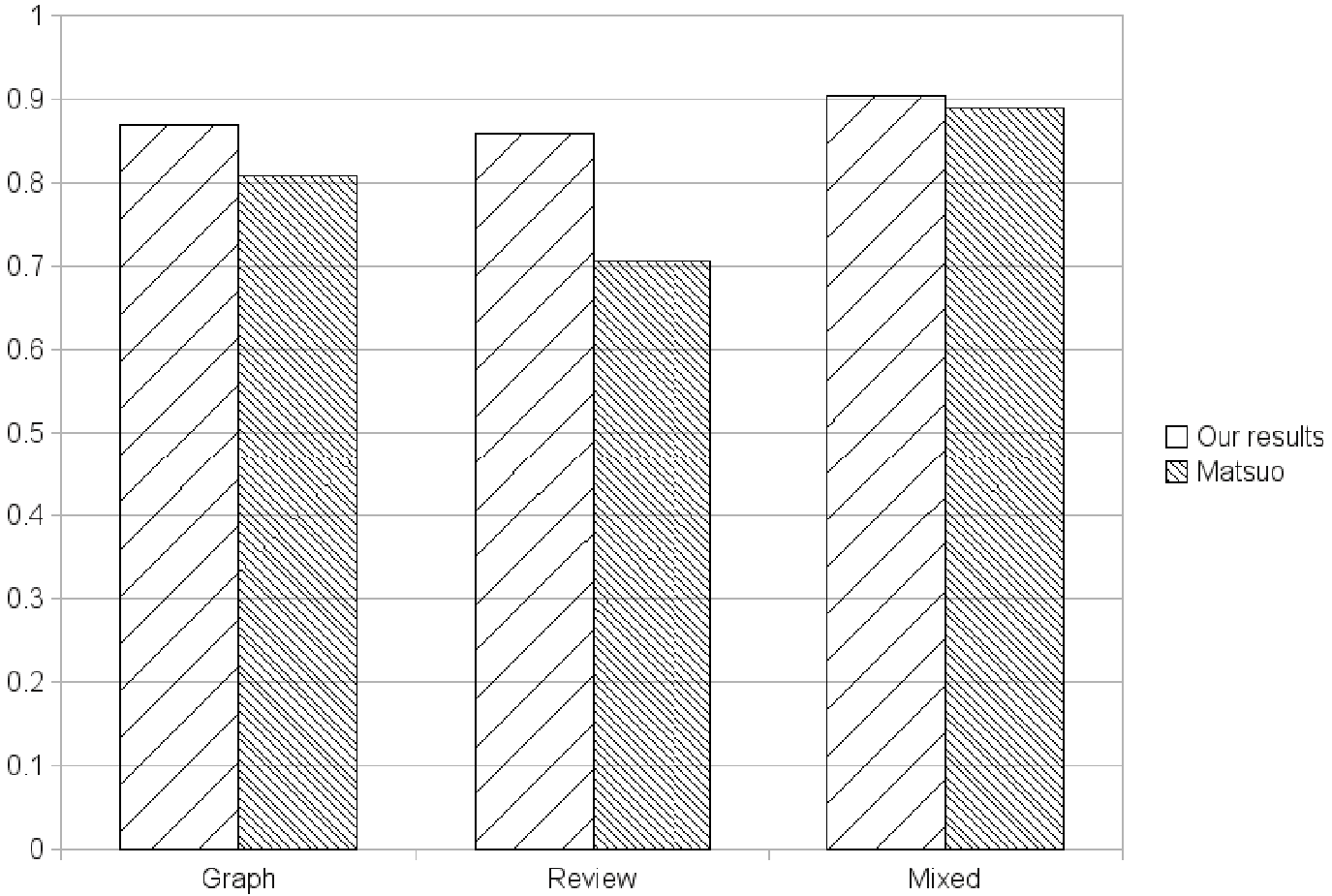 The image above illustrates the diverse feature set, showing how the C4.5 algorithm chooses between graph-based and review-based data.
Experiments: Testing the Newcomers
The study used the Epinions dataset (131k users, 717k trust links). To see if their method truly helped "strangers," they created specialized training sets:
- Low Outdegree: Users with fewer than 10 connections.
- Low Review Count: Users with fewer than 35 ratings.
Key Findings:
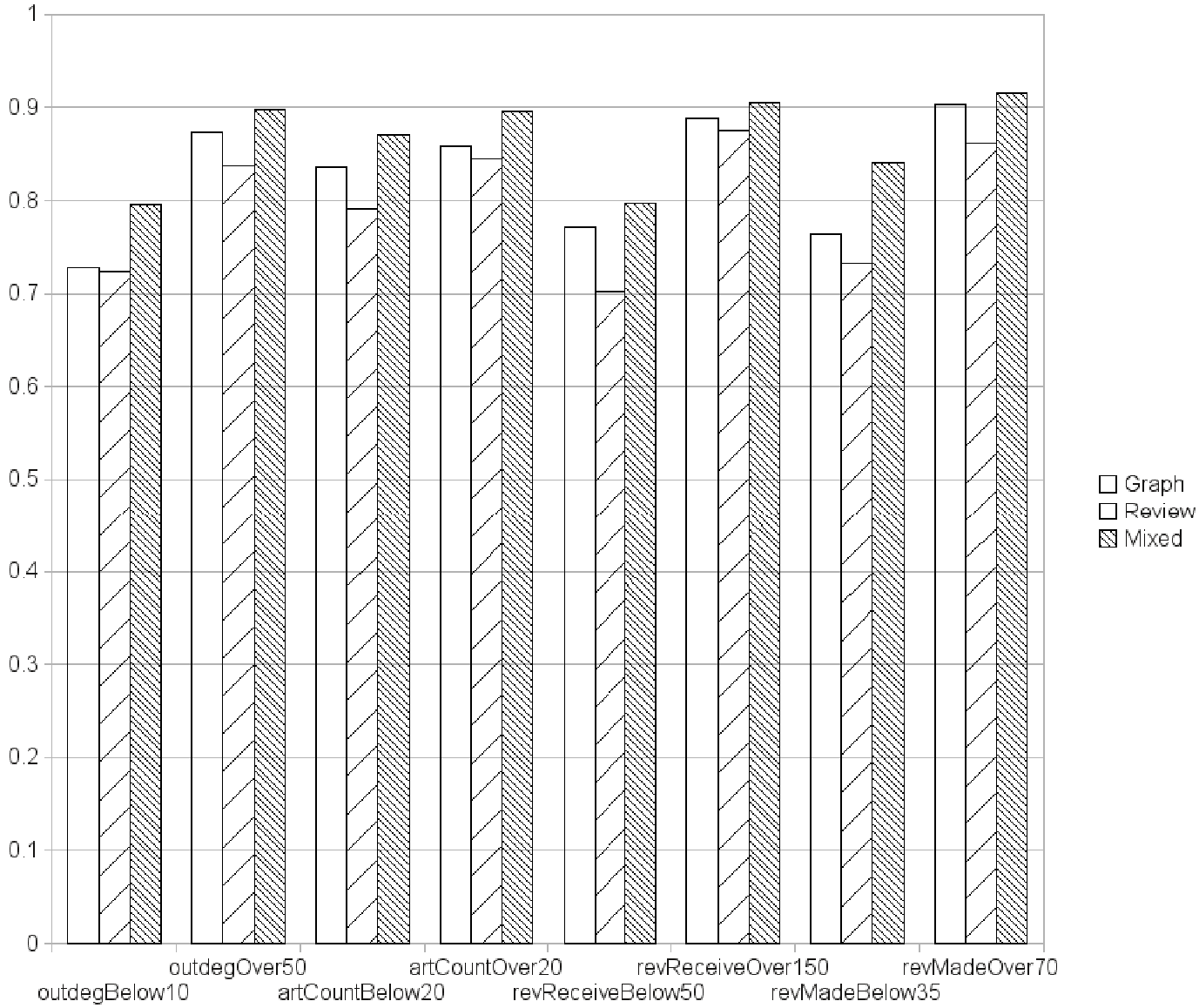
- The Hybrid Advantage: In almost every category, the "Mixed" classifier beat the specialized ones.
- The Newcomer Boost: For users with limited history (revMadeBel35), the mixed model saw a significant jump in the F-measure, proving that review patterns act as a proxy for social trust when the graph is empty.
Critical Insight: Why Does This Work?
The C4.5 algorithm revealed a fascinating hierarchy of influence. The most critical attributes were not just "having many friends," but specifically:
- Moletrust (Propagation): Trust is indeed contagious.
- ratings-good-xy: If User A consistently rates User B's articles highly, trust follows naturally.
- Distrust-outdegree: Some users are "haters" who naturally distrust more people; the model learns to weight their opinions differently.
Conclusion & Future Outlook
This work moves beyond simple structural analysis. It treats social networks as dynamic environments where actions (reviews) speak as loud as words (trust links).
Limitations: The study lacked a "Topic Hierarchy." For example, it couldn't tell that a user who trusts someone regarding "Apple iPhones" might also trust them regarding "iPad tablets" because the system didn't understand the semantic link between the two products.
Future Work: The next frontier involves Temporal Dynamics—predicting how trust evolves over time as a user's tastes change.