
PIMCQA_OSTP: Leveraging Quantum Tunneling for Trust Evaluation in Complex Social Networks
Trust Evaluation via Large-Scale Complex Service-Oriented Online Social Networks
This paper introduces PIMCQA_OSTP, the first quantum-inspired algorithm for selecting the Optimal Social Trust Path (OSTP) in large-scale Service-Oriented Online Social Networks (SOSNs). By mapping the multi-attribute trust evaluation problem to a multidimensional random Ising model, it achieves superior path utility and efficiency compared to state-of-the-art heuristic methods.
TL;DR
Evaluating trust in modern Service-Oriented Online Social Networks (SOSNs) is no longer a simple matter of a single "score." It involves complex, multi-dimensional Quality of Trust (QoT) attributes. This paper introduces PIMCQA_OSTP, a quantum-inspired algorithm that maps the trust path selection problem to an Ising model, utilizing quantum tunneling to find optimal paths that traditional heuristic algorithms miss.
Background: The Complexity of Modern Social Trust
In an era of ubiquitous web services—from job hunting to online shopping—we often rely on "intermediate participants" to recommend trustworthy service providers. This creates a Social Trust Path.
Previous research focused on single-dimensional trust values. However, real-world trust is multifaceted, involving:
- Trust (): Historical interaction reliability.
- Social Intimacy (): The strength of the relationship.
- Role Impact Factor (): The domain expertise of the recommender.
When we combine these into a utility function subject to multiple constraints, the selection of an Optimal Social Trust Path (OSTP) becomes an NP-complete challenge.
The "Local Minima" Trap in Heuristics
Existing SOTA methods like MFPB_HOSTP rely on heuristic searches. While fast, these methods are prone to getting stuck in local optima. If the path with the highest utility happens to be slightly outside the constraint boundaries, heuristics often fail to find a "near-optimal" feasible solution, instead returning illegal paths or significantly sub-optimal results as network size increases.
Methodology: From Social Graphs to Quantum Spins
The genius of this paper lies in Classical-Quantum Mapping. The authors treat the social network as a physical system:
- Ising Model Mapping: Each potential path solution is logically connected to an matrix of "spins" (0/1 states).
- Hamiltonian Construction: The cost function (utility and constraints) is formulated as the potential energy () of a quantum many-body system.
- Quantum Annealing (QA): Unlike Simulated Annealing (which uses thermal fluctuations to hop over energy barriers), QA uses Quantum Fluctuations.
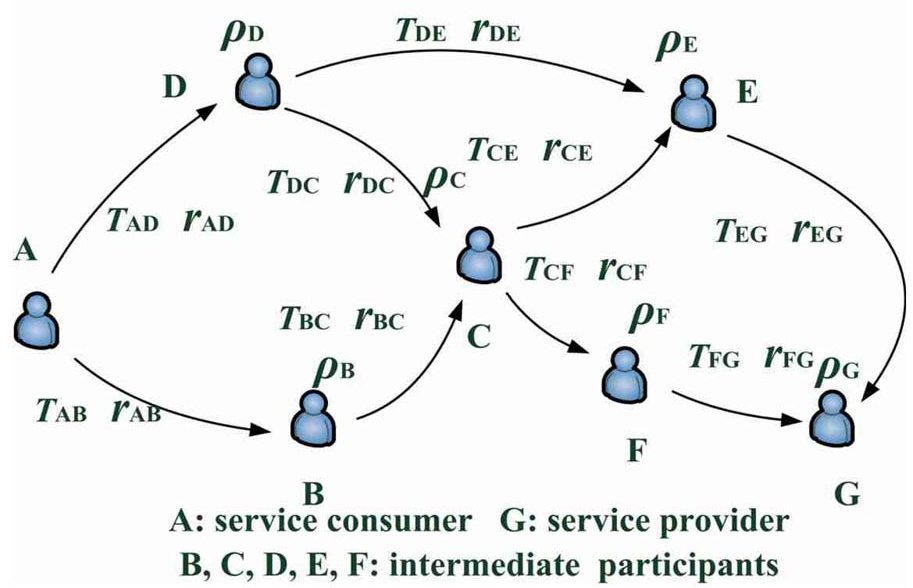 Figure 1: Complex SOSN structure showing service consumers, providers, and intermediaries.
The Secret Weapon: Quantum Tunneling
In classical physics, to get from one "valley" (local minimum) to another, you must go over the mountain. If the mountain is too high, you stay stuck. In the quantum world, particles can tunnel through the mountain. PIMCQA_OSTP uses this principle to explore the search space more effectively than any classical heuristic.
Experimental Results: Slaying the Baseline
The authors tested their algorithm using the Enron email dataset, a gold standard for social network analysis due to its power-law characteristics.
1. Path Utility (Quality)
PIMCQA_OSTP consistently identified paths with higher utility. Across different weight distributions of trust, intimacy, and role impact, the quantum-inspired approach outperformed the baseline by over 43% to 60%.
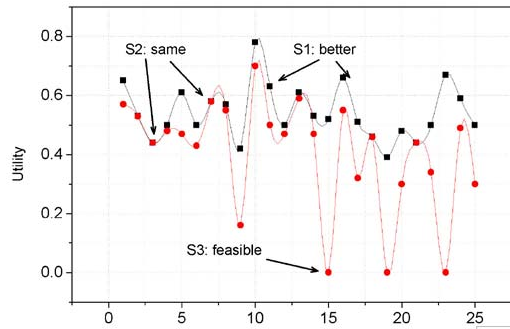 Figure 2: Utility comparison showing PIMCQA_OSTP (QA_OPS) consistently outperforming the heuristic baseline.
2. Efficiency (Execution Time)
A common misconception is that annealing is slow. However, for large-scale networks, PIMCQA_OSTP proved to be faster. Its total execution time was only ~30% of the MFPB_HOSTP baseline because the quantum-classical mapping avoids the exhaustive sub-network extraction required by classical filters.
Critical Insight: Why it Works
The effectiveness of PIMCQA_OSTP stems from its ability to sample the phase space equally well using wave functions. By employing Suzuki-Trotter transformation, the quantum Hamiltonian is discretized into classical "replicas," allowing classical hardware to simulate quantum-level optimization benefits.
Conclusion and Outlook
This work marks the first application of Quantum Annealing to SOSN trust evaluation. It demonstrates that as social networks grow in complexity and scale, we must look toward "Physics-AI" crossovers to handle the computational explosion of NP-complete problems.
Future Directions: The authors suggest the next step is a real-time service search engine that maintains a live database of QoT attributes, potentially revolutionizing how we find "trusted" experts in decentralized digital economies.