
GFTrust: Solving Path Dependence and Trust Decay via Generalized Network Flow
Trust Evaluation in Online Social Networks Using Generalized Network Flow
This paper introduces GFTrust, a trust evaluation scheme that maps indirect trust assessment in Online Social Networks (OSNs) to a generalized network flow problem. By modeling trust propagation as flow and trust decay as node leakage, it achieves SOTA prediction performance on Epinions and Advogato datasets, specifically improving FScore by 27.16% compared to existing reliability models.
Executive Summary
TL;DR: Assessing trust between strangers in a social network is notoriously difficult due to "path dependence" (overlapping recommendations) and "trust decay" (loss of confidence over distance). GFTrust reimagines this problem as a Generalized Network Flow task. By treating trust as a fluid that "leaks" at each intermediate node, the authors create a model that is more accurate, Sybil-resistant, and requires zero normalization.
Background Positioning: This work moves beyond simple path-multiplication or shortest-path heuristics. It positions itself as a robust, flow-based framework that addresses the structural dependencies of high-clustering (small-world) social networks, setting a new benchmark for trust prediction accuracy.
The Motivation: Why Current Trust Models Fail
In Online Social Networks (OSNs), trust isn't just a line from point A to point B; it’s a complex web.
- Path Dependence: If two recommendation paths share a common friend, simply adding their trust values "double-counts" that friend's influence, leading to artificial inflation.
- Trust Decay: Trust is non-transitive. If I trust Alice, and Alice trusts Bob, my trust in Bob is naturally lower. Most models use "Multiplication" or "Minimum" rules, which either decay too fast or fail to decay at all.
The authors realized that Network Flow is the perfect metaphor for this. Flow can split and merge (handling dependence) and pipes can leak (handling decay).
Methodology: Trust as a Leaky Pipe
The core innovation lies in Task-driven transformation of a trust graph into a flow network.
1. The Mapping
- Capacity = Trust Value: The direct trust between two users limits the "amount" of recommendation flow they can pass.
- Flow = Aggregated Trust: The total flow reaching the destination represents the final inferred trust.
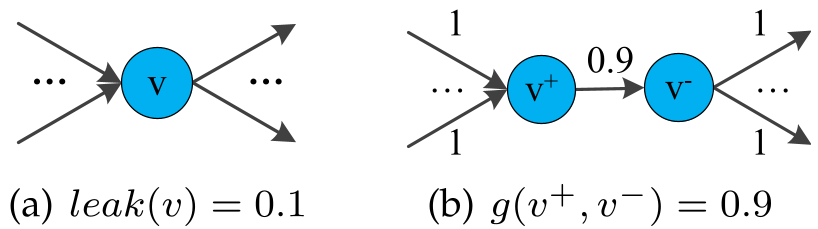
- Node Leakage = Trust Decay: To simulate the loss of confidence at each hop, the authors "split" intermediate nodes and introduce a gain factor .
2. The GFTrust Algorithm
Instead of standard max-flow, GFTrust uses a Shortest-Path-First augmentation strategy. This is based on a critical social observation: Shorter recommendation paths are inherently more reliable than longer ones. The algorithm iteratively pushes flow through the shortest available "pipes" until the initial source flow (set at 1.0) is exhausted or no paths remain.
Experiments & Results: A New SOTA
The authors tested GFTrust on the Epinions community dataset (3,168 nodes).
Performance Gains
Compared to common strategies like AveR-WAveT or SWTrust*, GFTrust dominates:
- FScore Improvement: +27.16% over the best baseline.
- Mean Error Reduction: -23.72%.
Effective Decay Patterns
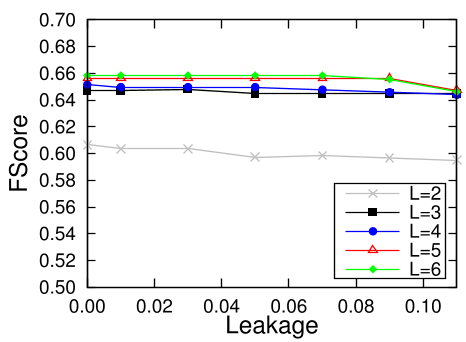
The study compared four leakage functions (Linear, Cosine, Exponential, Polynomial). Interestingly, Polynomial Leakage () performed best, suggesting that trust decay in social networks follows a power-law-like behavior rather than a simple linear drop.
Deep Insight: Beyond Accuracy
What makes GFTrust unique isn't just the math—it's the Economic Properties:
- Sybil Tolerance: Because trust "leaks" at every node, a malicious actor cannot increase their trust by creating thousands of fake "Sybil" identities. Each extra "hop" they add to the chain only makes the flow leak more.
- Social Incentive Compatibility: The model rewards users who provide high-quality services to many people, as this creates more "short paths" in the network, boosting their overall flow capacity.
Conclusion & Limitations
GFTrust elegantly solves the overlapping path problem by utilizing edge capacities to prevent "information reuse." It holds up against Sybil attacks and outperforms traditional reliability models.
Future Work: The authors note that the current leakage factors are primarily distance-based. Future iterations could integrate "Tie Strength" or "User Personality" (Propensity to Trust) as variables in the leakage function to create a truly personalized trust engine.
Senior Academic Editor Note: This paper is a masterclass in using classic graph theory (Flow) to solve modern social graph problems. It avoids the trap of over-complicating the model with Neural Networks, opting instead for a mathematically provable, intuitive framework.