
Trust in the Age of Knowledge Graphs: Redefining OSN Trust Evaluation with RNNs
Trust Evaluation in Online Social Networks Based on Knowledge Graph
This paper introduces a novel framework for trust evaluation in Online Social Networks (OSNs) by leveraging Knowledge Graphs (KG) and Recurrent Neural Networks (RNN). By treating trust relationships as semantic triplets, the authors utilize the TransE algorithm and a custom Path Reliability Measuring (PRM) algorithm to achieve state-of-the-art trust prediction accuracy.
TL;DR
In the digital economy, deciding whom to trust—especially for financial transactions—is a high-stakes challenge. Researchers from BUPT have published a pioneering approach that moves beyond simple social graphs into the realm of Knowledge Graphs (KG). By combining TransE embeddings with Recurrent Neural Networks (RNN), they’ve created a system that predicts trust with over 95% accuracy by "translating" relationships into a low-dimensional vector space.
Background: Why Simple Graphs Aren't Enough
Most traditional trust algorithms like TidalTrust or MoleTrust view social networks as simple nodes and edges. They focus on the "Shortest Path" or "Strongest Path." However, trust is not just a line; it is a semantic relationship. It is subjective (personal to the trustor), asymmetric (I trust you, but you might not trust me), and propagative.
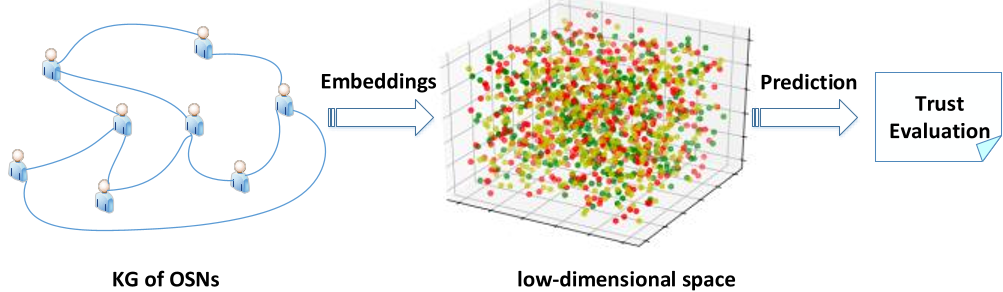
The authors argue that trust evaluation is essentially a Relationship Prediction problem. In a Knowledge Graph, we don't just see a connection; we see an "Entity-Relation-Entity" triplet. By treating "Trust Level" as the relation, we can use advanced AI to infer hidden connections.
Methodology: The TransE and RNN Synergy
1. Representation Learning with TransE
The core insight is borrowing the Translating Embeddings (TransE) theory. If User A trusts User B with a level , then in a vector space, the embedding of should be close to the embedding of plus the vector for trust ().
2. Path Reliability Measuring (PRM)
In a massive social network, there might be hundreds of paths between two strangers. Are they all equally reliable? The authors introduced PRM, which uses the variance of trust values along a path. If a path consists of consistent trust levels (e.g., all "Master" level), it is deemed more reliable than a fluctuating one.
3. RNN for Trust Aggregation
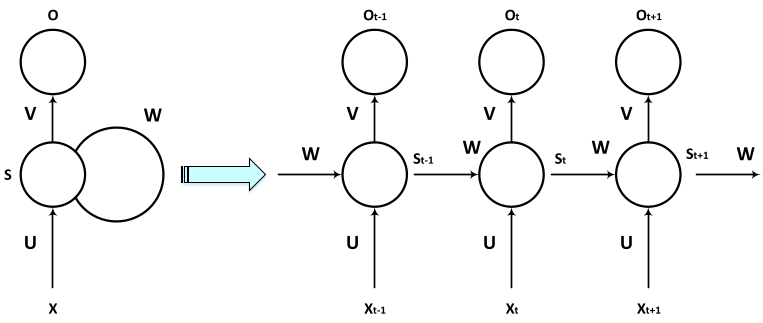
Because a trust path is a sequence of relations, the authors used an RNN to aggregate these values. While simpler methods like adding or multiplying trust scores exist, the RNN captures the non-linear dependency of the sequence, making it far more robust as the network grows.
Experimental Battleground: The Advogato Dataset
The model was tested on Advogato, a real-world community where users certify each other as Observer, Apprentice, Journeyer, or Master.
The results were clear:
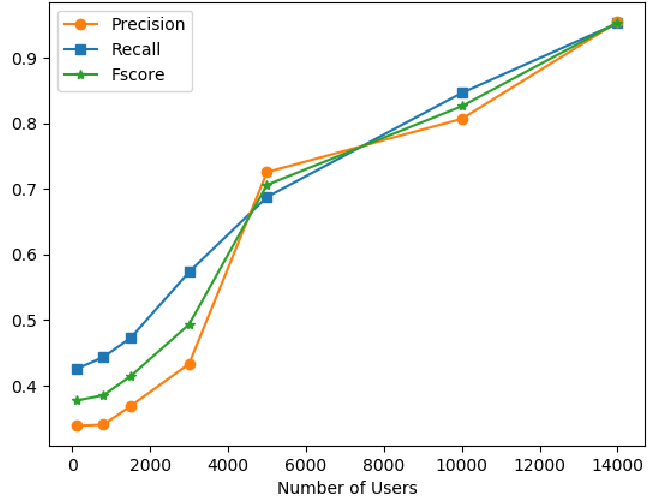
- Scalability: As the number of users increased toward 14,000, the RNN method remarkably maintained high precision and low error.
- Performance: Compared to simple "Add" or "Mul" (Multiplication) strategies, the RNN's Fscore remained superior, peaking at 95.34%.
- Hyper-parameters: The study found an optimal RNN cell size of roughly 100 for balancing complexity and performance.
Deep Insight & Conclusion
This paper is a significant milestone because it's the first to bridge the gap between Knowledge Graph theory and Social Trust metrics.
Key Points to Note:
- Beyond Connectivity: This moves the conversation from "Are we connected?" to "How does our relationship translate in a latent space?"
- Efficiency: Using mini-batch gradient descent (as seen in the TransE algorithm), the model is computationally feasible for medium-to-large OSNs.
Limitations: The model primarily focuses on the path reliability of trust values. Future work could integrate external user metadata (e.g., interests, location) into the Knowledge Graph to create even more "semantic" trust scores.
For developers building peer-to-peer marketplaces or decentralized social apps, this approach offers a mathematically rigorous way to protect users from "stranger danger" by quantifying the invisible threads of reputation.